
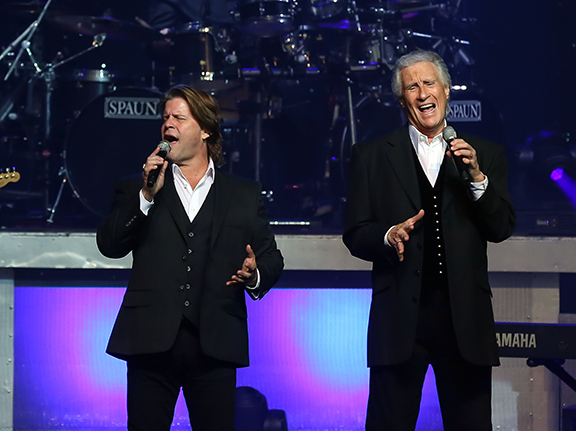
Cherokee – The legendary voice behind some of the most seminal songs of the American soundtrack is coming to Harrah’s Cherokee Casino Resort at 7:30 p.m. Saturday with the second year of The Righteous Brothers Farewell Tour.
The trademark silky bass-baritone of Bill Medley still registers a certain level of swoon and croon as he attested to the staying power of the group’s music during a phone interview with the Cherokee Scout.
“Reflecting over these years, it’s amazing what’s happened. I started as a songwriter and wasn’t looking to sing, but I found I was a better singer than writer,” Medley said jovially.
At 84 years old, Medley is still spry and ready to bring the duo’s signature sound to new audiences.
‘Blue-eyed soul
When asked about being the father of “blue-eyed soul,” a term coined by a Philadelphia disc jockey to describe The Righteous Brothers’ sound, which was also a denotation of their color because so many listeners asked if they were a black soul group, Medley said jokingly, “I may be the grandfather of it now.”
Medley discussed the duo’s California roots and his first song to become a hit, “Little Latin Lupe Lu” in 1962, and how he and partner Bobby Hatfield were urged to record the song by a friend who owned Moonglow Records.
As a native Californian, Medley said the two eschewed the surf music popularized by acts like the Beach Boys because, even though they’d been in a five-piece band together, when they broke out on their own they decided to take things in a different direction.
“Bobby and I were raised on rhythm and blues, and so we did the least commercial thing at the time, which was to be two white guys playing soul music,” Medley said.
“We sang the song in a club near the [El Toro] Marine Base, and everyone loved to dance to it. So then when we recorded it, we didn’t even have a name. Bobby said, ‘We ought to we call ourselves what the Marines call us.’ And then we had our name.”
Medley said that name, “The Righteous Brothers,” came from the black Marines who came to listen to “these two white guys singing rhythm and blues. And they’d say, ‘Man, you guys are righteous, brother.’ And it fit us. The rest is history, because Bobby said we should use it.”
Bring it on back now
Much of that history culminates this year with the 60th anniversary of the iconic No. 1 song, “You’ve Lost That Lovin’ Feelin’.”
That song, written by Barry Mann and Cynthia Weil, also held the distinction of being the most played song on U.S. radio during the 20th century. The song held that record for 22 more years, only being displaced in 2019, and it has been covered by a plethora of artists.
The most successful cover of “You’ve Lost That Lovin’ Feelin’ ” was performed by yet another blue-eyed soul duo in Daryl Hall & John Oates in 1980.
“I like their version. They gave the song the credibility that it’s worthy of. They didn’t try to replicate anything. They made it theirs,” Medley said.
“I told Barry and Cynthia, ‘You didn’t just write us a hit record, you wrote us a career.’ That one song was just amazing. And we also had some good hits after that.”
A storied career indeed, considering the song’s history includes being penned at the infamous Chateau Marmont Hotel to being produced by legendary “Wall of Sound” master Phil Spector and considered the finest implementation of his sound production technique. The song has also been featured in such quintessentially American movies such as Top Gun and television shows such as Cheers.
Time can do so much
The history of the duo though, doesn’t end with just one hit. The use of “Unchained Melody” in the popular 1990s movie Ghost brought the group a slew of new fans from the pottery scene, featuring Demi Moore and Patrick Swayze’s characters in an ethereal embrace before tragedy strikes.
While typically known as Hatfield’s signature song featuring his staggering tenor, Medley said, “We both wanted that one. We’d agreed to do one solo piece on each album, but Bobby won the coin toss on that song. I played the piano on that one. But it was all Bobby’s.”
Tragedy tends to strike in real life as well as films. Medley is no stranger to battles of the personal variety.
While the duo disbanded from 1968-75 to pursue solo endeavors, neither found that magic or chemistry without the other. So they reunited, announcing their reformation on The Sonny and Cher Show in 1974. The reunion spawned their next hit, “Rock and Roll Heaven,” an ode to several icons of the music industry lost before their time, including Jimi Hendrix and Janis Joplin.
After Medley’s first wife’s death in 1976, he took time off to care for his son. When the Brothers rejoined ranks in 1981, they did so on the American Bandstand 30th anniversary show, singing a revised version of “Rock and Roll Heaven” to include recently deceased John Lennon.
That moment, like many he experienced in U.S. musical history, was also meaningful for Medley since The Righteous Brothers opened for the Beatles on their first American tour.
“Yes, we opened for the Beatles. And for the [Rolling] Stones. And that was all before ‘Loving Feelin’,” Medley said.
With the Righteous Brothers reunited, the two felt empowered once again to take on solo projects. Medley’s duet with Jennifer Warnes, “(I’ve Had) The Time of My Life,” for the 1987 movie Dirty Dancing outshone almost any other recording either one had done before or since.
“That song [“Time”] is really the song that won’t die. We still, maybe once a week or month or so, get offers to use in a commercial or in a movie,” Medley said. “It’s really incredible, but you’re best to leave it alone and not re-record it. It’s a blessing. Always a blessing.”
That blessing also turned into a curse when on tour in 2003, Hatfield was found dead in his hotel room in Kalamazoo, Mich., by both Medley and the group’s road manager.
“After Bobby died, I didn’t think about ever touring again. I did some solo recordings and performances, but I never thought about resurrecting The Righteous Brothers,” Medley said. “Bobby was a great singer, so fun and so easy to work with. When we sang together, it was just kinda magical.”
Don’t stop believing
Fast forward to 2016, and Medley kept hearing about a guy in Branson, Mo., while he was doing some work of his own there, who had been playing John Belushi’s role in The Blues Brothers revue and recently begun performing in a Journey tribute band.
“We met and became friends, and I thought, ‘If this guy can sing anything like Steve Perry, then he can do Bobby,’ and I’ve got to see him,” Medley said. “And he did. And we did.”
That new brother is Bucky Heard, an Alabama born and raised Southern boy with a passion for performing and an Auburn pedigree to prove it.
“While I wasn’t looking to reform The Righteous Brothers, I had so many people say, ‘You’ve got to keep that music alive because so many people still want to come out and see it,’ ” Medley said. “Being ‘Righteous Brother Bill Medley’ doesn’t let the audience know what the show will be about, but when you say ‘The Righteous Brothers,’ you know they know they’re going to hear all those songs and that’s what they’ll see in the show.”
That show has performed consistently at venues around the country including residencies in Las Vegas since their collaboration a decade ago and Medley says that while this is touted as “The Farewell Tour,” they’ll be playing gigs well throughout 2026.
“We’ve got a full two years of contracts to fulfill. And the closer I get to it, I don’t want to retire. Each year I think, ‘Geesh, I’m 83, I’m 84, now I’m gonna be 85 and I’m still doing it,’ and I made my friends promise that when I’m too old to do it anymore that they’ll get me offstage and make me retire,” Medley said. “If I ever do retire, I’ll still be doing something with music, it’s all I really know. Although I didn’t like the pressure of producing, I’ll still be involved somehow. I’m a much better singer than anything.”
Time of my life
In reflecting over his career, Medley said his beginning performances in church have acted to serve as a solid foundation throughout the course of both his personal and professional lives.
“My faith is the glue that has held me together. I don’t take any credit for anything great that’s happened to me – I give it all to God. There’s no other answer than God,” Medley said. “He just took me by the collar and He told me, ‘Here’s what you need to do,’ and He put me and Bobby together and, boy, it just hasn’t stopped ever since.”
He has both had the pleasure to have worked with and known many household names of American music, from Carole King to the other King, Elvis Presley. In recalling these relationships, Medley references his 2014 book, Time of My Life: A Righteous Brothers Memoir, written with Mike Marino, a member of the popular group The McCoys, known for their 1960s hit “Hang on Sloopy.”
“I wrote this book a while back and everyone wanted me to tell stories, especially about Elvis, but I said I won’t do that,” Medley said. “We were friends, but some stories are kept for yourself.”
Sweet music man
Another thing Medley has done for himself is pay tribute to country artists he’s admired with his recent album Straight From the Heart. While Medley can almost always name-drop from any genre of American music, this album reflects some of his most beloved songs.
“A couple of months ago I got to do the Grand Ole Opry. Now I’m not singing country on these renditions, but I’m singing country songs,” Medley said. “I’m a blues singer, and I think some of the greatest blues songs you can sing are these older country songs. This album is about tributes to 12 of my favorite artists. And I think it’s the best album I’ve ever done.”
Those dozen songs include cover versions of Kris Kristofferson’s “Sunday Morning Coming Down,” which Medley hopes made it to Kristofferson before his death in September 2024.
“One of the artists that I really wanted to do was Kris and that song in particular, and I knew his health wasn’t doing well and I wanted to get that song done and get it to him so he could hear it, but I think I was too late. I hope not though,” Medley said.
“We’ve got Michael McDonald on this one. I’ve got Keb’ Mo’ and Vince Gill on duets as well. It’s some good work. ‘He Stopped Loving Her Today’ and ‘(Since You’ve) Gone’ by Ferlin Husky and Kenny Rogers’ ‘Sweet Music Man,’ just those songs that are some of my favorites.”
Medley’s duet with Shawn Colvin covering Hank Williams’ “I’m So Lonesome I Could Cry” is one of the most affecting, with Colvin’s plaintive tones playing perfectly to Medley’s smooth crooning.
Just once in my life
While Medley will sing songs from his newest album, he said fans will get all the classic hits on this tour, with his special touring guest and daughter McKenna Maples performing “(I’ve Had) The Time of My Life” with him.
“My daughter’s a great singer, and I’m real proud of her and she brings my grandson and he’s only 2 years old, and I love being with them because being on the road can be pretty un-soulful at times,” Medley said. “Not the shows, because the shows are the trophy, but the time spent with them afterwards and having him there and sing with her brings such joy. And Bucky is a killer singer, so I’m pretty protective onstage.”
Medley said he knows what the audience expects, having attended many shows with Heard where performers didn’t “sing those classic songs and what a disappointment and, I mean, they’re not showing up to see how good we could have been.
“So we want to just relate to the audience, and with our nine-piece band we do all the songs correctly so that most times the audience will leave saying, ‘Well, I wasn’t expecting that because it was a lot more than I thought it would be.’ ”
A lot more seems to be the theme of Medley’s life when he said, “It’s really been an amazing career. A very cool blessing.”
Details: Visit caesars.com/harrahs-cherokee/shows and righteousbrothers.com.