
Raleigh – The N.C. Wildlife Resources Commission has released information on new regulations, delayed trout waters and why there are so many bear sightings right now. Here’s the latest information to get you caught up.
New regulations
Effective Aug. 1, the commission has adopted the new rules for the 2024-25 season that were adopted during the February business meeting and approved by the Rules Review Commission in April. Some of those include the Wildlife Poacher Reward Program, which include inland fisheries related crimes for eligibility in the program.
New deer hunting regulations include shifting the western black powder and gun seasons so black powder season begins two Saturdays before Thanksgiving and runs two weeks until gun season. Gun season will begin the Saturday after Thanksgiving and run through Jan. 1.
This will shift the timing of the one week and one day black powder anterless seasons to begin the second Saturday of the season. Thanksgiving Day and the Friday after Thanksgiving Day will be designated as Youth Days in the western season and youth under age 18 can use any lawful weapon, including all firearms, to harvest deer on those days.
The new regulations create the Caswell Small Game Focal Area as a draw permit only area for all quail and woodcock hunting and point-of-sale permit only for rabbit and squirrel hunting outside the normal three days-per-week framework.
New trout waters classification will remove the Wild Trout Waters/Natural Bait Waters classification from Public Mountain Trout Waters.
The commission received input from constituents via email, an online comment portal, mail and at the public hearings across the state. They carefully reviewed the comments prior to voting.
Delayed Harvest
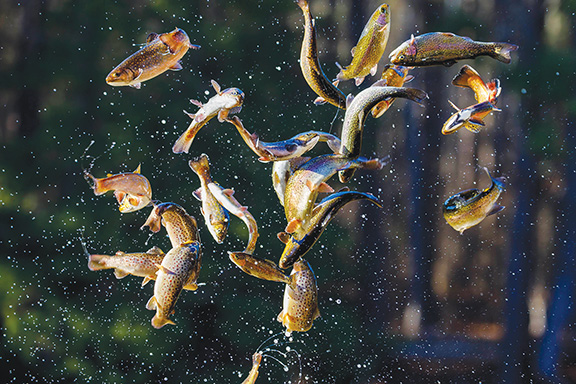
The commission will open 32 trout streams and two lakes classified as Delayed Harvest to trout harvest on Saturday and will run through Sept. 30.
Saturday from 6 a.m. to 11:59 a.m., Delayed Harvest waters will open only to youth under 18 years old. With the waters open to all anglers at noon. The Wildlife Commission established the youth-only fishing period in the morning of the opening day, which is always the first Saturday in June, to promote trout fishing in youth anglers and to provide special opportunities for them to catch and keep fish.
During this time, anglers can keep up to seven trout per day, with no gear or bait restrictions and no minimum size limits.
Delayed Harvest trout waters are posted with diamond-shaped, black-and-white signs. A list of Delayed Harvest trout waters, regulation information and trout maps can be found at ncwildlife.org/trout.
Bear sightings
During the springtime, N.C. experiences an increase in people calling the commission’s Wildlife Helpline (866-318-2401) to report that the have seen a bear. The commission said they have an increase in people calling about bear sightings from late April to Aug. Bears have been seen in both rural and urban areas throughout the state.
The reason for more sightings this time of year is because natural food resources are more limited in the spring than in summer and fall. Early spring foods include broadleaf plants and insects. Bears will actively seek out and use any abundant food source they can find, including unsecured trash cans and bird feeders in residential areas.
Colleen Olfenbuttel, the commission’s game mammals and surveys supervisor and bear expert, said, “Bears are emerging from their winter dens during spring and becoming more active. Mother bears have emerged from their
den with their cubs, 1-year-old bears are leaving their family groups and roaming to find a new home and, with breeding season just around the corner, male bears are starting to travel extensively searching for mates.
“Also, bears are hungry after hibernation, so the are all roaming around looking for food.”
Olfenbuttel added, “It’s imperative for the public to never feed a bear whether intentionally or inadvertently, as it will cause it to become habituated to people and alter its natural behavior.”
The commission said proactive prevention of bear issues is key. At the first indication that bars are active, neighbors who work together to quickly remove outdoor foods or other attractants will encourage bears to move on and not return.
A little over a month
ago, a video went viral of a group of people pulling bears cubs out of a tree in Asheville. This prompted an investigation by the commission. The commission said calls to their Wildlife Helpline of possible orphaned cubs also increase this time of year. They advise that a bear cub alone is rarely orphaned or abandoned. The commission advises to give the mother plenty of room and time to reconnect with her cub.
The commission does not relocate bears as the process of relocating them can be dangerous to personnel and the bear and generally is not an effective solution. There are no remote areas remaining in the state in which to relocate bears where they are unlikely to interact with humans and relation would move the problem to a new location.
Details: To learn about BearWise, visit bearwise.org.
For the new hunting season dates, visit ncwildlife.org.