
Andrews – In 2006, a trio of authors warned of an imminent labor shortage and brain drain that would require companies to redefine retirement and transform management practices to attract, accommodate and retain workers.
Their book, Workforce Crisis: How to Beat the Coming Shortage of Skills and Talent, remains relevant to businesses and organizations of all sizes today.
Thirteen years later, the Police Executive Research Forum – a nonprofit law enforcement think-tank – acknowledged the industry was amid a workforce crisis and surveyed agencies across the United States to gain insight on how to correct the problem. A focus of their research was on how to identify and attract nontraditional candidates who might not have otherwise considered a career in policing.
Among other suggestions, participants said law enforcement agencies must rethink the traditional trajectory of policing careers, provide an authentic portrayal of what policing is about and emphasize service over excitement.
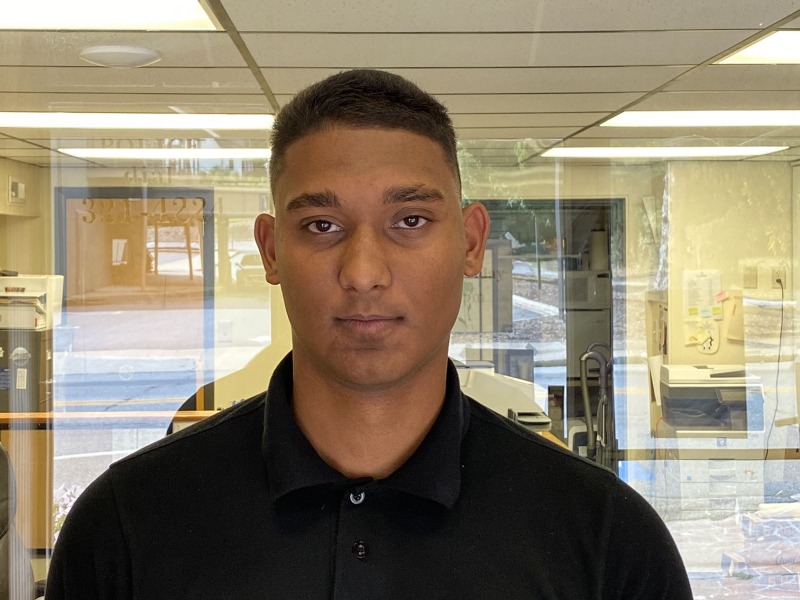
“Your community needs you, and your country needs you,” new Andrews Police recruit Shawn Esajas told the Cherokee Scout, responding to a similar question about how to attract young people to police work.
Esajas, 20, has always wanted to work in law enforcement. “Everyone in my family is a first responder,” he said. But a different childhood influence ultimately persuaded him to choose policing as a career.
“When I was a kid, I was really obsessed with (professional) wrestling,” Esajas recalled, adding that he would watch the crime television shows that aired beforehand. “I would sit there all day watching those, waiting for wrestling to come on. Those shows really sparked my interest in criminal justice.”
Those shows, coupled with family tales of adrenaline-rushed workdays, convinced him to pursue a career in law enforcement, despite the state of the industry today. Esajas hails from Tampa, Fla., where three officers were injured during ambush attacks last year amid a summer of nationwide riots.
“The stuff that's happening now wasn't going to deter me,” Esajas said. “Me and my dad talked about it. He told me that if I really wanted to pursue it, he wasn't going to stop me, and to be careful and mindful of the climate.”
Before signing up for the police academy in Florida, Esajas visited a friend in Cherokee County and decided to help a small town instead. He’s lived here about three months and attends Basic Law Enforcement Training at Tri-County Community College in Peachtree.
“Being able to help the community and make Andrews a better place is really why I chose here,” he said, adding that his father’s advice played a part in his decision as well. “It was pretty dangerous down there, and I felt like [Andrews] was a better option as far as safety of officers and the respect and treatment of officers in this area.”
A study by the International Association of Chiefs of Police found that public perception of law enforcement limits interest in the profession and is a barrier to effective recruitment. Cell phone recordings of interactions between the police and public, media coverage and entertainment portrayals of cops have led young people to view the profession differently than their parents may have.
When asked what police must do to change the perception of the badge, Esajas said officers must remain adaptable.
“To gain respect back is a two-way street,” Esajas said. “All the older officers are stuck in their ways of doing things, but with the times changing, we have to adapt and be smarter because everything is being recorded. If you want people to listen, you have to be respectful. And you should only use force when it's necessary.”
When asked what he would say to potential recruits who may be hesitant to join the force due to negative public perception of cops, Esajas replied, “If you want things to change, then you're going to have to change it from the inside. You can’t just talk about it, you have to actually do it.”
Today, Esajas works with the Andrews Police Department in a training capacity until he completes the necessary requirements to become a certified officer. He can participate in ride-alongs and other field training exercises, but cannot carry a firearm and does not have arrest authority.
In exchange for part-time employment and on-the-job training, Esajas has agreed to work for Andrews as a full-time officer for at least one year after graduating from BLET. He also attends Bluefield State College online, where he is majoring in criminal justice, and plans to apply for employment with a federal agency after serving five years as a municipal cop.