
Raleigh – As the debate over Medicaid expansion continues in Florida, lawmakers are turning their attention to North Carolina as a potential model.
North Carolina, which recently expanded its Medicaid program despite initial resistance, has caught the interest of Florida legislators seeking insights into the process. Florida is one of only 10 states that has not expanded Medicaid under the Affordable Care Act, and proponents argue the measure would allow more than 1 million residents to gain coverage.
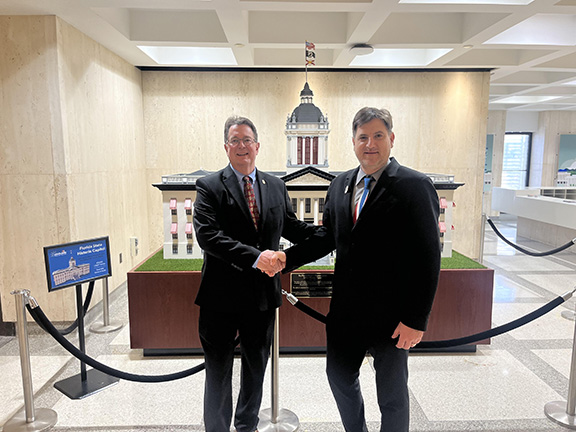
Republican North Carolina Sen. Kevin Corbin (R-Franklin), a key figure in the state’s Medicaid expansion, recently traveled to Tallahassee to share North Carolina’s experience with members of the Florida legislature. Describing the meeting as “going extremely well,” Corbin highlighted the potential for Florida to learn from North Carolina’s approach.
“North Carolina was very hesitant to take Medicaid expansion. You know, three, four or five years ago, there was a lot of hesitation among Republicans who felt like it was a buy-in to a continuation of Obamacare, and that we would be spending money loosely,” Corbin said. “First, we worked to completely transform the state’s Medicaid program, something Florida is working on. Then we expanded health-care access to women and children by expanding Medicaid eligibility to women 12 months postpartum. From there, expansion to include working families in the state just made sense as the fiscally responsible path forward.”
Corbin led the charge in 2022 for North Carolina to extend postpartum Medicaid to include coverage for 12 months after delivery, explaining that continued access to insurance coverage during this critical period should facilitate benefits in mental and physical health, care for chronic disease, access to contraception and potentially reduce maternal mortality.
N.C. Child, the state’s leading child-advocacy organization, named Corbin Legislator of the Year in 2023 for his efforts on expansion.
“Corbin saw the need through his work as an insurance agent,” said Tiffany Gladney, senior director of policy and government relations for N.C. Child. “He often talked about the sobering experience in having to turn down single mothers who came into his office seeking coverage but made too much to qualify for Medicaid and too little to afford private insurance. This was a deficit Corbin was determined to address. During his time in the House and Senate, he never stopped lifting up this critical need in our state.”
While emphasizing that no definitive decisions have been made, Corbin expressed optimism about Florida’s willingness to explore similar measures.
A crucial factor in North Carolina’s decision to expand Medicaid was its cost-effectiveness. Corbin, drawing from his experience as a longtime insurance agent, pointed out that Medicaid is often cheaper than private insurance or Medicare for the state.
Despite serving nearly 3 million participants, the program costs North Carolina roughly $21 billion, with the majority of the bill covered by the federal government and hospitals. The state pays ‘scarcely over 100 bucks a month per member,’” Corbin said.
Florida’s interest in North Carolina’s Medicaid expansion stems from its own efforts to address health-care access for low-income adults. North Carolina’s expansion, which began on Dec. 1, 2023, aimed to provide health insurance to an estimated 600,000 low-income adults over two years. Remarkably, the state achieved 58 percent of this goal within just two months, with over 346,400 newly eligible beneficiaries approved for coverage as of Feb. 1.
Key to North Carolina raising the state’s income limit for Medicaid, extending eligibility to individuals earning up to 138 percent of the federal poverty level based on household size ($25,820 for a family of three), up from the previous limit of 100 percent.