
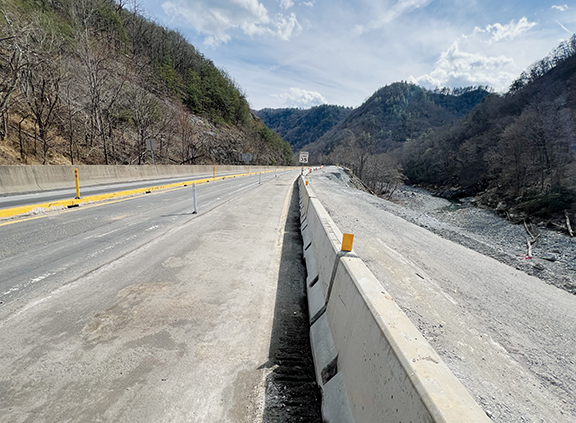
Jonathan Creek – It may seem bizarre to navigate a two-lane interstate with the typical speed limit cut in half, but it beats the detour.
Closed since Hurricane Helene literally destroyed portions of roadway when passing through the region Sept. 27, a 25-mile strip of I-40 re-opened to traffic Saturday. Twelve miles of the highway – from Exit 7 in North Carolina (Harmon Den) to Exit 447 (Hartford Road) in Tennessee – has been narrowed to one lane in each direction, with crews working feverishly to stabilize the westbound lanes and prepare them for use, while also continuing long-term repairs on eastbound lanes that crumbled into the Pigeon River Gorge during the storm.
“Our engineers have prioritized this re-opening over everything else, so we would not open this if we did not feel confident for people to travel it,” N.C. Department of Transportation resident engineer Nathan Tanner said.
“It’s a monumental accomplishment on a historic project. I think a lot of people in DOT have never seen this level of damage along a primary interstate route in their careers.”
For safety reasons, I-40 had been closed since the hurricane from Exit 20 (U.S. 276) in North Carolina to Exit 451 (Waterman Road) in Tennessee.
The Graham Star was one of several regional media outlets invited on an exclusive tour of the corridor on Feb. 27, just two days prior to its public re-opening. During a press conference held amid the tour, travelers were welcomed to use the roadway by Tanner, who noted the following modifications are now in place:
- Narrowed lanes, with reduced shoulders;
- A speed limit of 35 mph
- A 9-inch by 9-inch concrete curb separating the direction of travel;
- An emergency-only lane on the eastbound side of I-40;
- Only standard-size 18-wheelers will be allowed. Wide loads will still be required to use the current detours of Interstates 77 and 81.
A high volume of tractor trailers have frequented roads in far-western North Carolina since the hurricane, hoping to avoid the lengthy detours presented by taking other interstates. This has led to logistical issues of 18-wheelers disregarding DOT warnings and becoming stuck on U.S. 129 (the “Tail of the Dragon”) – just outside Graham and Swain counties, in Blount County, Tenn. – as well as Tennessee 68 in Polk County, Tenn., which lies just beyond Cherokee County.
Long road back
The press conference was held around mile marker 2 in North Carolina, on a reinforced portion of the eastbound roadway that was notably missing continuity on either end.
DOT officials recounted the helplessness they felt after being dispatched from the Haywood County Maintenance Yard in Clyde on Sept. 27, after hearing reports of “losing roadway.” What was hoped to be an exaggeration became all too real when workers arrived to find the Pigeon River raging and flooding the banks of I-40.
Unaccustomed to the demand, much of the shoulder at several locations along the interstate -- and the right lane of travel itself – collapsed.
“We were standing here watching trees bend over and then, they just snapped,” DOT Division 14 assistant resident engineer Daniel Ross said. “It was unreal.”
All told, more than 3 million cubic yards of dirt, rock and other material were swept away by the storm.
Wright Brothers Construction was awarded the contract to stabilize the westbound lanes in October and created the two-lane traffic pattern that opened Saturday. GeoStabilization International was named the subcontractor.
According to a release issued shortly after the media tour, the stabilization process involved driving steel rods into the bedrock, filling the rods with grout, applying a metal screen then sprayable concrete to the face of the walls. There were four different rigs operating at the same time.
Crews installed 90,000 square feet of soil-nail walls across the 10 different damage locations in less than 130 days. They also drilled nearly 2,100 feet of nails and fortified four miles of the shoulder for truck traffic.
The original plan was to open the roadway Jan. 1, but a stretch of interstate believed to be sufficiently repaired failed one week prior to the resumption of traffic.
The DOT is looking at a nearly three-year window for repairs to be fully completed and expand the road back to its previous four-lane status.
Ames Construction has been hired as the contractor for the long-term repair; RK&K as the designer; and HNTB as the project manager. The DOT said in the release that the agreement with the three entities is a construction manager/general contractor contract, which “accelerates the timeline and reduces costs by having the contractor and designer work side by side as the project progresses.”