
Cherokee – It’s no secret that the tribal reservation houses the Mountainside Theatre, where the nationally acclaimed Unto These Hills production is performed, one of the longest-running outdoor theatre productions in the entire nation.
Mountainside is a magnificent theatre, with just under 3,000 seats carved into a hill, all facing an expansive outdoor stage with a dirt floor. However, the inimitable theatre sat silent in the off season, hibernating all winter like a giant bear with no growl.
That hushed theatre bothered Jake Guinn of Havoc Movement. So Guinn, with his boundless energy and runaway imagination, envisioned a play that could debut in the spring.
It was a risky endeavor. Spring on the Cherokee Reservation is mercurial. Would an audience sit shivering through an hour-and-a-half-long production?
They would be fools not to. Guinn along with his twin sister, Darby Guinn, adapted Alice in Wonderland into an Appalachian setting, taking liberties with the well-known story, keeping it familiar but not predictable.
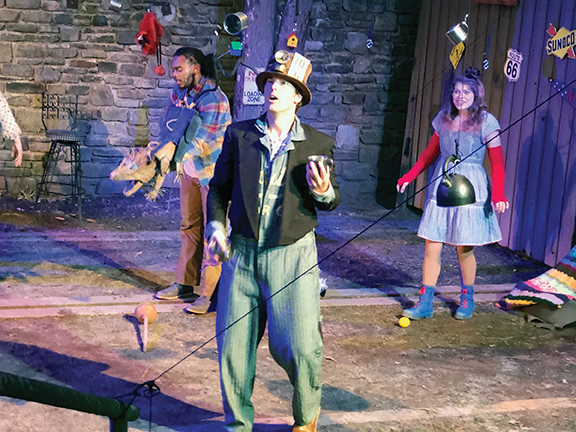
For one thing, a wildly energetic possum puppet specially crafted by Sarah Beth Hester of the Atlanta Center of Puppetry Arts replaces the sleepy dormouse at the famed tea party. And then there’s the hysterical collection of birds that caw, chirp and even dance.
Costume designer Cole Spivia showed off her ingenuity when she designed the birds’ wings out of items found in the hardware section of Lowe’s, including whiskbrooms and shiny silver rakes. But as inventive and playful as the costumes were, the real triumph of the show belonged to director Jason Paul Tate.
Born in the Appalachians, and with experience in movement and physical theatre, Tate’s sensibilities helped tame some of the wildness, giving the play needed banks for its frothing river.
With all the flying about on impossibly high apparatuses, the frenetic running around the stage, the pyrotechnics and the high volume over-lapping of dialogue and action, the play needed Tate’s steady influence to keep it from swirling into more circus than the memorable and meaningful production that it became.
Because the cast, mainly core members of the Havoc Movement, worked with each other before, there was a visible trust among them. This trust was vital as the play sometimes felt like a high-speed chase with dangerous obstacles requiring expert cooperation.
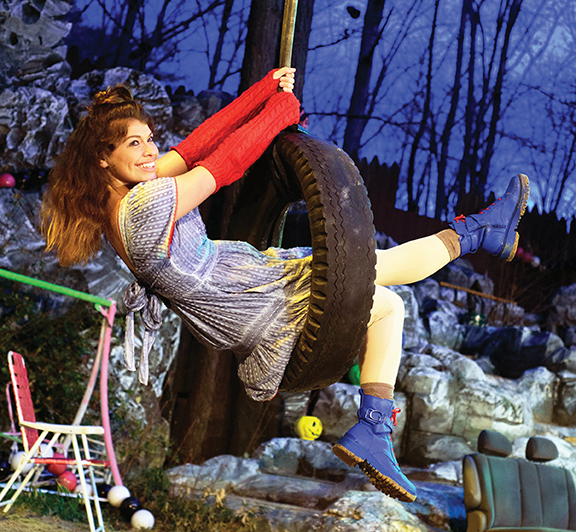
Alice, played by the confident Bailey Frankenburg, was present in nearly every scene. And if she wasn’t swinging on a tire swing at shocking heights, she was running around the stage in constant motion.
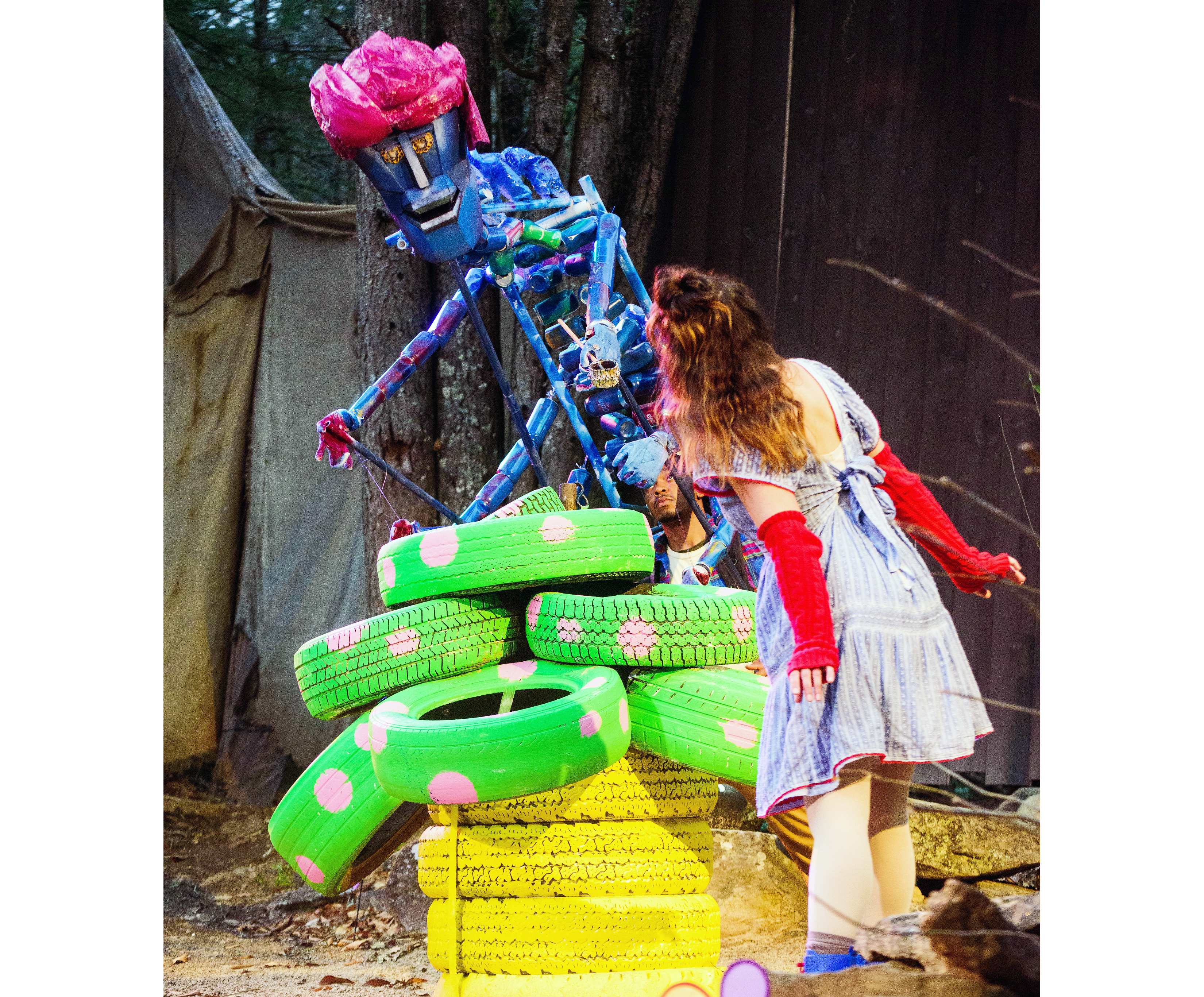
The welcome exception to her marathon was a scene with the caterpillar – again, nod to Spivia for a breathtaking costume. Perhaps the opium-smoking caterpillar helped to calm Alice, but in a fragile moment, she stood in one spot and sang a song with surprising delicacy considering her powerful voice.
Frankenburg’s talent was matched by Kristen Noonan, who played both the Mouse and the Queen with elegance and humor. Noonan has a gift for comedic timing. Even when dangling from a trapeze, she managed to hold both the cast and the audience under her spell.
But the character who ran away with the show was the Mad Hatter. Actor Jon Myer delivered a compelling performance with merriment and skill. Myer expressed his energy like a focused laser beam rather than the football floodlights seen in other parts of the play.
His Mad Hatter was loony and wild, but controlled. Myer never tipped into theatre of the absurd. Despite the largeness of his character, he played the Hatter with subtlety and magic.
Near the end of the play, Alice is speaking with the Mock Turtle, who awaits his fate. Will he remain alive as the Mock Turtle or be transformed into soup? He encourages Alice to follow the White Rabbit.
“There’s always something. Go on, before you lose your head, or worse, get stuck here until you make