
 |
I loved Sunday school as a child. My favorite part was reading the Bible stories and picturing it all in my head.
One story, about the adulteress who had been caught in a compromising position, troubled me as I grew older. John writes that religious leaders dragged her out of a compromising position to Jesus, who was surrounded by fans eager for a showy miracle.
“What do you want us to do with her?” they demanded, reminding him that the law listed adultery as a death penalty offense. It’s all quite dramatic.
Jesus sits with the question for a bit, building suspense. He uses his staff to draw in the sand and eventually tells them that whoever is without sin to go ahead and throw the first stone.
I heard a preacher once say that he thought Jesus was writing the names of the men who had also committed adultery in the sand during those tense moments waiting for the verdict. It’s a happy ending as far as Bible stories go, the woman, although publicly shamed, gets the chance to make better decisions tomorrow, and her accomplice remains inconsequential.
What troubles me about the story is the implied message of the woman’s guilt when the man was never indicted for the same offense. He wasn’t dragged out to the crowd and threatened with stoning. And it worries me that this version of blaming and shaming the woman somehow haunts modern sensibilities about such things.
Has this message, that women are responsible for men’s sexual behavior, become a ghost of biblical past whispering into law enforcement and prosecutors’ ears the idea that women are liable for men’s most reprehensible behaviors, including sexual assault?
If she hadn’t been so sexy, so flirtatious, such a tease type of thing, coupled with the “boys will be boys” adage, places the blame on the prey and abdicates the predator. After all, it’s up to the woman to wear the rape whistle.
One of my grad school professors passed out a paper the first day of class listing 10 ways to avoid rape. The first one read, “Carry a rape whistle. If you feel you are about to rape someone, blow it until help arrives to stop you.”
Many years ago, a friend of mine was raped. There wasn’t a name for it back then, but today it would
be called date rape. Like many girls in this situation, she wasn’t even sure if she was allowed to call it rape.
She had agreed to go out with him, after all, and even enjoyed kissing him in the car. So, when he first pressured her, and then demanded and, later still, raped her, she felt confused, and humiliated. She second-guessed herself.
Could she have given him mixed signals? Was she clear in communicating her refusal to consent? How many “No’s” are required for a man to switch from she’s just playing hard to get to I am raping a woman?
She never reported it for lots of reasons, among them that her rapist was a police officer and she felt powerless against the blue brotherhood. But her plight, the idea that she was somehow responsible for the rape, weighted her for many, many years. Unfortunately, her situation isn’t unusual.
According to the Rape, Abuse, Incest National Network, only 310 out of 1,000 rapes are reported. Historically, women who come forward are revictimized by the system meant to protect them. They are made to believe that they were somehow complicit in their own assault.
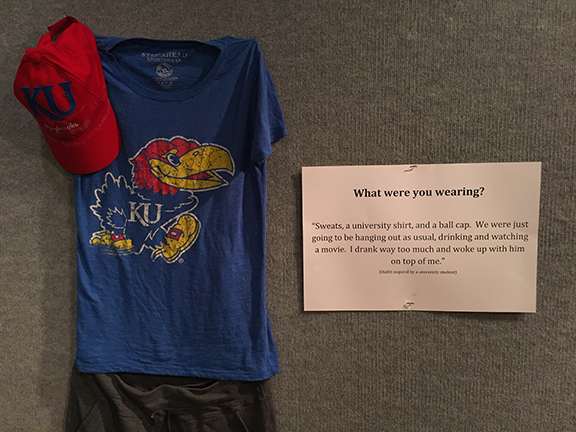
According to Dr. Wyandt-Hiebert of Kansas University, “What were you wearing?” is the No. 1 question asked by law enforcement to a rape survivor during the initial interview. She decided to collaborate with Jen Brockman to create an art instillation hoping to expose the flaw that women’s appearance, demeanor, or a bar tab is allowed to shift the blame from the rapist to the raped.
Brockman and Wyandt- Hiebert collected representational outfits worn by rape survivors and displayed them at the University of Kansas. Each outfit has an explanation card, briefly describing the clothing from the survivor’s point of view.
It’s a powerful display to scroll through dozens of ordinary outfits, just a simple thing one woman pulls from her closet on a typical morning. It’s heart-wrenching to know that the outfit will bear witness to an act of sexual violence before the day is over.
Most of the clothing is unremarkable, things we see women wearing everyday in Ingles or at Sunday morning church. The exhibit, (started in 2013) hopes to highlight the absurdity of questioning whether a woman deserved to be raped based on the clothes she chose to wear that day.
In John’s account of the adulteress, Jesus was the only one who got it right. He advised us to look within for blame. To examine ourselves for shadows. In the case of sexual assault, even a woman choosing to walk down her street naked has the right to expect to do so without being raped.
The blame rests only on the assaulter. I wonder what Jesus would have done if a rapist was dragged before him. I know that if I was there, even marred by my own impurities, while Jesus was writing in the sand, I would have searched for the most menacing stone, and then, after he spoke, been the first to throw it, with judgment and conviction.
To view the art installment, go to sapec.ku.edu. If you or someone you know has experienced a sexual assault, you can call the Reach Crisis Hotline anonymously at 828-847-8064.
Abigail Blythe Batton is a staff correspondent for the Cherokee Scout. Her column runs every other week. Email her at ablythebatton@gmail.com or leave a message at 837-5122.