
Panther Top Tower has been listed on the National His- toric Lookout Register since 1997. It was built in 1940 and is 30 feet tall.
 |
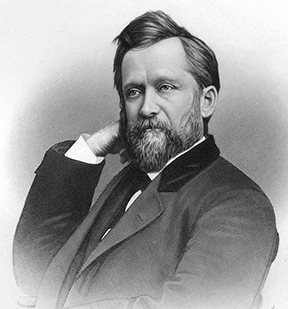
Charles Lanman was a member of the Hudson River School of artists, personal secretary to Senator Daniel Webster, and an explorer who fascinated American readers with books about his extensive travels in the Eastern United States.
In 1848 he embarked upon what he termed a “sketching trip” into the mountains, what would eventually become his book, Letters from the Alleghany Mountains published in 1849. Those travels included passing through our locality, describing in detail what he found, one man’s view of how our mountain home appeared to him only a decade after the Cherokee Removal.
His observations were not completely accurate, and while I did not correct or change his words, I did remove superfluous wording as was common in the writing of Lanman’s day.
In 1848 Lanman wrote:
“The following day I travelled down the Owassa valley until I reached the very pretty place where I am now tarrying.
“The Cherokee word Owassa signifies the main river, or the largest of the tributaries: and the paraphrase of this name into Hiowassee [sic] by the mapmakers is only a ridiculous blunder. So I have been informed by one of the oldest Cherokees now living. The Owassa is a tributary of the noble Tennessee, and is as clear, beautiful, rapid and picturesque a mountain river as I have ever seen. It is quite circuitous in its course, and the valley through which it runs is narrow, but very fertile and pretty well cultivated. The people live almost exclusively in log cabins, and appear to be intelligent and moral, though apparently destitute of all enterprise.
“The only novelty that I noticed on the road to this place was the spot known as Fort Embree. The only evidence that there ever was a fortification here are a breastwork of timber, a lot of demolished pickets, and two or three block-houses, which are now in a dilapidated condition. The site is a commanding one and takes in some of the grandest mountain outlines that I have yet seen.
“This fort, so called, was made by the General Government for the purpose of herding the poor Cherokees previous to their final banishment into exile. The Cherokees were a nation of mountaineers, and, had a wise policy been pursued with regard to them, they might now be chasing the deer upon these mountains, while all the valleys of the land might have been in a state of cultivation, even as they are now. The few Cherokees who were permitted to remain in Carolina, are now considered the most polite and inoffensive of the entire population; and the United States District Attorney residing in Cherokee county informs me, that of five hundred individuals whom he has had to prosecute within the last five years, only one of them was an Indian, and he was led into his difficulty by a drunken white man.
“In coming down the valley of Owassa I met with a number of incidents which I fancy worth mentioning. For example, approached a rickety log cabin, and was surprised to see the family and all the dogs vacate the premises, as if I had been a personified plague. I was subsequently informed that this was a common habit with the more barbarous people of this region when they see a stranger passing along the road.
“The little village of Murphy, whence I date this letter, lies at the junction of the Owassa and Valley rivers, and in point of location is one of the prettiest places in the world. Its Indian name was Klausuna, or the Large Turtle. It was so called, says a Cherokee legend, on account of its being the sunning place of an immense turtle which lived in its vicinity in ancient times.
“Running directly across the village of Murphy is a belt of marble, composed of the black, gray, pure white and flesh-colored varieties, which belt also crosses the Owassa river. Just above this marble causeway the Owassa, for a space of perhaps two hundred feet, is said to be over one hundred feet deep, and at one point, in fact, a bottom has never been found. I have heard the opinion that there is a subterranean communication between this immense hole in Owassa and the river Notely, which is some two miles distant. The proof of this theory is that a certain log was once marked on the Notely, which log was subsequently found floating in the pool of the Deep Hole in the Owassa.
“The only picture which attracted my particular attention in passing up the fertile but generally neglected bottom lands of Valley River, was a farm of twenty-five hundred acres, one thousand acres being as level as a floor and highly cultivated. The soil seemed exceedingly rich, and it was evident yielded a considerable income to its possessor. I heard, in fact, that the proprietor had been offered twenty-five thousand dollars for this farm. And in what kind of a house does my reader imagine this wealthy man resided? In a miserable log hovel, a decayed and windowless one, which a respectable member of the swine family would hardly deign to occupy. Instances something like to this had already come to my knowledge and caused me to wonder at the inconsistency and apparent want of common sense manifested by some of the farmers of this country, but this instance capped the climax. But again, the individual alluded to is a white man, and prides himself upon being more intelligent and acute than his neighbors; and yet one of his neighbors is an Indian woman, who raises about five thousand bushels of potatoes per annum but occupies a comfortable dwelling and lives like a rational being.”
Lanman’s brief passing through our area over 175 years ago is striking confirmation that some things never change, as we locals still today see outsiders and tourists failing to see us as we are, and never “get it” about living in our mountains.
Bruce Voyles’ local history column runs every other week in the Cherokee Scout. Email him at RoadsLessTraveled@cherokeescout.com.