
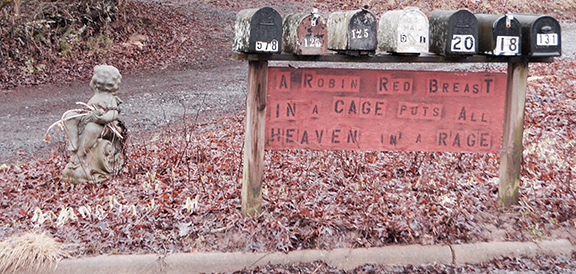
“A Robin Redbreast in a cage
Puts all of heaven in a rage
Some are born to sweet delight
Some are born to endless night.”
– William Blake, “Auguries of Innocence”
 |
The first time I visited Annie was in prison.
I was scared. She had been convicted for a complicated crime that ended in the murder of her 4-year old daughter. I found her on a popular crime site called Murderpedia when I wanted to write a book about a criminal, comparing her life to mine. The research required me to build a relationship with Annie.
We began with letters then progressed to very expensive phone calls, which led up to an actual in-person visit inside the North Carolina Correctional Institution for Women in Raleigh, North Carolina.
It takes tenacity to visit people in prison. Even at the Cherokee County Detention Center in Murphy, there are strict rules about what you can and can’t bring in and a pretty discriminatory dress code. Shirts and shoes are required of both genders but female visitors receive extra instructions including no tank tops, short skirts or tight dresses.
I was visiting a state run facility so the rule list was much longer including no personal items, photographs, paper or pencils. This last one was especially nerve wracking to me because I would have to commit the visit to memory until I could dash to the car afterward and record everything in a frantic information dump.
I drove four hours that day, but there was no guarantee I would get to see Annie. If she were cited for any infraction, she would lose her right to visitation. There would be no way for me to know until I was standing inside the gatehouse, waiting for my pat down.
I arrived early and spied a puddle of people waiting outside the barbed wire fence. We had 20 minutes before the gate would open so I joined the group. I wore a jaunty hat, but someone in the group gestured for me to take it off.
“You can’t wear that in there,” she said.
The others nodded in agreement, and I rushed back to my car to leave the cheerful thing on my seat. When I hustled back into the group, they were talking to each other.
“I know, I know,” A woman was saying. “Last time, that mean officer, you know the one I’m talking about, with the ragged ponytail?”
But when I joined the group, she stopped the story.
“Is this your first time?” she asked me.
“Yes,” I answered.
I started to say I was doing research for a book. I wanted to separate myself from them, the unlucky lot, who loved somebody in prison. I felt embarrassed and wanted to place myself above their situation. That’s what Annie said when speaking about the crime, “my (pause) situation.”
“Well, just do as they say and you’ll be fine,” the woman told me.
The others nodded in unison.
“Do you guys all know each other?” I asked.
“Well, we’re not part of a club or anything,” a 20-something girl wearing a yellow daisy head scarf chirped.
The grouped laughed softly. I’ll bet they confiscate that head scarf at check-in, smarty pants, I thought.
I desperately wanted to know what their person had done. I imagined I would be at the top of the hierarchy as “my” person’s crimes fell into the homicide category. But somehow, despite my arrogance and judgment, I knew not to ask.
Even though we were outside, we all spoke quietly, like we were in trouble.
One of the ladies, a sharply dressed woman with a bob so smooth and dark it reflected the sun, started to speak when we all heard rattling. We turned collectively to see a guard opening a giant padlock with Jacob Marley chains attached.
Our cluster, without instruction, quickly formed a tidy line.
As I waited, I considered the difference between my side of the pavement and Annie’s. I saw some inmates walking on the other side of the fence. We were just feet away from each other. We both breathed in the same damp air, we both looked up at an identical blue sky.
The prisoners, wearing tan dresses that resembled potato sacks clothes from the Great Depression, looked through the fence at us as we stared back evenly.
To me, both sides of the fence felt caged. At least on their side, their faces didn’t have to mask their horrors. They wore them on their uniforms. There was no pretense or pretending on their side, and that felt like a kind of freedom to me. I hide my secrets and insecurities behind my red lipstick smile, the surface betraying the depths.
When I finally got inside to see Annie, I looked around the concrete room. The chatter from the collective twosomes rose to the drop ceiling, where it formed a chorus. Up there, in the mingling, we had no demarcations of good or bad. Through our storytelling, we were all the same; we were all free.
Abigail Blythe Batton is a staff correspondent for the Cherokee Scout. Her column runs every other week. Email her at ablythebatton@gmail.com.