
 |
Andrew’s story is the American ideal. His last name wasn’t important – in the beginning.
He immigrated to America with his family to Pittsburg from Scotland in 1848. With his father unable to find work, at the age of 12, Andrew worked as a bobbin boy laboring six days a week for 12 hours a day. He earned $1.20 a week – or $42 a week in today’s dollars. That humble beginning stoked a hunger for success, and the following year he became a messenger boy in a telegraph company. A raise at $92 a week in modern dollars.
Andrew’s hard work, likability and attention to detail impressed several local businessmen. He learned to translate telegraph signals of Morse code by ear when most operators had to used paper. He was a top telegraph operator within a year and met Col. James Anderson who opened his personal library to working boys on Saturday nights. Andrew devoured the books he borrowed from Anderson and gave himself an advanced literary education.
When Andrew was 18, the head of the Pennsylvania Railroad needed the best telegraph operator available – and Andrew started work for owner Tom Scott. He was paid $146 a week in modern dollars. Scott soon moved Andrew into the business side of railroading and by 24 Andrew was superintendent of the Western Division of the Pennsylvania Railroad with a salary of $51,000 a year in modern dollars.
Scott was appointed assistant secretary of war in charge of military transportation in the Civil War and saw to it Andrew was appointed superintendent of the military railways and the government’s Eastern telegraph lines.
In 1864, Andrew invested in a Pennsylvania oil company that within a year paid off handsomely, allowing Andrew to invest in iron products for the war effort, another boom industry producing cannon and armor for gunboats. As his business grew, Andrew expanded into a steel rolling mill and steel production, bringing the Bessemer steel making process to America, which for the first time allowed mass production of steel.
Those profits allowed Andrew to gain control of all the suppliers of his raw materials. He bought smaller steel companies and combined them under a single umbrella company in 1892. By then, he was a friend of presidents, legendary writers and the social elite through his charming personality and his wealth.
Andrew did not marry during his mother’s lifetime, caring for her until he was 51. He married a 30-year-old shortly thereafter.
Andrew wrote articles for several newspapers and magazines, and in 1889 wrote, “The Gospel of Wealth” in which he espoused that the life of an industrialist should be in two segments, the first earning and accumulating wealth, and the second segment giving it away to worthy recipients.
He adapted a three-pronged approach that was similar, declaring that a person’s life should be broken down into three parts, the first of the three was educating yourself, the second putting that education to use and finding financial success, and the final segment as declared in his magazine article, giving that money away. “The man who dies rich dies in disgrace,” he declared.
By 1901, Andrew was 65 years old. A New York banker, John P. Morgan, wanted to combine all the steel companies in America, and he formed U.S. Steel, buying Andrew’s company and netting Andrew $225 million ($8.26 billion in modern dollars). That sale made him the richest man in the world.
Andrew practiced what he preached, giving money he considered investing in the future of America by investing in education, pensions, science, music, civil heroism and world peace. He gave $2 million to start a college that bears his name today – Carnegie-Mellon University.
Andrew was Andrew Carnegie.
He never stopped giving his money away. In 1911, he financed a 100-inch telescope on Mount Wilson known as the Hooker Telescope. He gave $10 million to establish the Carnegie Trust for Scotland Universities.
Andrew built a music venue in New York to promote musical performances – Carnegie Hall.
He funded constructing 7,000 pipe organs in churches and temples of different religious denominations. He was a major benefactor for a college in Alabama promoted by Booker T. Washington – Tuskegee Institute. Andrew would fund the Peace Palace in the Hague, which hosts the World Court and peace initiatives.
When Andrew realized he could not give away all his fortune in his lifetime, he established a corporation to continue his philanthropic works in 1911.
So, you might ask, why we are telling the story of a rich 19th-century industrialist? For the answer, we must go back to a young man unable to pay the $2 subscription for the local library to borrow books. He sent a letter to the library administrator asking for access but was turned down flat. That administrator was forced to change his policy when the 17-year-old Andrew Carnegie had the rejection letter published in the local newspaper. Andrew never forgot that lesson.
In 1903, he funded a library in Union County, S.C. While there were plenty of subscription libraries, that library was a history making public library. It was public and free – open to all.
Andrew Carnegie would give away $60 million to fund 1,689 public libraries, with the goal of helping those who helped themselves with the knowledge of books.
And among those 1,689 libraries, there was one with funding granted on May 15, 1916, in the amount of $7,500 to build and stock a library in a small town in western North Carolina named Murphy.
Construction was completed in 1919, the same year Andrew Carnegie died at the age of 83. He is buried in Sleepy Hollow, N.Y.
The Carnegie libraries were often the best buildings in town and have endured through the years, providing useful buildings after larger more modern public libraries were built.
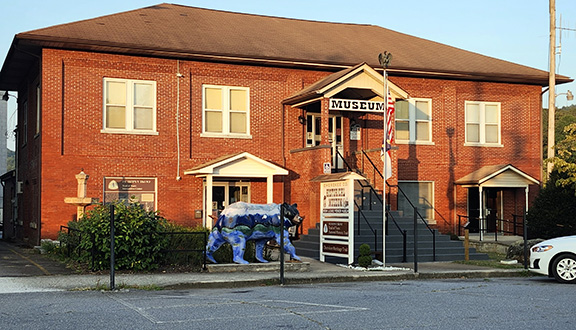
In Murphy, the Carnegie building still stands, home of the Cherokee County Historical Museum. Carnegie’s gift to Murphy still benefits our community.
Bruce Voyles’ local history column runs every other week in the Cherokee Scout. Email him at RoadsLessTraveled@cherokeescout.com.