

.
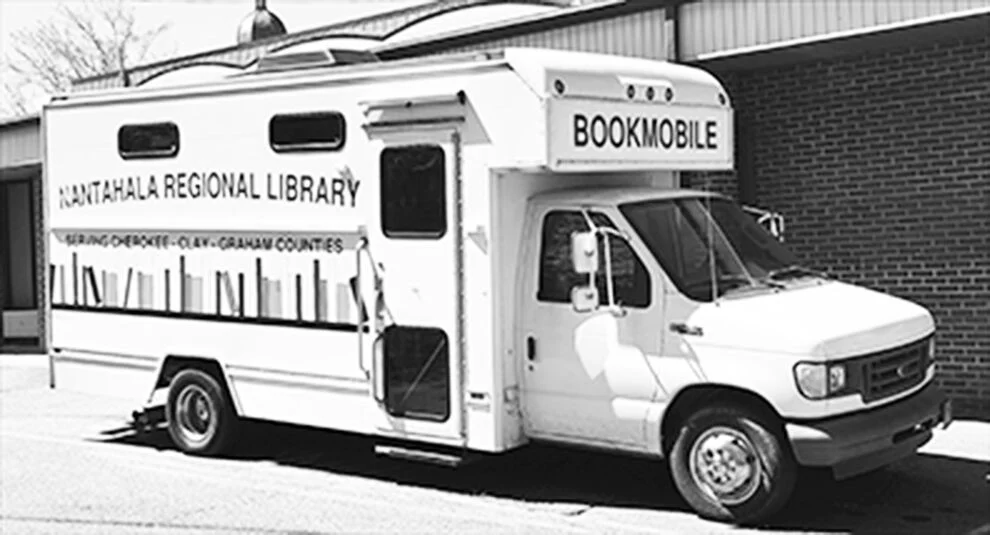
A boy is sitting on the bench of a store porch in Hiwassee Dam. It is a summer day, warm, the kind of afternoon where not much is moving. Pulling into the parking lot is something he has never seen before – a large vehicle, bigger than a delivery truck, with a single word painted on the side: Bookmobile.
It pulls up and stops. The door opens. The boy steps inside. He steps into another world. Floor to ceiling shelves, books in every direction, more books than he has ever seen in one place.
Something happens to him in that moment that will not unhappen. He wants to read every one of them. He wants, eventually, to write.
That bookmobile belonged to the Nantahala Regional Library. It did not arrive at Hiwassee Dam by accident. Getting it there had taken 30 years, a New Deal contract, a tax vote, five relocations, a collapsed wall and a small group of mountain citizens who decided, in the middle of the Great Depression, to build something that had never existed in North Carolina before.
The foundation was laid on May 15, 1916, when the Town of Murphy received $7,500 from the Carnegie Corporation of New York. Andrew Carnegie had by then funded more than 1,600 public library buildings across the English-speaking world. Murphy was one of only 10 in North Carolina. Carnegie’s model had one condition: he would provide the building, but the community had to pledge a tax levy to sustain its annual operation.
A library given as a gift and left to rot was not philanthropy. Carnegie wanted permanence. Murphy agreed. The two-story building that rose on a downtown lot became the foundation on which everything else would be built.
In 1934, the American Library Association estimated that one third of all Americans had no reasonable access to public library services. In the rural South the figure was worse – two thirds of the region’s population had no library access of any kind. Cherokee, Clay and Graham counties combined had roughly 25,000 people spread across 3,000 square miles of mountains and narrow river valleys.
A single municipal library in Murphy could serve the town. It could not serve the county, let alone three counties. Somebody had to think bigger.
The opportunity arrived in the spring of 1937, when several thousand workers poured into Cherokee County to build Hiwassee Dam. They came from across the state and the South – surveyors and ironworkers, form builders and concrete finishers, steel workers and carpenters – settling into a TVA planned community with dormitories, a commissary, a school and a post office. What they did not have was a library.
On May 1, 1937, the Murphy Library Board contracted with the Tennessee Valley Authority to provide library services at the dam site. The TVA was willing to pay for it. The board hired two librarians: Miss Ellen Axley to serve the construction community, and Mrs. Ida Belle Entrekin as the first regional librarian in North Carolina history.
The board that sent them out was chaired by L.B. Nichols and included Fannie Mitt Case, Claude King, W.A. Adams, Mrs. John Shields and E.A. Wood – six ordinary mountain citizens building something that had barely been tried anywhere in America. The idea was simple – and radical: geography and poverty should not determine whether a citizen had access to books. A worker’s child in a TVA planned community at Hiwassee Dam was owed the same shelf of possibilities as a child anywhere else.
When the TVA contract expired as the dam neared completion, the library faced a choice: shrink back into a municipal operation, or make the regional idea permanent. The board chose permanence. On Nov. 5, 1940, Cherokee County voters went to the polls on a library tax levy.
The result was 3,437 in favor and 1,643 against – a solid margin in a county where tax levies for public services were not lightly approved. Nine days later, contracts were signed between Cherokee, Clay and Graham counties and the Towns of Murphy and Andrews, formally establishing the Nantahala Regional Library.
It was the first regional library system in North Carolina and one of about 14 in the entire United States. The name came from the Cherokee word for the river and gorge – Nantahala, meaning land of the noonday sun.
The permanent institution had a decidedly impermanent early existence. The library moved five times in five years. A school building burned. The Carnegie building’s back wall collapsed when the town excavated its basement to house a fire truck. The staff kept the books circulating through all of it.
The campaign for a permanent building began in 1972, stalled when federal library construction money dried up, and resumed after local citizens wrote directly to their congressman. On May 16, 1976, the Nantahala Regional Library moved into a new building in Murphy. For the first time in its nearly 40-year history, the library had a home it could count on staying in.
The Nantahala Regional Library today is a four-branch system serving Cherokee, Clay and Graham counties from Murphy, Andrews, Hayesville and Robbinsville – communities separated by mountain ridges that make every branch a distinct act of civic commitment.
In 2022 it joined the N.C. Cardinal system, expanding accessible holdings from 100,000 physical items to 7.8 million. The bookmobile still runs.
That boy on the store porch at Hiwassee Dam was your author. What the Nantahala Regional Library put within reach – the bookmobile that pulled up on a summer afternoon bringing the world of books that followed, sparked what became a desire to write myself writing.
That influenced everything I have done since. The people who built this library in 1937 were not thinking about one boy on a porch at Hiwassee Dam. They were thinking about all of them.
Bruce Voyles’ local history column runs every other week in the Cherokee Scout. Email him at RoadsLessTraveled@cherokeescout.com.