
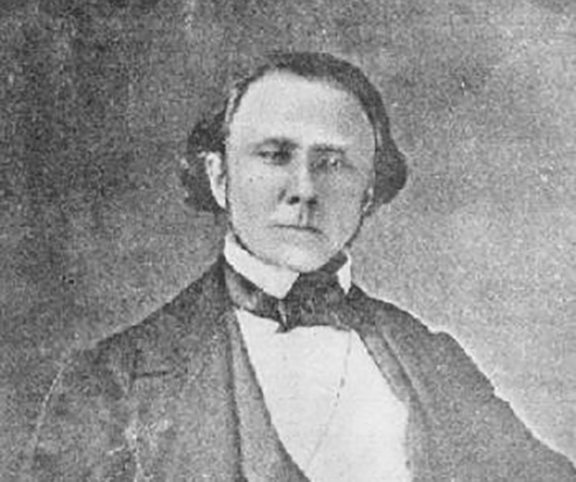

Western North Carolina history is incomplete without noting the amazing influence of W.H. Thomas.
During his lifetime, he would be considered a chief of the Eastern Band of Cherokee even though he was white and had no Cherokee blood, lobby in Washington against the Cherokee Removal, raise a Southern Legion for the Confederacy during the Civil War, push for a railroad so hard that he would be named as the father of western North Carolina railroads and almost single-handedly created what we know today as the Qualla Boundary, home of the Eastern Band of Cherokee Indians. He would also own a string of trading posts including one right here in Murphy. He did all this overcoming circumstances that few could have overcome.
Thomas’ father died before he was born in 1805. William Holland Thomas was raised near Waynesville and apprenticed to Congressman Felix Walker’s trading post on Soco Creek, first dealing with the Cherokee at age 13. He became fluent in Cherokee as well as able to write and read Cherokee after Sequoyah developed his syllabary. While working at the trading post he became friends with Chief Yonaguska (Drowning Bear), who would later adopt Thomas and pick him to become Principal Chief, despite a Cherokee law forbidding whites from holding tribal office. His Cherokee name was Will-usdi (Little Will).
Yonaguska was a visionary, deciding to separate from the Cherokee nation and his people becoming citizens of North Carolina as provided in the 1819 treaty. He also instituted an insistence on abstinence from alcohol.
When Felix Walker went bankrupt, Thomas took a set of law books as part of what he was owed, self-educated himself in the law and opened his own trading post.
When the Removal Act of 1830 was enacted, Thomas was enlisted as agent and attorney for the Qualla Cherokee and began buying land for them under his name. This would include 50,000 acres of what would become the 72,000-acre Qualla Boundary.
Thomas expanded his trading posts to a total of seven by 1822, but ran into competition from A.R.S. Hunter in Huntington, where the Hiwassee and Valley rivers meet. Regulations prevented Thomas from having a trading post within 1 mile of a military fort – meanwhile A.R.S. Hunter’s trading post all but adjoined Fort Butler. Supposedly the regulation was averted because Hunter’s trading post existed before Fort Butler was built.
Thomas would eventually own more than 100,000 acres of land, and while he was never officially the chief of the Cherokee he did take it as his mission to be guardian and protector over the people who adopted him as a young man. Living for extended time in Washington, his goal was to be twofold, prevent the Qualla Cherokee from being included in the Cherokee Removal, and to gain recognition for the Eastern Band of Cherokee.
In 1848, Thomas was elected to the N.C. Senate and remained being reelected in that office until the outbreak of the Civil War. It was primarily by Thomas’ efforts that the U.S. government officially recognized the Eastern Band of the Cherokee and allowed them to receive treaty claims.
Another project that consumed years of his life and energy was a railroad for western North Carolina, a goal he championed in the 1850s, envisioning a railroad connecting eastern North Carolina through the mountains and link to copper mining around Ducktown, Tenn. Thomas’ vision of such a railroad was not accomplished until the 1890s.
Thomas was also the primary promoter of a turnpike from Salisbury to Murphy.
While Thomas owned 50 slaves, he was originally against secession before he took a Confederate commission, believing the Cherokee had a better chance of treatment by a new Confederate government than a U.S. government that had been responsible for the Cherokee Removal.
Thomas, 57, raised eight companies of western North Carolinians, two companies of Cherokee and six companies of white men. A large part of the Thomas Legion was Walker’s Battalion, comprised of Cherokee County men (including the author’s great-great-grandfather Tillman Quinn). The official designation was the 69th N.C. Infantry Regiment.
The Legion concept was a combination of infantry, artillery and cavalry under a single command fighting as a unit; however, this did not fit with Confederate organization and much of the Legion was broken up, with some segments being sent to north Virginia to fight under Robert E. Lee. South Carolinian Gen. Wade Hampton also tried the legion concept but that, too, was reorganized.
Thomas and the rest of his command remained defending the mountain region of North Carolina, involved in numerous skirmishes, but Thomas’ goal was to keep the Cherokee away from the bloody campaigns of the larger armies.
Lt. Col. William C. Walker of Cherokee County served under Thomas. Walker contracted typhoid fever and was sent home to recuperate, where Union raiders surrounded his home (near Panther Top Road), and when he came to the door was shot in front of his family. Walker’s son, also home on leave, was spared.
Thomas was a political enemy of Gov. Zebulon Vance. Thomas would often let men who deserted his command return and rejoin the regiment, which Vance turned into a court-martial for Thomas at the war’s end. Nothing ever came of the charges.
Following the war, Thomas returned to his farm, Steoka Fields, near Whittier, with plans to return to politics, as he had received a pardon from President Andrew Johnson.
That was not to be, as his mind began to go. He fell into debt, the Cherokee suffered a devastating smallpox epidemic and, in March of 1867, Thomas was committed to a state mental hospital in Raleigh. He was in and out of mental hospitals until his death in 1893. With his mental clarity coming and going, he was still able to assist James Mooney of the Smithsonian Institution in his assembling of Cherokee legends and lore, and lucidly testifying in support of the Cherokee when establishing their rights to the Qualla Boundary of the Eastern Band of Cherokee, a lasting tribute to W.H. Thomas.
Thomas is buried in Greenwood Cemetery in Waynesville.
Bruce Voyles’ local history column runs every other week in the Cherokee Scout. Email him at RoadsLessTraveled@cherokeescout.com.