
 |
Few things have been as costly to the state of North Carolina as moonshine.
Our mountainous area has always been considered stereotypical prime territory for moonshiners. The area is even one the locations for the farcical Moonshiners television show; one season even featured Cherokee Countian Wayne Nix, and others from here have appeared in cameo roles, including my brother-in-law, Sam Graves.
Historically, moonshining was a common profession here – and most family trees of those born locally have a few branches of ancestors who engaged in the craft distillery business long before it became socially acceptable.
Much of the murders and mayhem in local history can be traced back to some occurrence related to the illegal, non-tax paid moonshine trade. We have described several in prior columns.
Moonshine can be a very expensive commodity due to social damage and violence related to its production and sale. (And that does not include the societal cost to some of the consumption of moonshine – but that is not the focus of this column). In this instance, we are talking about state borders.
The southern border for western North Carolina (and Tennessee) is the 35th parallel, which was determined by a survey conducted by Hugh Montgomery in 1818. A later survey in 1819 by Love and Terrell (Love representing North Carolina, and Terrell representing Georgia) had different findings – revealing that Montgomery’s survey had be 1,983 feet too far south, so the state line – and exact location of the 35th parallel was revised to the Love and Terrell determination.
This discrepancy of 1,983 feet is still a part of a legal boundary dispute between Tennessee and Georgia that exists today. Georgia wants to change the line to the northernmost, which they insist is the true line, while Tennessee contends the line accepted since the formation of the state is the acceptable line and should remain that way. At stake is the water in the Tennessee River – because should Georgia win that dispute their plan is to divert much of the river flow to feed the thirsty lands around Metro Atlanta. So far, Tennessee has prevailed.
North Carolina and Tennessee had their disagreements too, as described in our most recent column. The northern line between Tennessee and North Carolina was first established when North Carolina ceded what is now Tennessee to become the nation’s 16th state in 1796.
The line was to be, according to the act, “… thence along the extreme height of the said mountain (Great Iron or Smoky Mountain), to the place where it is called Unicoi or Unaka Mountain, between the Indian towns of Cowee and Old Chota; thence along the main ridge of the said mountain, to the southern boundary of the said state, as described in the act of cession of North Carolina to the United States of America.”
The two states agreed to have commissioners survey the line, but only North Carolina did, hiring Joseph McDowell, David Vance and Musssendine Matthew as commissioners to establish much of the line with surveyors Robert Henry, John Strother and six chainmen. They only got as far as Haywood County. There was no need to establish the remainder until the 1819 Treaty with the Cherokee – establishing among other things the Unicoi Turnpike. The lead surveyor for the commissioners was William Davenport.
The last hiker’s shelter in the Great Smoky Mountain National Park on the Appalachian Trail, nicknamed the Smokies Sheraton, is actually the Davenport Gap Shelter, named for the surveyor.
Starting at the ending spot of the previous survey in Haywood County, the plan was to follow the highest crest of the ridges to the Georgia line, starting on July 19, 1819, and concluded by the end of August that year.
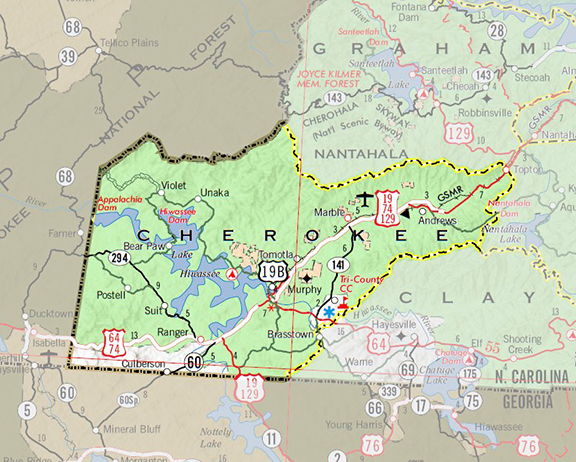
Per the original act, the party was to follow the top of a ridgeline to the Georgia border. It is easy to follow the squiggly lines of the ridges that makes the border between Tennessee and North Carolina until one comes to the Unicoi Gap, where the surveying party stopped following the ridge line and turned straight south – an unwavering straight line for 15 miles.
Legend has it that the reason the survey party stopped using the ridgeline was it was at this point they had run out of liquor – and they had learned of a reported still house at the Georgia state line.
While it is legend, there is no logical reason offered to explain why they did not follow the ridgeline. The moonshine explanation is the most often repeated.
And here is where the great “what if” comes in. What if the surveyors had followed the ridgeline as instructed? The state line would then go across Big Frog Mountain.
The correct line would have taken in Ducktown and Copperhill. Think about it. Ducktown, N.C., and Copperhill, N.C. That is not a big change until one considers that would have also meant the bulk of the copper mining industry in the Great Copper Basin would have been in North Carolina rather than in Tennessee.
Copper was discovered there in 1843 and the Hiwassee mine, the first mine – in Ducktown – began operating in 1850. When the mines closed in 1989, it was estimated that 95 million tons of ore had been taken from the ground – Tennessee ground, not North Carolina.
The state of North Carolina would have reaped the lucrative taxes from a company that was publicly traded on the New York Stock Exchange and existed for over 150 years, employing 5,000 people at its peak.
North Carolina missed out on that revenue because a surveying party ran out of liquor and turned straight south to the Georgia line – for moonshine. That is a fortune North Carolina was denied thanks to a few jugs of distilled corn liquor.
Bruce Voyles’ local history column runs every other week in the Cherokee Scout. Email him at RoadsLessTraveled@cherokeescout.com.