
 |
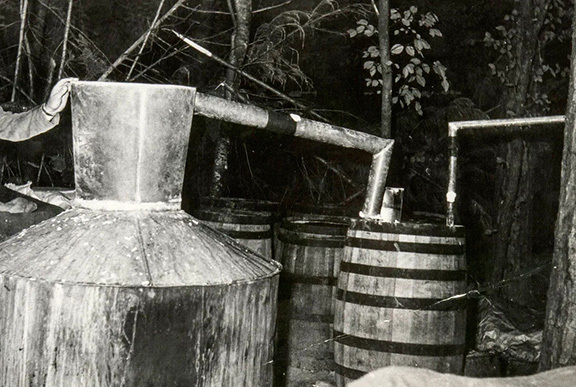
Cherokee County is so named because all the land in the county belonged to the Cherokee Nation originally. The white man came first as traders, seeking deer skins to be sent to Europe to make clothing. In exchange for those skins these traders brought with them essentials for an improved backwoods life, axes, knives, mirrors, saw blades – and one transportable item that was a popular trading staple. Liquor.
The source for that liquor is commonly assumed that someone outside the Cherokee lands distilled liquor and furnished it to the traders when they would resupply.
Settlers soon followed, working stands on the Unicoi Turnpike, farming on land available through their marriage to Cherokee women, or in some cases trespassing while seeking gold.
With the Cherokee Removal white men flooded the area. Most were Scots-Irish, Protestant families moved by England from the lowlands of Scotland to Catholic Ireland to help keep the rebellious Irish in line. A great many of their descendants made their way to the New World.
They came down the Great Wagon Road from Pennsylvania and up through Georgia, seeking cheap land and a place away from governmental interference, with most of them bringing with a fiercely independent spirit, a natural inclination to defy being told what to do, and most important for this story, a centuries-old Scots-Irish tradition of distilling moonshine. They made it in the old country – they might as well make it here, they reasoned.
Most of those mountain distillers were unaware of George Washington’s attempt to charge a tax on liquor, resulting in outrage that became the Whiskey Rebellion during Washington’s term.
Government has never stopped trying to tax moonshine, and some descendants of those Scots-Irish have never stopped making moonshine. A few generations ago, according to some local old timers, the liquor produced by your author’s ancestors was especially prized as “good liquor.”
Some purists even declare that if moonshine is legal, it cannot officially be moonshine.
Early settlers found turning corn into liquors was profitable, and government regulation or no, they were not going to stop. The tradition flourished here with our remote mountain hollows and accessibility of cool clean water creating an ideal location for producing liquor.
And as often the case when money is involved, it became common for feuds to develop between business competitors – with one side often informing the legal authorities of their competition’s location and activities. Violence often followed.
In one instance of local history, a misunderstanding over a moonshine still created a case that changed legal history and is still studied in law classes today.
The story begins in 1892, between William Hall and Andrew Bryson. Neighbors in the mountains, two young men, both in their 20s, who were sharing the use of a moonshine still. Until the day one went to use the still and found it gone.
Each accused the other
of the theft, and tempers flared. In July of 1892
Hall asked another friend, John Dockery, to help
him hunt down Bryson in the mountains north of Murphy to recover the still. They found Bryson and argued, ending only when Hall shot Bryson with a Winchester rifle. Bryson died there.
The legal problem was Bryson had been standing
in Tennessee when he was shot – while Hall and Dockery’s feet were planted in North Carolina when Hall fired.
North Carolina authorities quickly arrested Hall and Dockery, charging both with Bryson’s murder.
Hall’s lawyers argued Hall could not be convicted of murder in North Carolina because the crime, the death of Bryson, had in fact been committed in Tennessee.
The lawyer’s arguments did not matter to the judge, the men were tried, convicted by the jury, and sentenced to hang. They appealed to the N.C. Supreme Court, which agreed with Hall’s lawyers that no crime had been committed in North Carolina. By a unanimous vote, the N.C. Supreme Court threw out the conviction, ordering Hall and Dockery released. In May 1894 they were released from jail in Murphy and promptly re-arrested to await extradition to Tennessee to be tried for murder there.
However, the extradition laws of the time applied only to those who were fugitives from justice, and Hall’s lawyers insisted the two men could not be fugitives since they had not set foot in Tennessee, not during the crime, or ever, thus making it impossible to flee from a state in which one had never been.
The case was put before the North Carolina Supreme Court to decide the question. In December 1894, the court agreed that Hall and Dockery could not be extradited to Tennessee. It was a 3-2 decision, and one judge questioned if others would soon be using fights across state lines to avoid prosecution, as had once been done before dueling had been outlawed.
The justices explained that they could only decide cases based on the law – and if in this case that allowed the two shooters free on such a technicality, then the state of North Carolina should make such a law. Not wasting any time, the N.C. Legislature did enact such a law within three months.
Defendants in other states made use of the same ruling, prompting a group of law officers to draw up a Criminal Extradition Act that made the not-a-fugitive argument illegal.
Neither Hall nor Dockery ever suffered any further prosecution.
And the moonshine still in question? Bryson and Hall had stolen the still from a nearby farmer. It was stored in Bryson’s barn when it went missing.
The farmer had gone looking for the still, found it in the Bryson barn, and reclaimed his stolen property. He told Bryson’s father, who could not object, but had not yet told his son of the reclaimed still when Bryson went into the mountains on his last day on Earth.
With some better communication, the death of Bryson and the years long trials and appeals of Hall and Dockery could have been avoided – and the not-a-fugitive loophole might still be on the books.
Bruce Voyles’ local history column runs every other week in the Cherokee Scout. Email him at RoadsLessTraveled@cherokeescout.com.