

.
Look at the county map and read the names. Graham. Clay. Macon. Jackson. Madison. McDowell. Sevier County over in Tennessee. Shelby, North Carolina. They are Scots-Irish names, most of them – the surnames of frontier militia commanders and the men who shaped this corner of the country after the Revolution. The names are everywhere because the people were everywhere. Understanding who they were and how they got here goes a long way toward explaining why this part of the world is the way it is.
They are called the Scots-Irish, and the name tells the story. Lowland Scottish Presbyterians, transplanted by King James I to Ulster, the northernmost province of Ireland, beginning in 1610. The English called it the Plantation of Ulster. The idea was to break the power of the Gaelic Irish clans by seeding conquered land with loyal Protestant settlers. It did not work out as planned.
The Ulster Scots settled in and held their own, but they were subjected to the same grinding cycle of rack rents, religious discrimination and famine that had been wearing on the Irish they displaced. By the early 1700s, they were leaving. Between 1717 and the Revolution, more than 250,000 of them crossed the Atlantic, passing through Philadelphia and New Castle, Delaware. The coast was already settled. These were not people who had crossed an ocean to hand their rent money to another landlord. They turned south, down the Great Wagon Road through Pennsylvania’s Cumberland Valley and the Shenandoah and into the Carolina Piedmont. As the Piedmont filled, the boldest pushed west toward the Blue Ridge and beyond.
After Cherokee removal, their descendants flooded in. The surnames in the earliest land grants and tax records of Cherokee, Clay and Graham counties read like a roll call of the old Ulster settlements – the same families who had come through Pennsylvania generations before, filtering slowly down the chain of the Appalachians until they ran out of frontier.
In the summer of 1780, British Maj. Patrick Ferguson sent a message to the mountain settlers. If they did not submit to the Crown, he would march his army over the mountains, hang their leaders, and lay waste the country with fire and sword. What Ferguson did not understand was the people he was threatening – men who had been hearing that kind of language from kings and landlords and state churches since before their grandfathers were born. It did not have the intended effect.
Isaac Shelby rode 40 miles to confer with John Sevier. Word went out. On Sept. 25, 1780, more than 1,000 militiamen assembled at Sycamore Shoals on the Watauga River in what is now Elizabethton, Tenn. They were known as the Overmountain men.
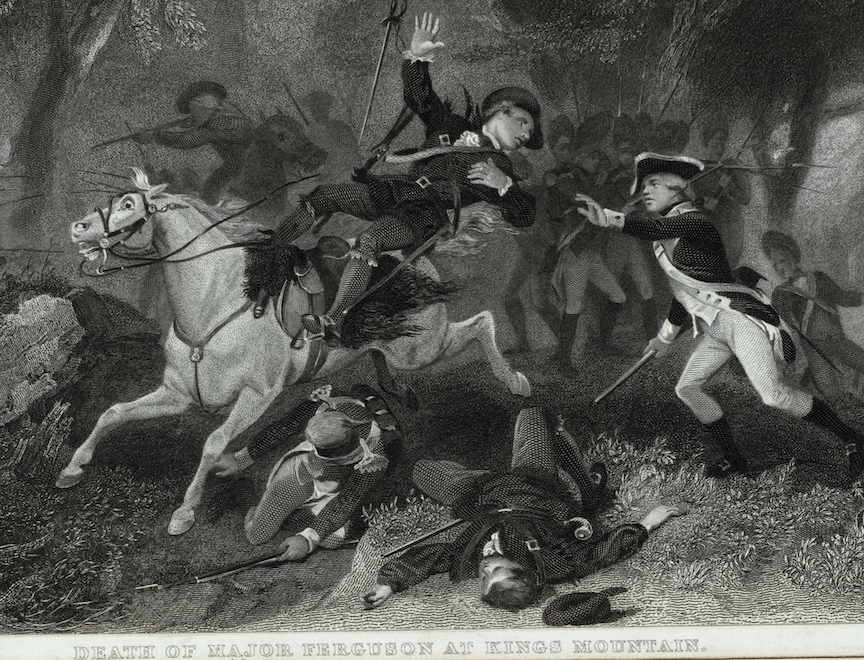
A frontier preacher named Samuel Doak delivered a sermon and sent them off swearing to wield the sword of the Lord and of Gideon. They marched over Roan Mountain through early October snow, keeping their powder dry under rock overhangs at night, and ran Ferguson to ground on top of Kings Mountain on Oct. 7, 1780. The battle lasted about an hour. Ferguson was shot from his horse and killed. Theodore Roosevelt later called it the turning point of the American Revolution.
The men who won it were Clevelands and McDowells, Shelbys and Seviers – the same names now on the counties and towns all across this end of the mountains. John Crockett, Davy Crockett’s father was there. Almost to a soldier, they were Scots-Irish.
The Scots-Irish brought three things to these mountains that defined the culture they made: a religion, a still and a fiddle.
The religion was Presbyterianism, shaped by John Knox’s uncompromising Scottish Reformation, which held that no king or bishop stood between a man and his God. In the isolation of the Appalachians, where qualified Presbyterian clergy were scarce, these families drifted toward Baptist and Methodist congregations that shared their theological stubbornness and needed no bishop’s approval to ordain a minister. The small independent church on the creek bank, governed by its own members and beholden to nothing outside itself, became the center of mountain social life. You can drive any road in Cherokee County on a Sunday morning and count the evidence.
The still came from Ulster, where the right to distill your own grain was a mark of freedom – the thing a free man could do and a tenant could not. When the new American government tried to tax whiskey in 1791, the Scots-Irish of the western frontier erupted in the Whiskey Rebellion. That resistance became a cultural stance that lasted in these mountains for another two centuries. A man’s still was not a criminal enterprise. It was a declaration of independence.
The fiddle carried the ballad tradition of the British Isles – narrative songs about love, betrayal, murder and heroism, durable enough that collectors found them intact in mountain cabins in the early 20th century, sung in versions barely changed from their 16th-century originals. Those driving modal tunes blended with African American banjo playing to produce old-time mountain music, which became the direct ancestor of bluegrass and country. The musical DNA of Nashville traces a straight line to the Scottish Borders by way of Ulster.
None of this was taught to me as history growing up here. It was just the air. The Baptist churches on every creek bend. I was baptized and later married at Mt. Carmel. The family cemeteries on the adjoining hillsides hold my ancestors and will someday hold my remains. My own people were Reids, Walkers, Waddells and Gentrys – the same stock, the same route, the same story. Those families have been on this land since shortly after Cherokee removal, and their people before that were filtering down through Pennsylvania and Virginia and the Carolina Piedmont for a hundred years before they found this particular hollow and stopped.
They came here because the land looked like the kind of land a free man could work without asking anyone’s permission. It looked like home.
Bruce Voyles’ local history column runs every other week in the Cherokee Scout. Email him at RoadsLess-Traveled@cherokeescout.com.