
 |
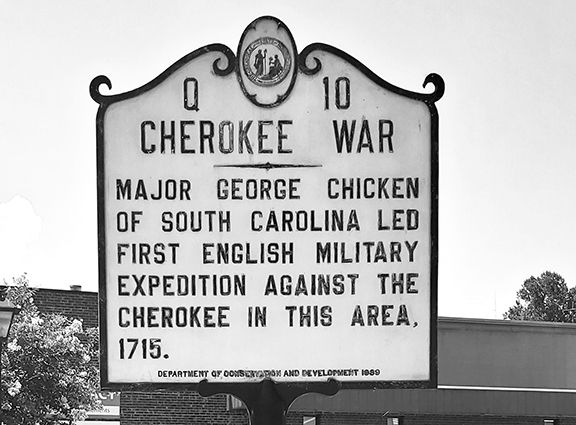
On Peachtree Street in downtown Murphy stands a historical marker erected in 1939 with a brief statement. “Cherokee War. Major George Chicken of South Carolina led the first English military expedition against the Cherokee in this area, 1715.”
Chicken is not a name one might associate with a military leader, but therein lies the story, and his connection to Cherokee County.
Chicken was a plantation owner from Goose Creek, S.C., a member of the S.C. House of Commons, and a militia officer. Beginning in 1712, Chicken had a hand in South Carolina’s policies toward Native American tribes. Sometimes that meant fighting. As a captain, Chicken led militia in the Tuscarora War of 1711-13, when he led an allied force of several hundred Native Americans, including Yamasee and Cherokee in forcing the Tuscarora from North Carolina.
The “Cherokee War” described on the marker is misnamed. It is better known to historians as the Yamasee War.
Trade in deer skins had been going on between the colonial settlers and Native American tribes, including Cherokee since 1690. The trade was conducted via the “Indian Path,” a trail from Charleston, S.C., to the Tellico area of Tennessee. The trail has been traveled for over 1000 years, and by 1715 the trail gave access to more than 100 traders actively dealing within the Cherokee nation.
Due to the seasonality of the taking of deer skins, these traders would extend credit, at usury rates, resulting in tribes such as South Carolina Yamasee tribe accumulating an insurmountable debt of 100,000 skins, two times the number of skins exported from the entire colony the year before.
Adding to the tension was steady encroachment on Yamasee lands, hindering the tribe’s activity in Native American slave trade, a major source of their income. Some estimate that by 1715, 25 percent of the slaves in South Carolina were Native American, captured by their rival tribes and sold into slavery on Carolina plantations.
Until 1715, the Yamasee were considered the colony’s closest Indian allies, but on Good Friday April 15, 1715, the Yamasee massacred a colonial trade delegation in the Yamasee town of Pocotaligo, sparking a war that would kill hundreds of settlers and force most the surviving settlers to cower into the safety of Charleston.
Ninety of the 100 colonial Indian traders were killed. Some suspect the traders were killed as payback for their unethical dealings, the tribes gambling that the next group of traders coming into Indian lands would be fairer in their trading.
Raids by Catawba and a small group of Cherokee joined in war, even capturing a South Carolina militia garrison. For a time there was danger of the colonists being defeated and kicked out of South Carolina.
The marauding Catawba and Cherokee began a second series of raids along the Santee River, killing 27 militia in one engagement, 22 in another, until the marauding band was met by Capt. George Chicken’s force of 120 men, who defeated them in a fight known as The Battle of the Ponds.
Chicken continued his campaign, northward, into Cherokee country, reaching Murphy.
Chicken was not interested in military conquest or more fighting. His plan was to secure a treaty with the Cherokee to help the colony fight the Creek, and gain assurances no more aid would go to the Yamasee.
The Creek were longtime enemies of the Cherokee. By supplying 200 rifles and promising white soldiers to assist in fighting the Creek, Chicken obtained his agreement and there was no Cherokee war in Murphy.
Chicken had demonstrated to the Cherokee that they were certainly within the military reach of his militia.
Chicken would return to the area in 1725 on assignment from South Carolina to address the issue of unlicensed traders underselling licensed traders in the Cherokee Overhill settlements near Tellico.
This fighter with the Chicken surname died in South Carolina in 1727. He was 37 years old.
It would be 110 years later that white traders would again be taking advantage of the Cherokee with another bad deal, exchanging these lands we call home today for a little cash and dusty desolation in Oklahoma.
For 3,000 Cherokee who started on the Trail of Tears, it would begin at the same place George Chicken’s campaign ended in Murphy.
Bruce Voyles’ local history column runs every other week in the Cherokee Scout. Email him at RoadsLessTraveled@cherokeescout.com.