
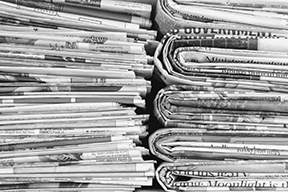
Cherokee County is no longer accepting newspapers for recycling at local convenience centers.
 |
In 2019, more than 66 percent of all newspapers were recycled, according to the American Forest & Paper Association, but that number has dropped all the way down to zero in Cherokee County.
During the Cherokee County Board of Commissioners’ meeting on April 5, the board voted to amend the recycling ordinance to no longer accept newspapers because it’s no longer a profitable enterprise. In 2015, the county made $1,640.36 from recycling newsprint – and that was when the Asheville, Atlanta and Chattanooga daily newspapers still circulated in the area – but that total was projected to drop to an estimated loss of $869 in the 2021 fiscal year.
Naturally, a part of me is disappointed in the decision. One of the things I love about newspapers is that each edition can be recycled into a future one, so for that to no longer be happening in the place I call home is a bummer, especially when our surrounding counties are continuing to collect newsprint.
It’s also a negative from an environmental standpoint, as those newspapers will now be taking up space at the county landfill. Showing they still have value after reading, newspapers were even used as a “fluff liner” to help protect a new cell at the landfill in 2020. And if all newspapers in the country were recycled, about 250 million trees would be saved each year, according to the forest and paper association.
At the same time, I can understand the decision. The county makes more money recycling corrugated cardboard if they don’t include newsprint with it. Newspapers also take up a tremendous amount of space before they can be trucked out, as County Manager Randy Wiggins pointed out at the meeting, and when it gets wet it can cause unfortunate problems, like making Dumpsters rust.
What has me baffled is in the newspaper industry today, newsprint is in short supply – so short that prices have already risen about 10 percent and are expected to reach 15 percent this year. If supply is so short prices are skyrocketing, it stands to reason that suppliers would be offering more money for newsprint – so why aren’t they?
Sadly, I can’t find an answer that makes much sense.
Other factors also have made an impact. Starting in 2018, China no longer accepted newsprint for recycling, which affected a large chunk of the U.S. market. And places like Philadelphia are burning their residents’ recycling material in an incinerator that converts waste to energy.
“Recycling has been dysfunctional for a long time,” Mitch Hedlund – executive director of Recycle Across America, a nonprofit organization that pushes for more standardized labels on recycling bins to help people better sort material – told The New York Times. “But not many people really noticed when China was our dumping ground.”
I only have one minor complaint in the material handed out at the county’s meeting. The country’s actual numbers and trend lines show that community newspapers, not big-city dailies, are the ones most likely to survive – and even thrive – for many years into the future.
A bigger concern is the future of recycling itself. Here’s one example: In 1992, the City of Florence, Ala., had weekly curbside pickup of all glass, paper, plastics and even motor oil. Today, like many other municipalities, they are down to recycling only a few, very specific items.
If you’re not recycling yet, you can be part of the solution by separating what the county does still collect so it will continue to be profitable to do so. We waste so much every day in this country already, and I can’t stand the thought of throwing away anything else that’s reusable.
David Brown is publisher & editor of the Cherokee Scout. You can reach him by phone, 837-5122; or email, dbrown@cherokeescout.com.