
 |
As a youngster raised in Cherokee County, one quickly learns there are vast stretches of mountain here native to bear, whitetail deer and, since the 1920s, Russian boar, aided by much of our state’s border with Tennessee being the Tellico Reserve of the Cherokee National Forest.
Many still spend much of the summer and early fall preparing for those eagerly awaited days in mid-October, when hunting season opens. Hunting bear and boar necessitates becoming a member of a hunting clan, admission coming through fathers, grandfathers, uncles, cousins or friends.
My group’s patriarch in my peak hunting days was the legendary bear hunter Willard Morrow of Violet. He was an expert woodsman, dog handler and teacher.
Bear hunters are typically assigned a stand close to known game trails. Hunters have stood in these same spots, and game has traveled these same trails for generations. Such hard-learned information of those locations is passed down like family heirlooms.
Dogs are deployed to trail and flush the bear and boar from the laurel thickets and dens, hopefully along a game trail where a hunter might be standing. For bear and boar hunting, dogs are as essential as a rifle or hunting boots.
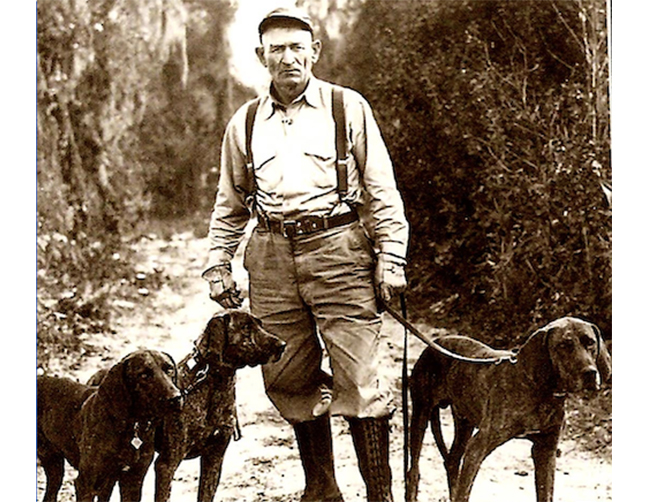
While there is a constant mixing and crossing of dog breeds to refine a “better” bear dog, there is one breed of dog that is hands down the accepted tops – the Plott hound.
On a bear hunt with Foggy Mountain Guide Service in Maine, owner Wayne Bosowicz, considered one of the deans of Maine bear guides, and I were discussing bear dogs. He invited me to join him as he fed his pack their evening meal. They were all Plott hounds, which he praised as the ultimate bear dog.
“I get them from North Carolina,” he told me. “From Rex Sudderth.”
Bosowicz was shocked when I told him the source for his bear dogs had also been my high school principal at Hiwassee Dam.
The Plott hound legend began around 1750, when 16-year-old George Plott left Germany for America, bringing with him five hunting dogs that were descendants of Hanoverian Schweisshunds, tracking dogs with excellent noses, medium-size, often with brindle colors, bred to hunt wild boar.
George landed in New Bern, N.C., and by the 1800s his son Henry moved to Haywood County, where he and his descendants continued to breed hounds, mixing in bloodlines, refining the breed for hunting mountain lion and bear, seeking keen noses, fearlessness combined with the intelligence in order to survive a fighting bayed bear.
One source describes the Plott hounds as a dog bred “to follow cold trails at speed over rough terrain in all weather, and grapple with large animals once cornered … agile, yet powerful with great endurance. The Plott is bold and confident, not backing down from a challenge.”
Word began to spread.
In Our Southern Highlanders, Horace Kephart wrote, “Have these dogs got the Plott strain? I’ve been told that the Plott hounds are the best bear dogs in the country.”
In 1935, Branch Rickey, the baseball legend who brought Jackie Robinson into the Major Leagues, contracted with Von Plott to guide him on a bear hunt, where in three days the group of hunters using Plott hounds, struck 20 bear trails and took a record-setting six bear in one day. Demand followed, as did the fame of the Plott breed.
There are only four breeds of dog considered native to the United States. Of those four, there is only one – the Plott hound – that was developed in North Carolina.
The Plott hound was first registered with the United Kennel Club in 1946. Due to the breed’s popularity among coonhunters the Plott is one of six UKC coonhound breeds, and the only one that does not trace its ancestry to the English foxhound.
North Carolina named the Plott hound as the official state dog in 1989.
It was not until 2006 that the breed was recognized by the American Kennel Club. Plott hounds were shown at the Westminster Dog Show for the first time in 2008.
While some Plott hounds will walk the dog show ring, far more will be found baying through the hollows and thickets with the scent of a bear in their nostrils. If you would like to see an example of this legendary breed, ask any local bear hunter. Odds are they will own one.
Bruce Voyles’ local history column runs every other week in the Cherokee Scout. Email him at RoadsLessTraveled@cherokeescout.com.