
When talking about World War II, a number often mentioned is the projection of 500,000 causalities should the U.S. have invaded the Japanese home islands. However, there is no documentation that those figures ever existed. There is similar lack of attribution when looking at the Cherokee Removal and Trail of Tears.
I conducted an informal poll asking the question, “How many people do you think died on the Trail of Tears?” Answers ranged from 5,000-20,000. There were less than 18,000 Cherokee at the time.
The commonly stated 4,000 deaths out of 16,000 is unconfirmable.
The Trail of Tears moniker was not coined by a Cherokee, but is attributed to a Choctaw in a conversation with a Baptist preacher about an Indian Territory Road. According to Gaston Litton, an archivist at the University of Oklahoma,
the first known time the phrase “Trail of Tears” was used in print was in 1908 and not exclusive to the Cherokee, as almost all members of what was called the five “civilized tribes” were removed to Oklahoma via similar trails.
The removal of the Cherokee began only after being given two years in which to get their affairs in order. Thousands had seen the writing on the wall and made their way to Oklahoma under their own power – including most members of the Treaty Party, 500 of whom left in January of 1837. A second party left in October 1837 numbering 365, reporting 18 deaths along the way. By January 1838, records say 2,103 Cherokee had left for Oklahoma.
John Ross refused to sign the treaty, instead touring among his people implying if they followed his lead they would not have to leave. This went so far as to some Cherokee refusing the food and supplies furnished by the Army, as acceptance might imply their agreement with the protested treaty.
In June 1838, the United States deported parties of 800, 875 and 1,070 to the west at government expense. Then John Ross and the National Council proposed a solution to Gen. Winfield Scott. “No departures until Sept. 1, and pay us to move my people.”
The deal struck was a good one for Ross and his brother, who bid $65 per person to handle the transport. At that same time, Sam Houston in the Republic of Texas and his adopted father, Cherokee Chief John Jolly, bid $9 per head for the transport. Ross’ bid was accepted instead.
In the 1840s, when the Church of Latter-day Saints was transporting Europeans to Utah, they estimated the total cost, including crossing the Atlantic, to be $45.
The forced removal was instituted on Cherokee who had refused all pleadings and threats – and troops showed up beginning in 1838, forcing them to abandon their homes.
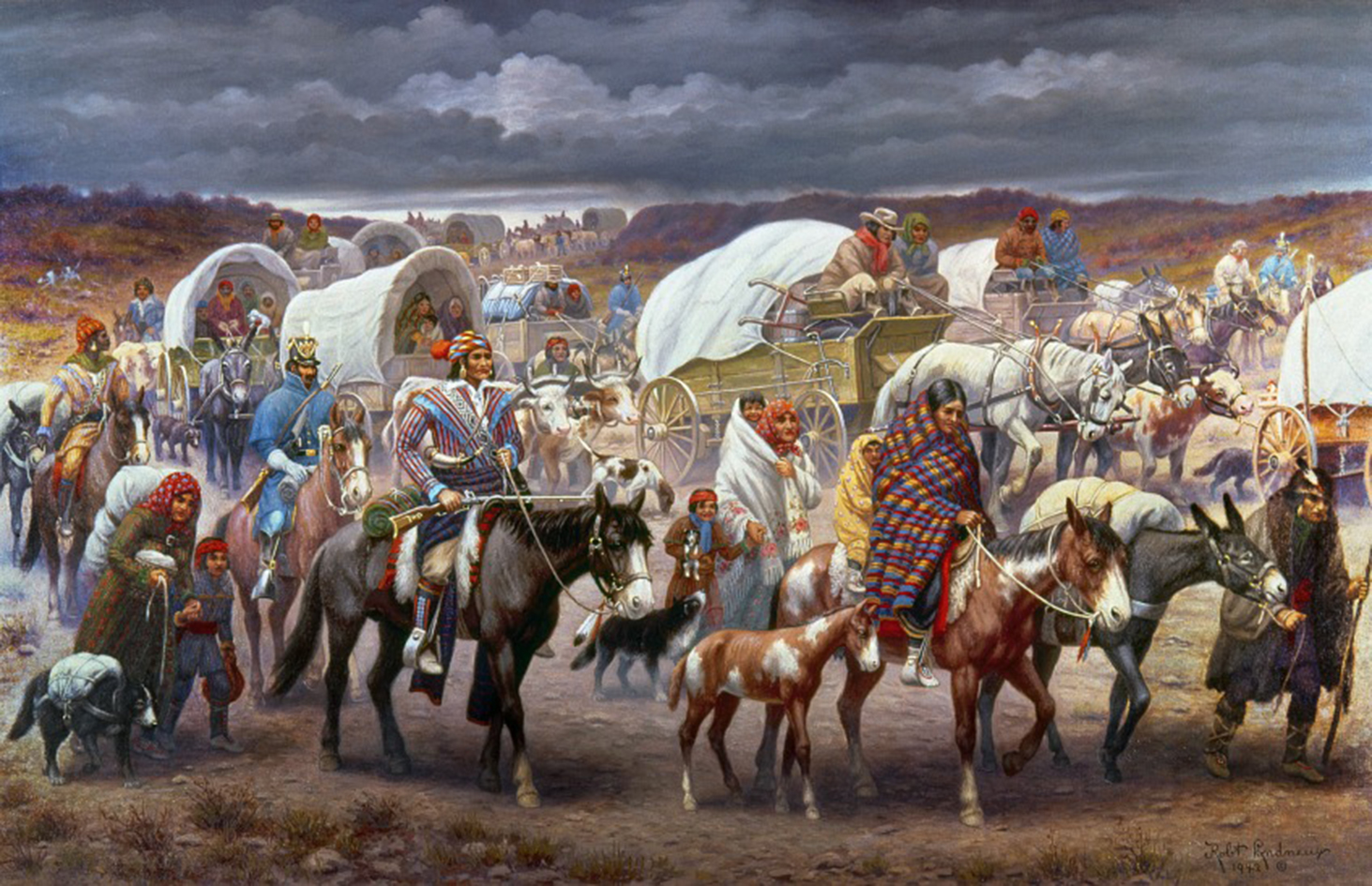
An accepted common image of the Trail of Tears is Native Americans prodded along by soldiers at the point of a bayonet. The reality for 13,000 Cherokee is they were divided into detachments of roughly 1,000 each, each conducted by two Cherokee leaders. John and Lewis Ross were the contractors.
Their lack of experience in such a transport and overestimating the speed of the detachments (they figured 10 miles per day) caused much of the resulting misery along the way.
That brings us to perhaps the most questionable figure of all, the deaths on the Trail of Tears.
The only known primary source that comes close to naming the 4,000 death figure was from Elizur Butler, a doctor and medical missionary who worked for the American Board of Commissioners for Foreign Missions, a Protestant group based at Harvard. A letter he wrote to the board stated he estimated 4,000 deaths were “not extravagant,” even though at the time of the letter there were detachments not yet to Oklahoma and Butler himself said the figure was based on hearsay and guesswork.
When an ABCFM history was published in 1840, the Butler figure was quoted, so for most historians there is no need to go further. Ignored are Cherokee files on deposit in the Gilcrease Institute in Tulsa, Okla., that reports 12,623 departing in the East and 12,783 arriving. American military numbers reported at the time are similar.
The head of the Bureau of Indian Affairs, T. Hartley Crawford, reported in a letter to the Secretary of War in 1840 that the death toll among the 13 detachments was 447. Among the 13 detachments, deaths were reported from 6-9 percent; Oregon Trail deaths were estimated at 10 percent.
The 1835 Census of the Eastern Cherokee was roughly 18,000. Subtracting 13,000 transported by John Ross & Co., 2,130 who transported themselves, and 2,745 transported at government expense, we end up with less than 200 unaccounted for, not taking into consideration adding for births in the nation from 1835-38.
The Cherokee Removal was apparently not genocide, as is bantered about today. The provable numbers do not support the premise.
The forced removal was absolutely a travesty, but was more of a land grab, much as we see land taken for the public good under “imminent domain.” When you hear those two words, the landowner is usually in trouble.
Following the money, the Cherokee were paid roughly 50 cents an acre, while only months later the U.S. government sold that same land to whites for up to $5 an acre. Add the value of the natural resources like gold, copper, marble and talc found in Cherokee County alone, and the motivation for Removal is obvious.
The Cherokee have but one consolation for their mistreatment by the white man – they are slowly getting repaid every time a bet is placed by the white man at a Cherokee casino.
The unprovable number of 4,000 deaths on the Trail of Tears is printed in too many places to be corrected, even though the numbers are there for anyone wishing to do their own research.
Bruce Voyles’ local history column runs every other week in the Cherokee Scout. Email him at RoadsLessTraveled@cherokeescout.com.