
 |
Traditions are often habits and perspective taken from our Scots-Irish and German ancestors, refined by this land we have occupied for generations. Such traditions abound in our mountain home.
Consider the pioneers here. Some were Cherokee and successfully avoided removal, others were white traders, prospectors, farmers and those searching for new lands. Almost to a man, they came here to be independent of politicians’ whims yielding to shouting voices, hoping to be left alone to live as they wanted.
They believed in the right to determine their own futures without being told by someone else what they should – or should not be doing – and what was – or was not – appropriate. That spirit is alive and well here.
That also explains resistance to anyone whose actions threaten those traditions. Newcomers to these mountains, of which there is an influx in recent years, have not benefited from exposure to these generations’ old traditions.
Thus misunderstandings and conflict sometimes arises between newcomers and natives. Don’t worry, I’m here to help.
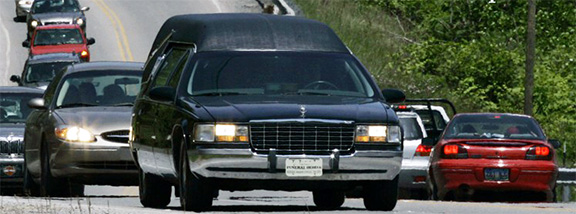
For instance, it is a tradition to pull to the side of the road and stop when meeting a funeral procession. It is considered respectful, even if you do not know the deceased. Stopping is a statement of respect to the community. Conversely, continuing to drive by a funeral procession is considered rude.
North Carolina law
says that the left lane on a four-lane highway is for passing.
Tradition is faster autos are in the left lane. Driving dead on the speed limit or, heaven forbid, slower, is not only illegal but an inconvenience for everyone involved. Again, respect.
Those raised here learned how to handle curvy mountain roads since they were age 16. If the speed limit is 55 mph, we tend to drive close to that, even on curves.
That does not mean slow down to 25 mph or put on your brakes in a curve going uphill. If you are driving slowly and accumulate a chain of 10 or so autos behind you, they are not following you in admiration of your ability to slowly go around a curve. At a wide spot in the road, let those faster drivers by. Again, out of courtesy and respect.
Cherokee County has been designated by the county government as a gun sanctuary county. Many of those raised here can recall a time when almost every pickup had a gun rack (with firearm) in the back glass – in high school parking lots.
Despite the proliferation of firearms, we have had few problems compared to urban centers, in part because there was a tradition here of hunting, and firearms education that started with “treat every gun like it is loaded” from six on. That is not to say if you do not want to own a firearm that you should – but it is not considered any of your business if we follow the years-old tradition here and choose to legally own numerous firearms.
There are thousands of acres of national forest here, open to hunting and legal for carrying firearms. For hunters of bear and boar, dogs are used to chase and bay the game.
These dogs have collars with the owner’s name on them, often radio collars, and the dogs tend to chase the game wherever it leads them. Occasionally, that means the dog is seen near a road. That does not mean a newcomer should stop, pick up the dog, and take it to the animal shelter. The tradition is if the dog has a collar, it is not lost and will make its way home, especially during dog training and hunting seasons.
Another tradition is waving to strangers. It is called being friendly and can be as simple as gripping the top of the steering wheel and raising an index finger to approaching cars.
If you have not tried it, you should. It will likely bring a smile to your face.
There is more acceptance if one respects those age-old traditions and does not try to change them. For instance, one sure sign of a newcomer who bucks local tradition is the first week after you purchase your property, here comes the “no trespassing” signs. You might ask yourself why the previous owners did not feel the need for such signs.
When Florida-born Olympic Park bomber Eric Rudolph went to ground here, an NBC camera crew was asked, “You have been here a while. You have met people from here who have college educations and all their teeth – why do you not put some of them on camera?”
The response: “That is not what our editors in New York want to see.”
That example is why newcomers often find locals are traditionally suspicious of how they are perceived. Remember, here newcomers are the ones with accents. What is spoken here is the last vestiges of the mother tongue, Elizabethan English, often found in Shakespeare, preserved for generations in these isolated mountain hollows before the satellite dishes piped the outside world in so our younger generations could learn to add “like” to every third word in a sentence.
There is a pervading tradition among locals of pride from whence we came. Some can trace our family’s roots here to prior to the Cherokee Removal.
I have three direct ancestors who were here. The
family has survived, prospered and struggled, moved off and returned, but resided here for over eight generations. When newcomers arrive and start demanding change, challenging traditions to make here more like where they left, do not be surprised if we locals resist and being told what we should be doing to suit a newcomer’s way of thinking – escaping that attitude is why our ancestors came here in the first place.
One bumper sticker popular here a few years ago read, “We don’t care how you did it where you came from.” Think about it.
Respecting traditions is just that – respect, perhaps the most important tradition for us all.
Bruce Voyles’ local history column runs every other week in the Cherokee Scout. Email him at RoadsLessTraveled@cherokeescout.com.