
 |
In a time of poor roads and isolated farmsteads, with horse and wagons the primary means of travel, our mountain-based forefathers learned early on to manage for themselves. Throw in the independent spirit that brought them to these mountains in the beginning, add a short temper, stir in a perceived insult and the result can be a tragedy that remains a blight on our heritage. Or, as others might call it, a dose of mountain justice.
The story begins innocently enough. In 1898, George Maney was a young man living near Robbinsville, married to a pastor’s daughter with a son and twin daughters. He was listed on the rolls of the Eastern Band of Cherokee Indians and was stricken with what was called “galloping consumption,” a form of TB in which he was coughing up blood and considered highly contagious. There was no known cure. Maney was in denial and refused to seek medical treatment or isolation.
The Sherrill family, Thad and his two sisters, lived on Mountain Creek in Graham County, roughly 3 miles outside Robbinsville. None were married, and they became friends with the Maney family. Thad Sherrill, a 52-year-old well-liked cattleman, advised Maney’s wife to take the children and move back in with her parents before the obstinate Maney infected his children with his affliction. She did so.
Maney was incensed, declaring Sherrill was having an affair with Maney’s wife. In his anger and quest for revenge, Maney laid an ambush for Sherrill.
Sherrill left home on June 18, 1898, to salt his cattle and did not return that night. His sisters raised the alarm, and soon 200 men were searching, finding his body late the next day. His corpse was hidden in the laurel 12 feet off the road. He had been shot through the body, and his head decapitated from his body by large rocks. Only parts of his skull were found, and some of the flesh eaten by hogs. He was 3/8 of a mile from Maney’s house.
When questioned about the last time Maney had seen Sherrill alive, he gave conflicting statements. Maney and his brother were arrested and charged with Sherrill’s murder.
The local populace was infuriated. One account in the Asheville Times the day after Maney’s arrest stated, “The people were strongly talking of lynching at the last account. It would not surprise anyone here to hear that a lynching has occurred.”
In jail and aware an angry mob was gathering, Maney confessed to shooting Sherrill with a Winchester rifle from ambush, then dragging the wounded Sherrill into the laurel, where he shot him in the head with a pistol. He refused to say what he had done with Sherrill’s head.
The mob grew rowdier, with Sheriff Jim Ammons and his deputies eventually fending off infuriated citizens at gunpoint to prevent lynching – and under the cover of darkness they moved Maney to a safer location – the jail in the next county west, Murphy.
Maney and other prisoners later escaped the Murphy jail and fled into the vastness of the mountains. Ben Sherrill, Thad’s brother, left Georgetown, Texas, to return to the area and lead a search of his own for his brother’s escaped murderer.
In the 1950s, Pea Patch Jim Phillips declared that he had helped hide Maney during his time at large. (An aside – there were three Jim Phillips in the area at the time, and to tell them apart all three were given nicknames. In addition to Pea Patch there was Dancin’ Jim Phillips and Fiddlin’ Jim Phillips.)
Maney’s life at large did not last. He came out of hiding on Jan. 15, 1899, suffering a frostbitten foot and health issues from his still untreated galloping consumption. He turned himself in to attorney Ben Posey, who turned him over to Murphy authorities.
When word reached Robbinsville, a group of men – including Ben Sherrill – set out for Murphy. The group picked up more men through each community they passed in route. By the time they reached Murphy, the party was estimated to number 50 men.
Around 9 p.m., someone beat on the door of the Murphy jail, declaring they had a horse thief who needed to be locked up. When Deputy Sheriff Axley opened the door, he was rushed and the mob drug Maney from the jail, looping a noose around his arms as they dragged him to the Upper Valley River Bridge.
The Upper Valley River Bridge does not exist today but was located near the still standing railroad trestle on the Murphy River Walk.
Maney was given time to pray, which he knelt to do. Upon standing, he declared that his brother William, also still in custody, had nothing to do with the murder. The mob had a thin rope, which they doubled around Maney’s neck and dropped him over the side of the bridge, quickly departing for a return to Robbinsville. No one involved in the lynching was ever positively identified.
Two hours later, the town marshal and Murphy’s mayor ventured to the bridge to recover Maney’s body, which was hanging only inches above the river’s surface. On examination of his body, they discovered his neck was not broken in the fall, and he had died from strangulation.
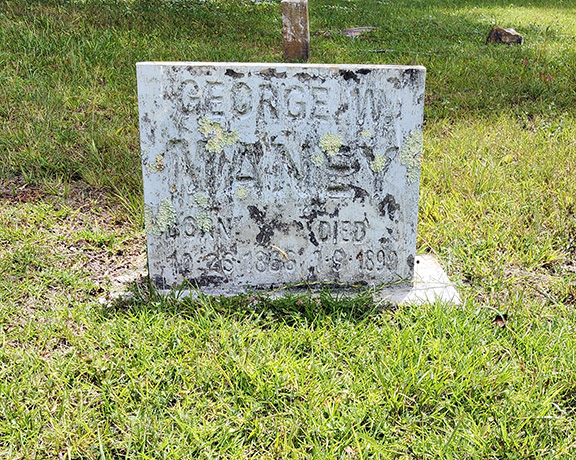
Maney was buried in Harshaw Chapel Cemetery, his grave marked with a concrete tombstone. He was 32.
In 1961, a marble tombstone was erected over Sherrill’s grave in the Mother Church cemetery in Robbinsville. Funds were raised by local politicians and historians – including Bob Barker, who wanted to honor local historical figures.
It reads, “Thad Sherrill, son of Jason-Clarissa 1846-1898 Bushwacked on Mt. Creek by George Maney. Maney lynched by mob in Murphy 1899 Hanging Him to Upper Valley River Bridge.”
Maney’s demise is the only lynching known to have ever occurred in Cherokee County. No charges were ever brought against anyone in connection with the lynching.
Note: Thanks to Cherokee Scout Editor Randy Foster for much original research.
Bruce Voyles’ local history column runs every other week in the Cherokee Scout. Email him at RoadsLessTraveled@cherokeescout.com.