
 |
Each candidate for elective office that the Cherokee Scout has interviewed this campaign season has shared something thought-provoking that caused me to fire up the online encyclopedia and learn more. One of the more intriguing is the debate of equality vs. equity.
According to a 2020 study by George Washington University, equality means each individual or group of people is given the same resources or opportunities. Equity recognizes that each person has different circumstances, allocating the exact resources and opportunities needed to reach an equal outcome.
For example, think about that in terms of income taxes. Equality means everyone would pay, say, a total of $100, regardless of their annual gross or net income. Equity, meanwhile, has everyone pay 10 percent. That means some people fork over more dollars than others, but all pay an equal percentage according to their abilities.
The YouTube video “Social Inequalities Explained in a $100 race” does a good job of pointing out how the system really works today. The speaker had everyone at the startling line take two steps forward if they:
- Have parents who are still married.
- Grew up with a father figure in the home.
- Had access to a free school tutor growing up.
- Never had to worry about their cell phone being shut off.
- Never had to help mom and dad pay the bills.
- Were a not an athlete but didn’t have to worry about paying for college.
- Never had to worry about where your next meal will come from
Note that those statements have nothing to do with anything they deserve or have earned. It’s not about the decisions they’ve made nor things they’ve done. Yet, they still have a huge head start to get the $100.
Does that mean the folks in the back row can’t win the race? Of course not. However, as the narrator says, it would be foolish for us to not recognize that some people have a better opportunity to win than others.
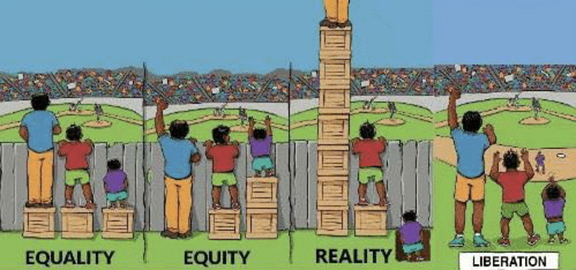
The artwork with this column graphically illustrates the differences.
Three boys of different heights are watching a game over a tall fence. In a world of equality, all three receive boxes that are the same exact size to help look over the fence. Unfortunately, that doesn’t solve the problem for the shortest boy.
In a world of equity, the tallest boy wouldn’t receive a box since he didn’t need one to see over the fence. The middle-size boy would receive one of the three boxes, then the smallest one would receive two. In this world, all three can watch the game together.
Is that an ideal situation? Of course not! In a perfect world, true justice and liberation would remove the fence surrounding the game, thereby allowing everyone of all heights to watch without a problem. Alas, this isn’t a perfect world, which is why in reality the tallest (prettiest, richest, smartest, etc.) receive several boxes – like the ones who got a head start in the race – while the one in in the middle gets a little something and the smallest boy finds himself further down the hole.
Those of us already at the game need to reach out and share how to succeed with those who don’t. The end goal shouldn’t be to simply level the playing field, but to make the field avai able to everyone who is willing to work at it. As the United Way put it, there is not a one-size-fits-all solution (equality) to the problems we see in the world, but there’s a right-size solution for each individual’s needs (equity).
David Brown is publisher of the Cherokee Scout. You can reach him by phone, 837-5122; email, dbrown@cherokeescout.com; or on Twitter @daviddBstroh.