
 |
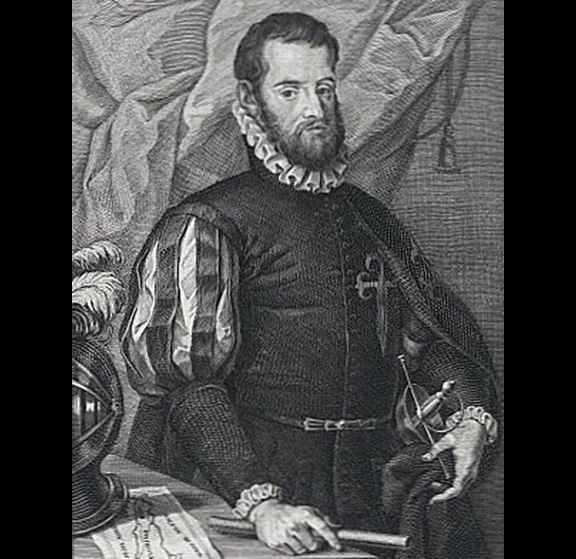
Hernando de Soto gets credit for being the first European set foot in what we now call home. It was 1540. He was searching for gold and extending the Spanish empire, seeking to duplicate the Spanish conquest of the Aztecs and Incas and the riches found there. He didn’t find gold, passed through, got as far as the Mississippi before he died, leaving his men to finish the mission.
But the Spanish were not the only people looking toward the New World. French Huguenots led by Jean Ribaut fleeing religious persecution in France established a colony, Charlesfort, on what is now Parris Island, S.C., in 1562, hoping to make it a refuge for other Huguenots. Ribaut left to return to France for more supplies, was delayed in England, and within 11 months the inhabitants gave up, built a makeshift ship and sailed back to France.
The French tried again, at Fort Caroline, near the St. Johns River, on land claimed by King Phillip of Spain, who was further incensed that the settlers were not Catholic but Protestant Huguenots. Jean Ribaut again went for more supplies and returned in 1565 with 600 more settlers and soldiers for Fort Caroline.
The same time Ribaut was leaving France, Spanish Admiral Pedro Menedez de Aviles was sent from Spain to eject the French. He landed with 800 men shortly after Ribaut. Aviles established a base in Florida for the battles to come and named the base St. Augustine, in honor of founding the town on the saint’s feast day.
Ribaut tried to strike first and wipe out St. Augustine, but a storm shipwrecked his expedition on the Florida coast south of St. Augustine. Meanwhile Aviles attacked the undermanned Fort Caroline, spared the women and children but killed every man, and intercepted and killed all the shipwrecked French trying to get back to Fort Caroline. The French never returned.
For good measure the earlier French settlement at Charlesfort was razed, and the Spanish occupied the island, building Fort San Felipe, establishing it as Spanish capital named Santa Elena in 1566.
That same year Captain Juan Pardo arrived with 250 men to reinforce the garrison of the new fort. A mutiny had reduced the fort’s garrison and they were running short on supplies. Admiral Aviles (who was also now governor of the area) visited and ordered Pardo remedy the situation.
Thus Juan Pardo set forth from Santa Elena with 125 men to find Indian towns that could supply food to the Spanish outpost and establish bases among the tribes he might encounter. Aviles ordered Pardo to make friends with the Indians and to make efforts to Christianize them.
His expedition brought him deep into western North Carolina. He established Fort San Juan at Joara (near Morganton, N.C., today), leaving 30 men under the command of Sergeant Hernando Moyana de Morales at the fort, naming the area Cuenca, after his Spanish hometown.
Pardo then followed the Catawba River and passed near Salisbury, while Moyana and his men searched for gold in upper East Tennessee. In an alliance with a local chief he claimed to have attacked Chiscas Indian towns, burned 50 houses and killing 1,000 at one location and 1,500 at another. Quite a feat for a man with 30 men and requiring some of them to guard the fort in his absence. During his descriptions of one Indian attack, he mentioned a brine springs, what is thought today to be proof they were near Saltville, Va. The Indian towns attacked were thought to be on the Nolichucky and Watauga Rivers. This was all Cherokee territory – and likely Cherokee ancestors.
The Chiscas and Spanish continue fighting each other for over 100 years thereafter.
When Moyano arrived at the town of Chiaha (Zimmerman’s Island on the French Broad, near Dandridge, Tenn.) he built a small fort there.
Pardo’s exploration continued from December 1566 to March 1567. Aviles began to fear a vengeful French attack and ordered Pardo to end the exploration and return to Santa Elena. Pardo left Moyano at his small fort.
Encouraged by Pardo’s glowing reports upon his return to Santa Elena, Aviles ordered a second mission six months later. The goal of Pardo’s second expedition into the Appalachians was finding a land route to the Mexican silver mines in Zacatecas, Mexico. The Spanish mistakenly believed the Smoky Mountains were part of a chain of mountains that extended into Mexico. Without the ability to determine latitude, the distance was grossly miscalculated.
Pardo established five more forts, including one near what is Camden, S.C., today, and utilized housing and stored corn furnished by Native Americans per his instructions from his first expedition.
At Fort San Juan Pardo learned Moyano had been confined to his fort in Chiaha and he went to rescue Moyano, passing though a fortified town known as Tanasqui. The soldiers were impressed with the surrounding land, declaring it a “land of the angels.” The name of that town would later be more familiarly pronounced as Tennessee.
With Moyano reinforced, the expedition continued toward Coosa, saw the Great Smokies, and at a town at the junction of Citico Creek and the Little Tennessee (between Tellico Plains and Vonore, Tenn.) Pardo learned the chief of the Coosa planned an ambush of the Spaniards.
Pardo avoided the ambush, returning to Moyano’s fort before continuing to Santa Elena.
Pardo served as lieutenant governor of Santa Elena until April of 1569, and that same year tribes attacked and burned all six forts, killing 119 of the 120 men manning the forts. One escaped to bring news of their fate.
This was enough for Pardo, he returned to Spain in 1569 and vanished into history. The second European and last Spanish expedition into western North Carolina.
A stone supposedly inscribed by Pardo bears a pictograph of the sun and date 1567. It was discovered near Inman, S.C., in 1934 and is housed in the Spartanburg County Public Library.
The fort site at Morganton is being excavated through the Joara Foundation partnering with Warren Wilson College.
Bruce Voyles’ local history column runs every other week in the Cherokee Scout. Email him at RoadsLessTraveled@cherokeescout.com.