
 |
My first political experience came in 1976, when my mother and stepfather decided to support Jimmy Carter, a relatively unknown governor from Plains, Ga., who was running for president that year. Since my stepfather’s guitar case had an “IMPEACH NIXON” sticker plastered on it, it’s not hard to see why.
Later, I learned that my folks’ support of Carter had a lot to do with his promise to legalize marijuana. (That didn’t happen, which may explain why they didn’t volunteer for him again when he ran for re-election in 1980.) But as a 10-year-old boy who only knew the word “bill” as a man’s name, this was all fun and games.
Over a few weekends, we would go door to door into specific neighborhoods, simply saying “hi” and handing out a “Vote for Carter” pamphlet. While my 5-year-old sister was always accompanied by Mom, she allowed me to go from house to house by myself – something I would not let my grandchildren do in today’s world.
Here’s the thing I remember most about that experience some 47 years ago: Everyone was really nice. No one wondered aloud whether I was a 10-year-old commie studying critical race theory in a socialist school. They simply said thanks, accepted the material I gave them and occasionally even encouraged me to stay involved in politics before closing the door and continuing their day.
That remains the only time in my life I have ever handed out political literature. Even though Carter’s term as president didn’t turn out the way he hoped it would – with high inflation, high unemployment and U.S. hostages held by terrorists in Iran – he was responsible for the Camp David Accords that brought peace between Egypt and Israel.
Still, I couldn’t help but admire the man Carter was after he left the Oval Office. Most former presidents join a few corporate boards, where they meet once a year or so and rake in $50,000 for the privilege. Others write books, go on speaking tours, take up painting or genuinely retire from public life. But what Jimmy Carter did is become the best ex-president in my lifetime.
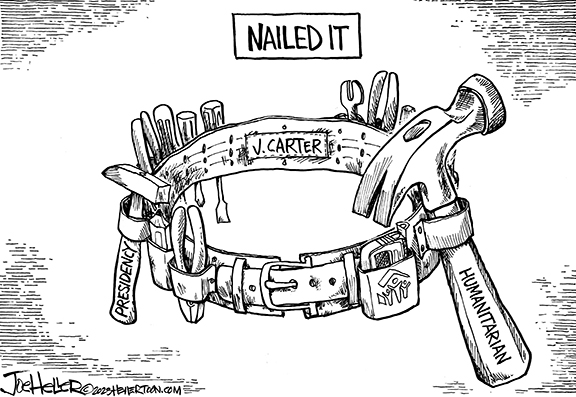
Through the Carter Center in Atlanta, Jimmy and his wife, Rosalynn, became heavily involved with Habitat for Humanity; photos of Carter swinging a hammer are legion – and all true, as he was a superb carpenter. He also served as a diplomat of sorts during international elections, working to install or preserve democracy around the world, which ultimately led to him earning the Nobel Prize for Peace in 2002.
Even when it wasn’t in his best interests, Carter would not lie, to the point of being brutally honest in an infamous magazine interview. Contrast that with politicians today who can’t make a single speech without setting off every lie detector within 100 yards.
And Carter lived his faith, continuing to teach Sunday school classes into his 80s, even though the Secret Service had to check everyone before they entered. He was the same humble person when he was the leader of the free world as he was while attending Maranatha Baptist Church in Plains, Ga.
Carter, who at 98 has lived longer than any other commander in chief, is receiving hospice care today at his modest home in Plains, with 95-year-old Rosalynn faithfully by his side. He decided against further medical treatment so he could spend the time he has left with his loved ones and away from hospitals.
Regardless of how much time Carter has left on this side of heaven, his life was well lived. His kind of politician, and person, may never be seen again.
David Brown is publisher of the Cherokee Scout. You can reach him by phone, 837-5122; email, dbrown@cherokeescout.com; or on Twitter @daviddBstroh.