
 |
Wally Avett recently shared papers from local historian Robert Barker that included a list of Cherokee County Union veterans. The nine pages reveal two primary groups of Cherokee Countians who took a Northern stand.
A large number of locals were against secession. One was the Second Tennessee Cavalry, and the other was better known as Bryson’s Boys.
Bryson’s Boys were a Union raider group, homegrown Yankees as they were called. They were also known as the First North Carolina National Guard and Scouts. They were led by Goldman Bryson. Their primary purpose for raiding was to fight Confederate conscription, and Bryson soon found himself with a growing command, up to 200 men at its peak, although less than 50 was the norm.
Word began to spread of their deeds, causing Gen. Braxton Bragg to label Bryson’s command “mounted robbers.” They raided Murphy, burning the jail, stealing arms and ammo designated for local militia.
Seeking a more official designation (and likely with it better uniforms, supplies and weapons) the group journeyed to Knoxville, Tenn., recently occupied by Union Gen. Ambrose Burnside, where the group was reorganized as the Third Tennessee Mounted Infantry.
Bryson was 46 years old, a veteran of the Cherokee Removal and by some reports also serving in the war with Mexico. Having served under the American flag with two commands, it possibly explains his reluctance to break away.
These newly minted Union soldiers, many from Cherokee County, left Knoxville with orders from Burnside to scout and recruit more troops from among the numerous disgruntled Union sympathizers and Confederate deserters in the mountains.
Many in this group had been Confederates themselves in the early days of the war, lured in by the heat of the moment and with the encouragement of local politicians, despite the county leaning toward remaining in the Union. Quickly disillusioned by the Confederate conscription act and the Confederate government extending their enlistments beyond their agreed upon time of discharge, the results should have been obvious.
As independent mountain men they protested with their feet and returned home, taking refuge in the mountains until organized into a group by Bryson, under whose guidance they proceeded to raid and skirmish with Confederate Cherokee County men, many of them in the Thomas Legion and local Home Guard.
When the 3rd Tennessee made camp that night, unbeknownst to them, they had been seen. Confederate cavalry under Gen. John C. Vaughn was dispatched to chase them down. One hundred Confederate cavalry began pursuit.
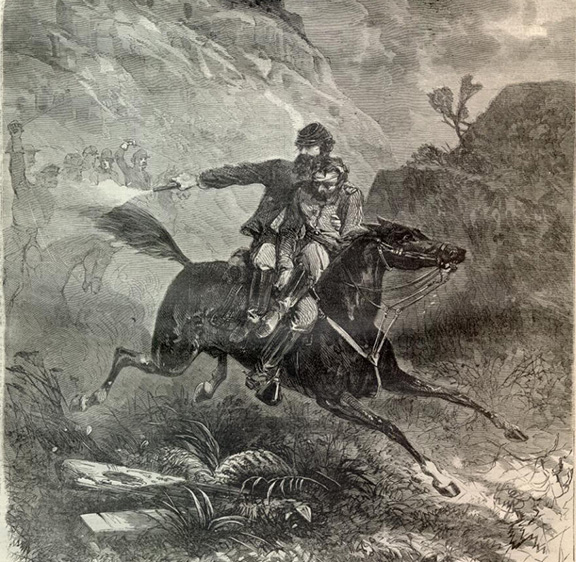
Bryson’s camp at Evan’s Mill (Gowen’s Cove today) was taken unaware, and in the surprise attack Vaughn’s troops killed several and captured 17. Bryson and John Ledford escaped, heading to Bryson’s farm on Coker Creek.
Vaughn took his 17 captives and turned toward the Confederate camps outside Knoxville, leaving pursuit of Bryson to men under the command of Lt. Campbell Taylor of the Thomas Legion. Taylor and his men went without food to take up the chase.
It was personal, as Bryson had allegedly killed a Cherokee named Timson before the war. As a local man and one-eighth Cherokee himself, Taylor knew the region and caught Bryson and Ledford at Bryson’s farm. Ledford surrendered, but Bryson tried to flee and was shot and killed.
Several local histories, proudly pro-Confederate, refer to Bryson’s command as a “band of robbers,” but what happened after the dispersal of Bryson’s command indicates a different story.
The day following Bryson’s death, John Ledford was brought to the town square in Murphy and publicly hanged without trial. Taylor’s men were proudly wearing Bryson’s blood-stained uniform.
Vaughn’s command did no better, by most accounts taking his 17 prisoners to the Tellico River and massacred them, although their graves have never been found. Vaughn’s brother-in-law, Thomas Boyd, serving in Vaughn’s command took the muster roll and written orders from Burnside found on Bryson, sending Burnside’s orders up the line where they would eventually make their way into a listing in the “Official Records of the War of the Rebellion.” Campbell was commended in the dispatches sent to the commanding officers as a reward for his efforts.
However, the muster roll did not get turned in. Instead, following the war, Boyd used that muster roll to defraud the U.S. government of what would be close to $1 million. Before the final resolution, he would murder a black man in his attempt to cover up the fraud. In the end, it was prison time for Boyd.
It makes one wonder who were the real “robbers” and bad men. Seventeen unarmed prisoners murdered, another hung without due process and a massive pension scheme of securing pensions under the names of the 17 men by one of the very men who killed them.
In 1865, Taylor and Baker Welch would be indicted for the murder of 16-year-old Columbus Moss of Marble, supposedly killing him for the brass-toed shoes Moss was carrying around his neck. Taylor and Baker fled to Oklahoma and were never captured.
Of Bryson’s band, 19 were killed in the Evan’s Mill attack and days that followed, but plenty remained to extract their own vengeance. Lt. Col. William C. Walker of the Thomas Legion would be killed while home on sick leave shortly thereafter.
After his death, Bryson’s command fell to the next highest ranking officer, Capt. Enoch Peter Voyles. His first lieutenant was Hugh Rogers. They fought until the end of the war and remained, farming in Cherokee County on Persimmon Creek and Grape Creek. They begat more than a few descendants, who remain today in the county where they fought.
Among them your author, great-great-grandson of Enoch Peter Voyles, and my wife, Debra Graves Voyles, great-great-granddaughter of Hugh Rogers.
Bruce Voyles’ local history column runs every other week in the Cherokee Scout. Email him at RoadsLessTraveled@cherokeescout.com.