
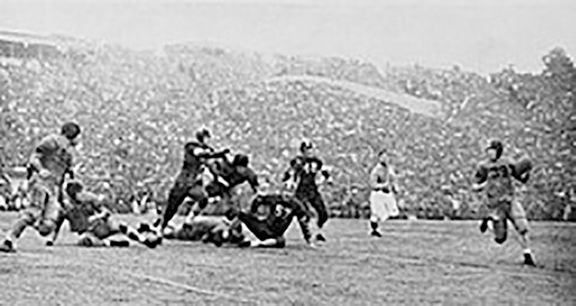
The historic Rose Bowl game has only been played outside of Pasadena, Calif., twice in its 111-game history.
The years 1942 and 2021 where the only times the prestigious college football bowl game has been played outside of Pasadena, both times due to unexpected major historic events in world history.
The 1942 Rose Bowl was held in Durham due to the attack on Pearl Harbor, while the 2021 Rose Bowl was played in Arlington, Texas, due to California’s COVID-19 restrictions on large gatherings. Durham got to host the game since Duke was taking on Oregon State that year.
Less than a month before the 1942 Rose Bowl was set to be played in Pasadena, Japan carried out an aerial attack on the Pearl Harbor naval base in Oahu, Hawaii on Dec. 7, 1942. This attack led the United States to enter World War II.
In the wake of the attack on Pearl Harbor, there were fears that another attack could happen on the West Coast of the United States. The federal government even went as far as to ban large gatherings during the war.
The first major event after the attack to be effected was the Rose Bowl, which is played on New Year’s Day each year.
On Dec. 15, 1941, the game and Rose Bowl Parade were canceled by the event committee. Since the West Coast was off limits as a potential alternate site, Oregon State could not host the game. Duke University and the City of Durham welcomed the game with open arms.
On Dec. 16, Duke invited Oregon State to play the game at Duke Stadium. The stadium only holds 35,000 people, compared to the 90,000 who were expected at the game in Pasadena. To add more seating, they brought in bleaches from University of North Carolina-Chapel Hill and N.C. State’s stadiums to help seat an additional 20,000.
In just three days, 56,000 tickets were purchased – a sold-out crowd.
Duke typically had an allocated number of tickets for their Black students, but initially didn’t allow them to attend the Rose Bowl. After the Carolina Times – Durham’s African-American newspaper – wrote an article claiming that Duke would sell tickets to Japanese-Americans and not African-Americans, Duke reversed course and 140 tickets were released to black fans.
In a similar situation was Oregon State player Chiaki “Jack” Yoshihara, who immigrated to the United States when he was 3, did not get to play in the game. Due to government restrictions, Japanese-Americans were not allowed more than 35 miles from their homes.
Due to this rule, Yoshihara had to stay in Oregon and could not go to the Rose Bowl. His fellow teammates, students, Oregon State’s president and campus ROTC commandant protested this, but it did not work.
To get to Duke Stadium, the Oregon State Beavers traveled by train, making two stops to practice along the way.
First they stopped in Chicago and practiced at the University of Chicago’s Stagg Field. The field hadn’t been used for football since the university dropped its football program after the 1939 season.
The second stop was in Washington to practice at Griffith Stadium, which was home to the then-Washington Redskins. Griffith Stadium was demolished in 1965, and the team changed their name to the Commanders in 2022 after dropping the Redskins name in 2020.
The Beavers arrived in Durham on Dec. 24, just days before they were going to hit the gridiron against the Blue Devils.
Leading up to the game, the Rose Bowl court and queen still had somewhat of a parade. On New Year’s Day, the court and queen drove down an empty Colorado Boulevard in Pasadena, as they would have in front of a million people in any other year.
Duke was the favorite heading into the game, but Oregon State was fired up as many doubters voiced their opinions.
The 1942 edition of The Chanticleer, Duke’s yearbook, talks about the weather leading up to the game.
“Jan. 1 in Durham began as a cloudy, threatening day. Three hours before the game time a heavy, driving rain which was to keep relentlessly throughout the afternoon came pouring down,” the yearbook reads. “Despite the gloomy picture, 56,000 fans crowded into specially enlarged Duke stadium for the contest.”
The Beavers got the scoring started with the lone score of the first quarter, as Donald Durden rushed into the end zone from 15 yards out. Duke tied the game with 3:32 left before halftime as Steve Lach scored a 4-yard rushing touchdown.
The first passing touchdown of the game gave the Beavers a 14-7 lead in the third quarter. Duke then tied the game less than five minutes later on a 1-yard run by Winston Siegfried.
With 25 seconds left in the third quarter, Oregon State quarterback Bob Durden passed to Gene Gray for a 68-yard touchdown. They missed the field goal and led 20-14 heading into the final quarter.
The only score of the fourth was a Duke safety. Oregon State went on to win the 1942 Rose Bowl 20-16.
“Although Duke’s second attempt to gain the coveted Rose Bowl crown narrowly failed in its effort, the glamor surrounding the 1942 spectacle made it a long to-be-remembered occasion,” Duke’s 1942 yearbook reads. “Those who witnessed it saw football at its best and saw an outstanding milestone in the sport history of organized college football.”
Duke’s Durden was named the game’s Most Valuable Player with 54 rushing yards and a touchdown.
That year was Oregon State’s only Rose Bowl win, and the only time the two teams played each other. If Duke had not played in the 1939 Rose Bowl, they would have been the only invitee to have never played the game in Pasadena.
The Associated Press’ Sid Federicos labeled the 1942 Rose Bowl as the biggest upset in the bowl game’s early history. Some claim that Columbia’s 1934 win of the bowl game was a bigger upset.
After the Battle of Midway, the Allied Forces won the battle and ended the Japanese offensives in the Pacific Theater in June 1942. After that, the West Coast was deemed no longer a threat of attack.
Duke’s Walter Griffith and Oregon State’s Everett Smith – both halfbacks who played in the Rose Bowl – died fighting in World War II in the Pacific Theater in 1942.
Duke’s Al Hoover and Bob Nanni also died in the Pacific Theater. Hoover died in the Battle of Peleliu in 1944 and Nanni was killed in the Battle of Iwo Jima in 1945.
A total of 29 of the 31 players on the Rose Bowl-winning Oregon State team ended up serving in World War II.
Yoshihara – who was not allowed to play in the game due to restrictions on Japanese-Americans going away from their homes – tried to enlist, but was repeatedly denied. He spent most of 1942 in an interment camp in Idaho.
The last surviving player who played in the game was Duke’s Jim Smith, who passed away in 2019 at age 98.
It has been played in Pasadena at the Rose Bowl Stadium every year – except in 2021, when it was played at AT&T Stadium in Arlington, Texas, due to California’s restrictions on large gatherings due to COVID-19.