
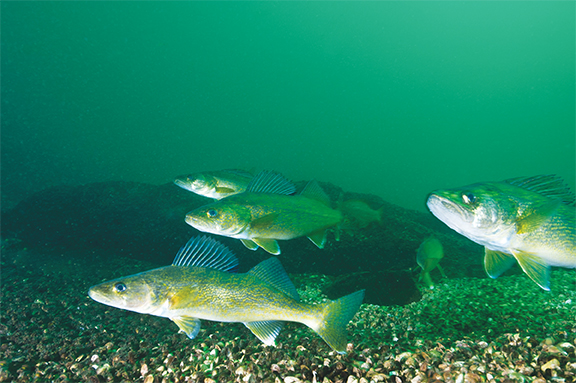
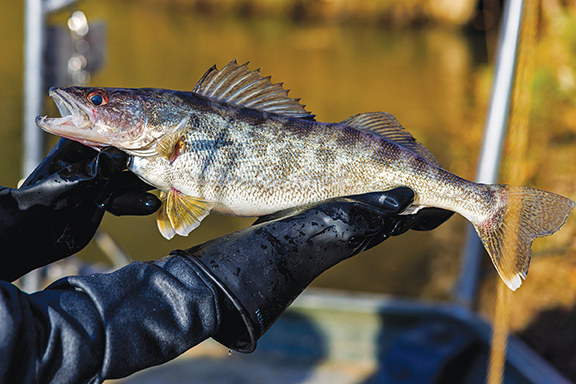
Anglers in western North Carolina talk about bass and trout, but walleye fishing is on an upswing, according to the N.C. Wildlife Resources Commission.
The NCWRC took a survey from Lake Hiwassee and Lake James and the results – along with angler reports – suggest walleye populations are on the rebound in the mountains. The state has been managing walleye for more than 70 years, working since 2000 to increase walleye numbers through a robust hatchery-reared stocking program.
“Without consistent stocking, many native, long-standing, and culturally important walleye fisheries would be greatly diminished,” said Scott Loftis, mountain region aquatic habitat restoration coordinator.
Walleye populations in mountain reservoirs, like Lake Hiwassee, were self-sustaining prior to 2000. There was no need to supplement the populations because they were self-sustaining. Walleye populations then began to decline mainly due to impacts from illegally introduced invasive species, such as white perch, alewife and blueback herring.
The state’s efforts
The NCWRC began supplementing the populations with hatchery-reared fish due to the decline in self-sustaining walleye populations.
So far this year, state staff have stocked more than half a million walleye fingerlings. Over the last six years, more than 3,207,000 walleye fingerlings were stocked. Walleye fingerlings are typically 1-2 inches in length.
Walleye stocking numbers have dramatically increased since 2019 due to the expanded productions efforts at Table Rock, Watha and Mckinney Lake state fish hatcheries that have been working to maximize available pond space.
“These production efforts are making a difference. For example, in the past six years, the average number of female and male walleyes collected during the spring brood fish surveys in the Catawba River above Lake James increased by 404% and 227%, respectively,” District 8 fisheries biologist David Goodfred said.
“The increase in brood fish numbers appears to correlate to the stocking rate increase of walleye fingerlings into Lake James since 2019.”
Stocking rates have also increase for Lake Fontana in Graham and Swain counties, Lake Hiwassee in Cherokee County and Lake Glenville in Jackson County.
Walleye can be harvested year-round with appropriate angling techniques and are good to eat. Anglers typically use spinning gear and ice jigs when fishing for walleye. Trolling can work, but takes specialized gear.
“Walleye strike jigs very lightly and it can take quite a bit of practice to notice the strikes. They can be caught in different habitats at different times of the year,” District 9 Fisheries Biologist Powell Wheeler said.
“This species makes a spawning run up tributary rivers in early spring, and some anglers target them there. But most walleye fishing occurs deep in the lake. Some anglers catch them at depths of nearly 100 feet.
“Walleye tend to grow very quickly up here. They start getting caught when they are 12-14 inches long and generally anglers never catch smaller ones. If they are big enough to catch, they are big enough to keep,” he added.
Walleye are part of the perch family of fish and are the family’s largest member. They are found in streams and rivers, but prefer lake environments. They are usually found at depths of 20-60 feet, but can also be at depths of around 100 feet.
Walleye regulations
According to the 2024-25 N.C. Inland Fishing, Hunting & Trapping Regulations Digest published by the NCWRC, walleye are inland game fish. Also under this category are mountain trout and most species of bass.
Inland game fish may be caught with only a hook and line. Landing nets may be used to land fishes caught on a hook and line. It is unlawful to snag fish by pulling or jerking a deice equipped with one or more hooks through the water for the purpose of impaling fish.
Many game fish harvesting regulations are determined by length limits. Fish length is determined by measuring along a straight line – not the curvature of the body – the distance from the tip of the closed mouth to the top of the compressed tail fin.
It is unlawful to take more than the daily creel limit of any inland game fish having a specified creel limit in any one day. It is also unlawful to possess fish whose size, creel or season restrictions are not in compliance with the regulations on the waters being fished.
Anglers cannot change the appearance of fish subject to size limits or daily limits or remove the head and/or tail from fish that are regulated by a size limit so they may not be measured and/or identified.
Inland game fish may be used as bait if they are legally taken and meet the size and limits of the waters being fished and other regulations. The purchase and sale of inland game fish are unlawful, except from and by licensed commercial trout pounds and fish propagators.
Visit ncwrc.org/fishing to purchase a fishing license. Anglers can also visit Walmart to purchase a fishing license in-store.