
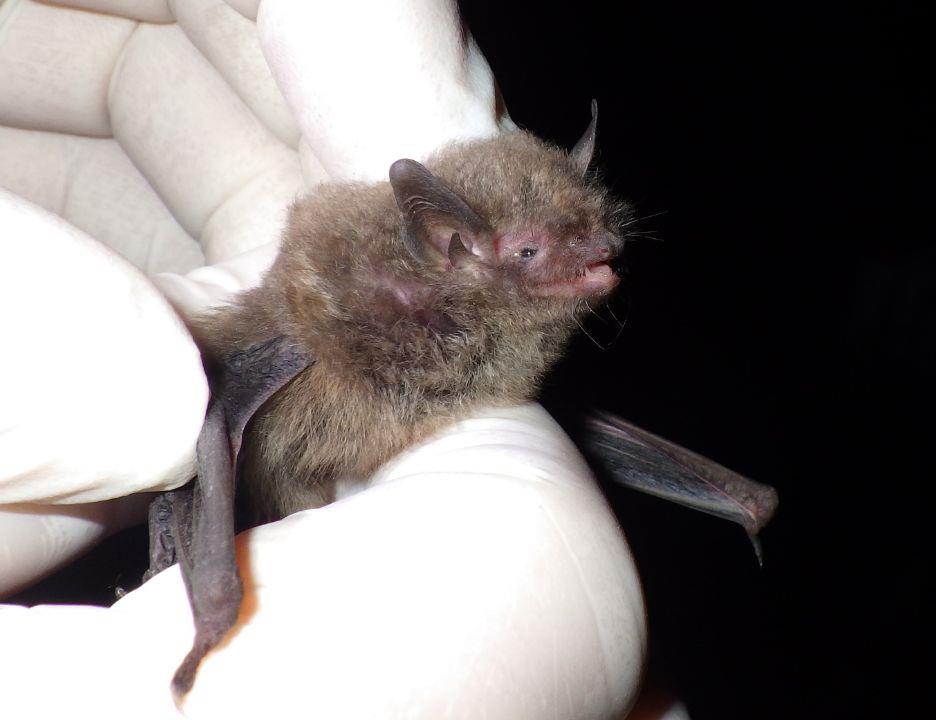
ROBBINSVILLE – It was an unexpected find for biologists with the N.C. Wildlife Resources Commission (NCWRC), U.S. Forest Service and Brown Environmental 13.
Earlier this year, while searching the Nantahala National Forest in Graham County for “survivor bat colonies” of a deadly disease called White-Nose Syndrome (WNS), they discovered a federally endangered bat species that had not been captured during mist netting surveys in N.C. since 2015.
“We had recently captured little brown bats, another WNS-susceptible species, in the area and expanded our survey effort in the hopes of catching more little brown bats and possibly other WNS-survivor species,” said NCWRC Bat Biologist Katherine Etchison.
What the researchers didn’t expect to encounter were Indiana bats! Don’t let the name fool you. These bats are native to several eastern states. But a decline in numbers, mainly from WNS, had wildlife experts wondering if there were any remaining colonies in N.C., with only a single Indiana bat five years ago confirmed in Haywood County during a roost survey. (Roost surveys are used to identify critical habitats, while mist netting allows hands-on data collection.)
“It was a surprise for sure and was so fulfilling after a spending a decade on surveys that didn’t result in Indiana bat captures. We always hope we’re going to catch this species, and we put in the work to catch them, but they’re just so rare nowadays” said Etchison.
These recent Indiana bat captures are the result of many hours of intensive scouting and acoustic surveys as NCWRC searches for WNS survivor colonies. Biologists use the technique called mist netting to capture bats for data gathering and research. They were able to “net” five reproductive female Indiana bats.
Two of the five reproductive female Indiana bats were radio-tagged and tracked to their roost in a dead Eastern hemlock tree in the Joyce Kilmer-Slickrock Wilderness Area – a maternity site. Twenty-four bats were counted exiting the roost at sunset.
Planning for future monitoring and efforts to learn more about this important bat colony are underway. “This was a big find for us,” said Etchison. “So, we’re thinking ahead to the steps we can take to learn more about this Indiana bat colony.”
It’s unknown how many bats are surviving WNS here in N.C. despite the efforts to find out.
“Bat populations are so difficult to estimate that we don’t even try and instead focus on population trends,” said Etchison. “Indiana bats were very rare before WNS and then became so rare after WNS that we go for years without finding them despite attempts.”
What is known about Indiana Bats
- Indiana bats are beneficial. Bats consume billions of insects every year and provide what’s called an ecosystem service to the agricultural industry. They are also great pollinators and spreaders of seeds.
- Listed as federally endangered since 1967
- Length: 3-3.5 inches
- Wingspan: 9.5 - 10.5 inches
- Weight: 0.16 - 0.34 ounces
- Characteristics: varies from dark to light brown, sometimes a dullish gray; distinguished by pink lips
- Habitat: in winter—caves and mines; in warmer months—females and their young will roost under the bark of large trees; males roost under tree bark or in bat houses
- Range: the midwestern, southern and eastern parts of the United States; locations more limited in the winter than in the summer
- Diet: small insects
- Reproduction: breed once a year, in the fall; average of 1 pup a season; gestation lasts for 60 days
What is known about WNS
An estimated 6.7 million bats have died since 2006 because of white-nose syndrome.
More than half of the bat species in the United States are in severe decline or listed as endangered. In addition to loss of habitat, one of the most-dire threats comes from white-nose syndrome, a disease that has decimated bats in the U.S. and Canada.
WNS was first found in N.C. in 2011 and affects 7 bat species.
In N.C., WNS impacts have been severe in the mountains, whereas Piedmont bats have shown no population declines and the disease has not been found within the Coastal Plain.