
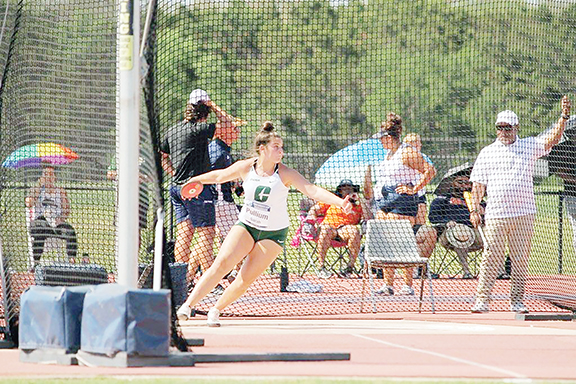
Murphy – From the outside looking in, Lady Bulldogs alumna Sarah Pullium had a seamless transition from high school to her freshman year at the University of North Carolina in Charlotte.
Pullium increased her personal best in the discus throw from 140 feet in high school to 156 feet, 9 inches, making her the fourth-best performer in the event in school history. That throw ranked fifth at the Conference USA Championships, helping the 49ers capture their first conference title since 2019.
Of course, it’s never that easy. Pullium’s freshman year was a strong start to her collegiate career, though it didn’t come without a rough transition. For Charlotte assistant coach Candace Fuller, Pullium doing as well as she did this year only has her more excited about what’s next.
“If anyone’s looking at this picture and seeing it’s amazing, wait for it,” Fuller said. “You haven’t seen amazing with Sarah yet. … I think she has one of the longest runways from a developmental athletes (I’ve) had in a really long time.”
Coming into Charlotte, Fuller said Pullium had a nice level of strength and athleticism. That allowed her to succeed in high school despite poor technique. Poor throwing technique is common among high school athletes, but Pullium had also developed some pretty bad habits, so they had to rework every part of her throwing technique. The way she threw in high school didn’t allow her to have the same ceiling she could have with proper technique.
At Murphy, Pullium said she really only used her upper body for power in her throw. Just something as simple as engaging your lower body meant a steeper learning curve.
“When we first got out there, we learned that throwing is not how far you can chuck it with your right arm,” Pullium said. “Throwing is a full body work where we have to use every single part.”
Just using her upper body made Pullium’s movement “jerky,” Fuller said, which made her more volatile in the ring. For Fuller, the discus throw is supposed to be graceful, with all parts of the body moving toward throwing the implement as far as possible.
That extends not just to the muscles used for throwing, but visual cues used within the throw as well. If you’re trying to throw the discus in a straight line while maximizing distance, Fuller said, your eyes also have to be trained to that spot to help keep your body in line. She said it’s similar to how dancers use visual cues when they twirl during performances.
That added another challenge for Pullium, and probably her biggest. In high school, Pullium would whip her head around toward her shoulder on every throw. Her body got comfortable doing that, Fuller said, and did not like the change of trying to look straight ahead throughout the throw. Some days, Pullium wouldn’t come close to getting off a clean throw.
“It was a hard process,” Pullium said. “There were days where I couldn’t spin in a circle without falling over, or just stand up straight for that matter.”
However, like she did at Murphy, Pullium continued to put the work in. At Charlotte, she was throwing more than she ever had before. In high school, she would throw a little bit during the fall, ramp up to a few times a week in January before throwing five times a week during the season.
In the fall and winter at Charlotte, she would throw 30 minutes a day during the week, which upgraded to an hour a day during the week in-season. That meant a lot of time for failure, but also to get better. And she kept coming back.
“She wants to learn, she wants to master the movements,” Fuller said. “She wants to do the things that the sport requires but just like everybody she gets really frustrated when it doesn’t happen immediately and it doesn’t, it’s not going to. And she just manages to find a way to reset day-after-day-after-day and go through the grind and come back and get after it.”
With her struggles getting the movement patterns down, Pullium wasn’t sure how her spring would go. Fuller said she has a natural feel for throwing the discus, which allowed her to set personal records even while undergoing major technical changes. Her first personal best of the season came in late March, then she broke 150 feet for the first time a week later before setting her current best at the conference championships in May.
“I definitely surprised myself a little bit,” Pullium said. “And I’m excited … because I know I’m nowhere close to reaching my potential.”
The Charlotte school record stands at 163 feet, 9 inches, and is in Pullium’s sights. She has it as a goal for next season.
However, Fuller thinks she could go way past it. She sees bigger goals for Pullium, including the potential to compete at the NCAA Track & Field Regional Championships next year.
However, that’s just one phase of the process. Fuller has three sets of goals for her athletes: distance goals, experience goals and movement goals. With three sets of goals, athletes can usually find success in one, which means progress and keeps them motivated to move forward.
Distance is the easiest to keep track of, while experience comes with competing at certain level meets and helping contribute to team success. The movement goal is for the long term and takes time to master.
Fuller said time is what Pullium needs. After only being in a Division I track and field program for nine months, her journey is just beginning. Today, it’s about getting more reps and breaking bad habits. That should allow her to become more consistent, which means Pullium will only get better.
“I see so much positive and so much potential,” Fuller said. “Anything we might have missed this year will be water under the bridge because her runway is so long and so promising.
“She’s a national-caliber athlete. It’s just a question of when. That’s not something I say about all the athletes I coach.”