
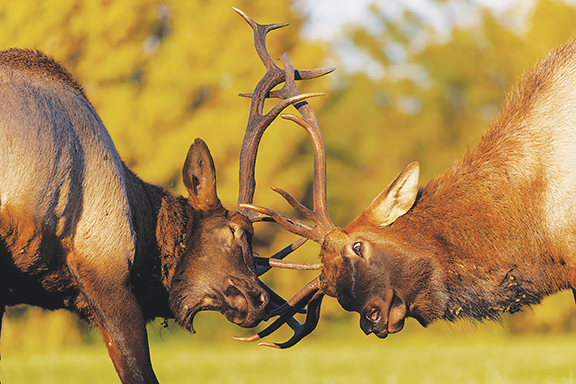
Elk are a big and beautiful part of western North Carolina’s wildlife ecosystem. However, the N.C. Wildlife Resources Commission urges the public to admire them from afar.
State officials encourage the public to refrain from feeding, approaching or touching wild elk falling recent reports of dangerously close interaction with elk in the Maggie Valley area.
Elk are common in western North Carolina, mainly in the Great Smoky Mountains area in and around Haywood, Jackson and Swain counties, not far from Cherokee County. In certain parts, elk are known to wander through neighborhoods and towns, which makes them easily accessible to people.
“These are big, powerful animals,” said James Tomberlin, mountain operations supervisor with the Wildlife Resources Commission, “and getting too close to them jeopardizes those people approaching the animal, the elk and local residents.”
The state advises residents and visitors to be elk smart when the possibility of encountering elk is present.
They encourage people to give elk space by keeping a distance of at least 100 yards from any elk. Never approach them since they are wild animals that are unpredictable and sometimes aggressive, especially during the fall breeding season. Female elk will defend their young if they feel threatened.
Never feed elk, as feeding them associates humans, vehicles and/or homes as a potential food source. This can create conflict and public safety issues, which could promote the spread of infectious diseases.
They also say to not name elk. Characterizing elk, or any wildlife, by naming them creates a false perception they are tame and potentially approachable. The Wildlife Resources Commission says elk are not pets, and personifying elk as humans takes away from their truly wild nature.
The state is partnering with officials in Maggie Valley and surrounding areas to enhance awareness to residents and tourists about keeping their distance from elk after recent reports of dangerously close interactions.
If a conflict with elk arises, the Wildlife Resources Commission recommends multiple ways to resolve conflicts with elk. They recommend fencing of at least 8-foot metal woven wire, scare devices like pyrotechnics or screamers to discourage elk from the area and repellents, such as granular or chemical sprays, to make plants and foliage less desirable.
If things escalate, they also recommend nonlethal projectiles, such as paintballs or Air-soft pellets, in a safe application to cause uncomfortable or even mild pain to encourage elk to leave the area. Do not use birdshot, as it can result in a slow and painful death, blindness or other serious complications.
The Wildlife Resources Commission is conducting a research project on a population estimate of elk in conjunction with the University of Tennessee. The five-year project will employ spatially explicit nature-mark-recapture methods based on fecal DNA to estimate elk vital rates and will determine if current immigration, survival and recruitment rates are sufficient to enable a sustainable hunt in the state.
Through partnerships, they have acquired William H. Silver Game Land and also the implementation of multiple habitat improvement projects. The projects include daylighting existing non-paves roads, creating linear wildlife openings, developing elk meadows, managing vegetation and conducting prescribed burns. The projects provide high-quality forage that meets the needs of lactating elk cows and recently born calves.
Details: To report any unauthorized interactions with elk or any wildlife violations, contact N.C. Wildlife Resources Commission Law Enforcement at 800-662-7137.
Any wildlife questions or concerts can be directed to the state’s Wildlife Helpline at 866-318-2401 or email HWI@ncwildlife.gov.