
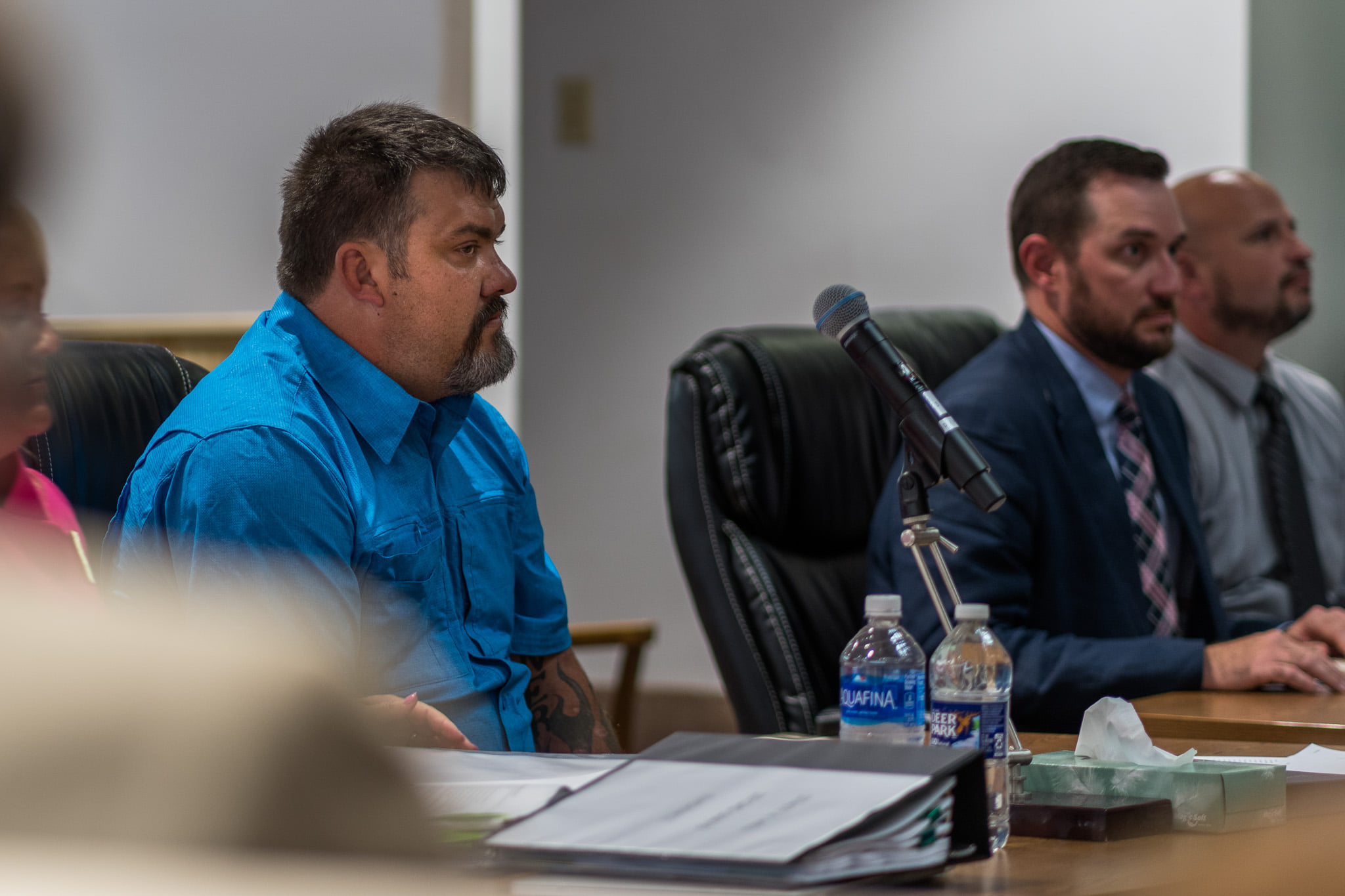
Robbinsville – Area residents have been anxious to hear a Superior Court judge’s decision regarding a local defendant’s motion to dismiss criminal charges, which also brought to light a Giglio letter from a federal prosecutor who believed a Graham County deputy lacked integrity.
Judge William Coward was expected to rule on the motion following a two-day hearing last month, in which a former sheriff’s deputy testified that lawyers within the District Attorney’s Office are trying to cover up crimes allegedly committed by current and former Graham County law enforcement officials.
If the judge had ruled in favor of the defendant, he would have effectively agreed with federal officials regarding the integrity of Deputy Matt Cox. That would have had serious ramifications, likely influencing both open and previously adjudicated cases.
However, before Coward made a decision, he recused himself from the case on the grounds that the defendant is related to the Graham County Clerk of Court. Following the recusal, the District Attorney’s Office reached a plea deal with the defendant, effectively shelving a Superior Court ruling on Cox’s integrity, at least for the time being.
Christopher Drew Hill, 41, pled guilty to eluding arrest and assault with a deadly weapon on a government official, both felonies. As part of the plea deal, Hill agreed to a minimum sentence of 21 months in prison, with the possibility of serving 44 months of incarceration. He was ordered to serve an active sentence of 30 days in county jail before being released on supervised probation.
Prior to the plea, Hill challenged the validity of a 2019 traffic stop initiated by Cox. At an evidence suppression hearing last month, Cox testified that he had been in communication with his boss, who was communicating with an informant regarding Hill’s whereabouts prior to stopping him for having an inoperable tag light. Hill, however, testified that the tag light was functioning properly at the time of his arrest.
Hill fled the traffic stop after a K-9 was used to detect the possible presence of drugs in his vehicle. An officer was dragged by the vehicle as Hill sped away, and a high-speed chase ensued, ending when Hill wrecked his truck.
Hill’s attorney, Holly Christy, argued the arrest was a “setup” to try and catch her client with drugs, which Cox denied. She further argued that Cox’s integrity was tarnished after two federal courts ruled his testimony regarding a 2012 traffic stop “was not credible.”
Christy asked Coward to dismiss the charges against Hill due to the conflicting accounts of what happened and Cox’s perceived lack of integrity. After the plea deal, prosecutors declared vindication.
“[Hill] has waived all grounds to contest the matter and acknowledges the validity of the traffic stop,” assistant district attorney Caleb Decker said in a release following the plea agreement.
However, Christy disagrees.
“Contrary to any assertion by the District Attorney’s Office, this plea neither ‘acknowledges the validity of the traffic stop,’ nor does it ‘underscore the professionalism and integrity of Deputy Matt Cox,’ ” Christy said in response to Decker’s statement. “Mr. Hill did not plead responsible for his vehicle having a malfunctioning tag light.
“Further, the Giglio order entered against Deputy Cox by the U.S. Attorney’s Office for having provided patently false testimony in a federal criminal hearing still stands, at least in Federal Court. It is the DA’s office that has chosen to use Cox’s testimony in prosecutions in State Court despite this.”
With this case being closed, Cox remains on the street, despite the federal Giglio letter, which was issued by former U.S. Attorney Anne Tompkins in March 2014. Police are issued such letters when prosecutors believe an officer’s actions diminishes their credibility to a point where a defendant could use that perceived lack of integrity to their advantage in court.
Officers who receive a Giglio letter are often taken off the streets or relegated to a role where they would not be the arresting officer in a criminal case. However, the DA’s office does not agree with the feds’ interpretation of Cox’s testimony in the 2012 case and firmly stands behind him.
The federal Giglio letter most likely will be mentioned in a different criminal case in which Cox is the arresting officer.
“If it does, we're going to argue it all over again,” District Attorney Ashley Welch said.