
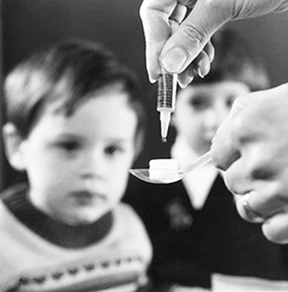
Gerry Chambers needed an iron lung to breathe for him as a child.
Murphy – Gerry Chambers was 8 years old when, lying in the back of an ambulance, he saw worry on his father’s face.
It was 1952, and they were on their way to the hospital in Asheville under the suspicion that he had contracted polio. Despite his high fever and extreme fatigue, he heard the attendant say they were driving through Cherokee territory. Chambers attempted to overcome the stiffness in his limbs to look out the window.
“No, lie still,” the attendant told him. But Chambers was determined. “I leaned up on one elbow because I wanted to see an Indian chief,” he said.
Chamber managed to hold himself up for a bit, but exhaustion overtook him and he collapsed back down on the gurney. “I was pretty disappointed,” he said with a laugh.
Like COVID-19, polio has several variants – and the strain Chambers endured was the serious kind resulting in paralysis or even death. Fortunately, the hospital had an iron lung, which works like a mechanical respirator.
The patient is loaded into a heavy metal cocoon-like structure – it’s a tight fit – and the air pressure within the confined space essentially breathes for the patient. Only a person’s head remains outside the machine.
Chambers hated the iron lung sessions. He remembered once, “I had an itch on my nose,” which could not be allayed until a nurse came to check on him.
However, Chambers walked away from that experience with some true grit. “Survivors develop compassion,” he said. “They are courageous and stubborn.”
His view on the COVID vaccinate reflects his experience with polio.
“We (polio survivors) are sensitive to epidemics. We understand the fear,” Chambers said.
While Chambers received the COVID vaccination, he concedes that the issue is complicated.
“I understand that people are afraid of the repercussions of the vaccine,” he said, adding that while the vaccine is a personal choice, that choice will affect the rest of the community.
“I have a choice with how I respond to the pandemic, but do I have the right to endanger another human being?” Chambers asked.
David Badger, director of the Murphy Health Department, explained it this way.
“People make judgment calls for themselves,” he said. “The problem with the [vaccine] argument is that, at the end of day, someone makes a choice to drink and drive.”
Like Chambers, Badger understands how the rights of the individual are sacred – up to the point where it interferes with the sacred rights of others. It’s like the old adage, “You have a right to swing your fist just up to the point where my nose begins.” But for many people, that intersection is muddy with no clear, defining boundary lines.
Badger understands the complexity of the vaccine issue. “People internally make a risk assessment,” he said, when considering the COVID vaccine.
“With polio, for example, they consider which is the greater risk versus the outcome. They ask, ‘What are the downsides to getting the shot?’ ” Badger said. “People see the ramifications of polio versus COVID.”
Badger also pointed to differences in access to information then versus today.
At the time Chambers became infected, Badger said, “You might turn on radio and hear a 30-minute snippet of what’s going on with polio. Now there are millions of webpages of information about COVID.”
Badger sees this increase and speed of information as a challenge. “Factual information can be given quickly,” he said, “but also non-factual information can be given quickly.”
Chambers believes, “Polio enforced a belief in science; it caused a deeper study and understanding of viruses.”
Badger sees things a bit differently. “People are always going to be skeptical of science and data,” he said. “It’s part of human nature.”
He read a story in The New York Times about the history of small pox. “Benjamin Franklin’s son did not get the vaccine. His wife didn’t want him to have it,” Badger said. “But the 5- or 6-year-old boy died of it, and Franklin’s wife regretted that decision.”
For Chambers, receiving the COVID vaccine required no internal machinations.
“They are preventative,” he said, a view shared by Badger.
“Vaccines are an important and useful tool in preventing infections and saving lives in the long run,” her said.
Part of his job, Badger added, “is to educate, not to force them to believe with what we believe. There is nothing wrong with skepticism or using judgment to analyze things. But do they make the best decisions?”
He leaves that question unanswered. Chambers believes the national media could do more to calm people. “They could offer other viewpoints and speak to the idea of a social contract,” he said.
Badger, however, has his sights set further down the road.
“The bigger concern in the bigger picture is that people are going to suffer over time,” he said. “There are bigger upstream concerns. In many respects, COVID has been politicized.”
Badger also points to a certain weariness of COVID information overload.
“With two-plus years, people have grown tired of it; they’ve grown skeptical,” he said.
For Chambers, after a five-week and four-day stay in the hospital, he unequivocally believes in science.
“Viruses are always going to be with us,” he said. “We need to stay calm and believe in the advance of science.”