
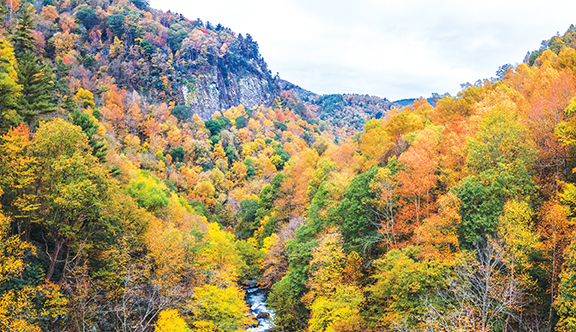

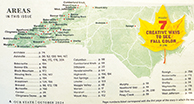
Murphy – The October edition of Our State Magazine, a statewide publication that promotes tourism, includes a series of articles about western North Carolina that project optimism for the coming fall colors season, but which wound up having a far darker side.
The magazine includes a map with dots over communities that it is featuring in each edition. October’s map highlights western North Carolina’s fall foliage locations, but it’s nearly identical to maps that show parts of the state hardest hit by Hurricane Helene in late September.
With a 25-county swath of North Carolina still reeling in Helene’s aftermath, roads remain closed, power is spotty, and even essential services like drinking water and sewage treatment remain out of service in many communities. While fall 2024 may be a bust for storm-affected counties, the influx of labor and recovery dollars to rebuild the region over the next year or two may more than make up for it.
Meanwhile, Helene barely touched Cherokee County. Although local residents are eligible for disaster unemployment assistance, because the county was not included in the federal major disaster declaration, local businesses are not eligible for disaster relief; no reconstruction or recovery are necessary. No help is on the way because, compared to its neighbors, no help is needed.
However, in far-western counties like Cherokee, where local businesses rely on fall tourism to help balance their books, a severe fall-off of fall tourists could be a huge problem.
A big industry
Helene shut down the Blue Ridge Parkway indefinitely and will impact, if not cancel, there 2024 fall foliage tourism in most of western North Carolina.
Fall foliage tourism is a $1 billion industry in North Carolina, according to an Appalachian State University study. A typical family of four spends $400-$1,000 on a trip.
“That’s no small chump change, and such expenditures are critical to the success of businesses in the mountains, many of whom depend on fall tourism to balance their books,” the report says.
Appalachian State’s website includes a map of fall color peak times for the North Carolina mountains. The peak season for much of the storm-affected areas occurred the week or two following Helene.
Peak viewing in the far-western state ranges from Oct. 13 through Nov. 28, with most of Cherokee County falling from Nov. 1-10.
According to drivenc.gov, a website run by the N.C. Department of Transportation that reports highway status throughout North Carolina, as of Monday, Interstate 40 remains closed at the Tennessee line. However, it is open through to U.S. 64/74 near Lake Junaluska, with most highways open west of there clear to Georgia and Tennessee.
That’s a big improvement since the week following Helene, when Cherokee County was cut off from the rest of the state. However, Cherokee and its neighbors are still dealing with the lingering perception that all of western North Carolina is shut down.
A large roadside billboard advertises “Visitors needed” and lists Franklin, Highlands, Cashiers, Sylva, Dillsboro, Cherokee, Bryson City, Robbinsville, Murphy, Andrews and Hayesville, according to a photo posted by Smoky Mountain Host of North Carolina, which offers travel information for the Great Smoky Mountains in North Carolina via its Facebook page, Visit Smokies.
Maggie Valley and Waynesville will be added to the list, Smoky Mountain Host posted. Visit Cherokee County, a website and social media for the Cherokee County Tourism Development Authority, shared the post on its Facebook page.
“We welcome your visit to Murphy, Andrews & Brasstown, NC,” the site posted. “Our area is fully operational, as we fortunately were not impacted by Helene. We appreciate your support to our local economy this fall, as we rely on this season heavily. The efforts of our locals, alongside the resilience of the people, showcase the strength of our regions during this difficult time.
“At this time we ask that you get here safely and follow drivenc.gov guidance to avoid traveling through impacted areas.”
Murphy Mayor Tim Radford posted a reminder on his Facebook page that Cherokee County and its neighbors are still open for business.
“Four western North Carolina counties – including Cherokee, Graham, Clay and Swain – are fully open and accessible via safe routes, according to local authorities. Despite the recent hurricane’s impact on other areas, these mountain communities have largely escaped damage and are ready to welcome visitors,” he posted.
“Tourism is a critical part of the region’s economy, and officials are encouraging visitors to explore the beauty of the mountains as a way to support local businesses and communities. Whether hiking, exploring scenic byways or visiting local shops and restaurants, tourists play a significant role in helping the region thrive, particularly in the aftermath of the storm.
“However, officials stress that visitors should avoid traveling to areas severely affected by the storm. Relief efforts are ongoing in these hard-hit regions, and it is essential that resources and infrastructure remain focused on recovery.
“Travelers are advised to check local road conditions and plan their routes carefully, ensuring they
steer clear of the damaged areas while supporting those parts of the western North Carolina mountains that are open and ready to receive guests.”