
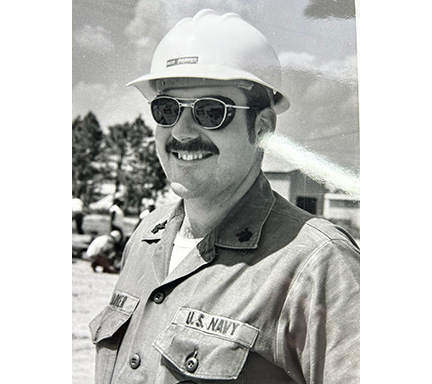
Brian Parker joined the U.S. Navy in October of 1967. He attended boot camp at Recruit Training Command Great Lakes before being assigned to the USS America CVA66, in the Surface to Air Missiles Division. His duties included maintaining a guided missile launching system which was the secondary defense of the ship.
In 1968, he was building bombs during the Tet Offensive for 12 hours a day, seven days a week, 30 days a month.
“It was probably the most arduous job I had in my 20-year career. There was a lot of manual labor involved, we worked so hard that the 12-hour shifts went by quickly,” Parker said.
He never suffered injuries in the military with the exception of an occasional cut or two from the sharp metal bands that secured objects on pallets.
He recalled a scary moment in 1970 in Vietnam when he worked on a guided missile launching system. They would stand on watch throughout the night. One night the horn went off in the missile house as a result of an unidentified plane approaching their ship. They loaded the missiles and were preparing them to be put on the launcher before they realized it was a civilian aircraft with several hundred people aboard.
The radar goes out 40-50 miles or more. Airplanes have a friend or foe signal and the passenger plane wasn’t sending a signal because it wasn’t turned on.
“We were trying to reach the aircraft to identify themselves. At the last minute they finally flipped on their friendly signal. That was probably the scariest moment in my life, thinking we were gonna have to shoot down the aircraft,” Parker said.
When the ship needed food, fuel or other supplies they were delivered by another ship that would pull up alongside of their ship. Both ships would remain in motion as the supplies went from one to the other.
“The proudest moment for me was when I was on Diego Garcia, a tiny island in the middle of the Indian Ocean. Very few people get to go there, and I was on the crew that began the largest pier that the Seabees ever built,” Parker said.
Being in the Navy has its share of challenges. He was on a ship with 96 other men in one room. The bunks were stacked three beds high.
“You just accept it because that’s just the way it was,” Parker said.
It’s traditional however, for Navy ships to be kept spotless so there was no uncleanliness or odors to contend with while out at sea. Even with all the company of his fellow seamen, he said, “There was always, always a longing for home.”
Parker received several awards during his Navy career, including the Navy Achievement Medals, Navy Unit Commendation, Good Conduct and Vietnam Service medals. He also earned Navy rifle and pistol marksmanships before exiting the Navy on Dec. 31, 1987.
His volunteer work after his service in the Navy includes work with the American Red Cross, military service organizations such as the Patriot Guard Riders and with FEMA after major disasters, where he worked as a certified residential housing inspector.
Parker enjoys honoring and serving other veterans.
He was born in Windsor Ontario, Canada, in 1948. He grew up in Detroit, graduating from Southfield High School in Michigan.
He and his wife, Sue, live in Marble. Now retired, Parker said his tasks are to do whatever is on his honey-do list.
He is the proud parent of one grown child, four grandkids and one great-grandchild. Parker’s pets include two dogs.
When Parker is confronted by someone thanking him for his military service, he always replies with, “You were worth it.”