
Unsettled weather when winter is turning into spring has always been with us.
But it got wicked on April 3, 1974, when a national outbreak of 148 tornadoes raked the country from the South and Midwest into New England.
Cherokee County was hit hard – a terror attack from Mother Nature on an awful Wednesday night.
Four dead, dozens injured (many from flying glass) and 14 still in hospitals in Murphy and Andrews a week after the storm.
Well over 100 families suddenly homeless – 90 houses and mobile homes destroyed, another 55 with major damage and not fit to live in.
As a people, we were stunned. Panic, shell-shock, in a daze – hard words describe a population looking to the skies and fearing more blows. Naturally looking to the Cherokee County Courthouse because of its size and bulk (and it is our government temple).
So scared folks poured into the courthouse that night, refusing to spend the rest of the night in their own homes. Murphy Town Hall was also opened, along with the Henn Theatre and several downtown churches. An estimated 800 people were sheltered.
The late Red Schuyler, Cherokee Scout advertising manager, was one of them. He said way up in the night they heard another tornado cross over Murphy, high in the clouds above.
Mean March wind
As editor, I had been writing about storms and taking photos of wind damage for about two weeks prior to the big one. First storm picture on the front page was of the flattened drive-in movie screen at Peachtree, issue of March 28.
Then high winds hit again in several places – five trailers destroyed at a Peachtree mobile home park, WCVP’s Big 6 radio tower blown down, chicken houses demolished. All duly photographed and dominating front page of next issue.
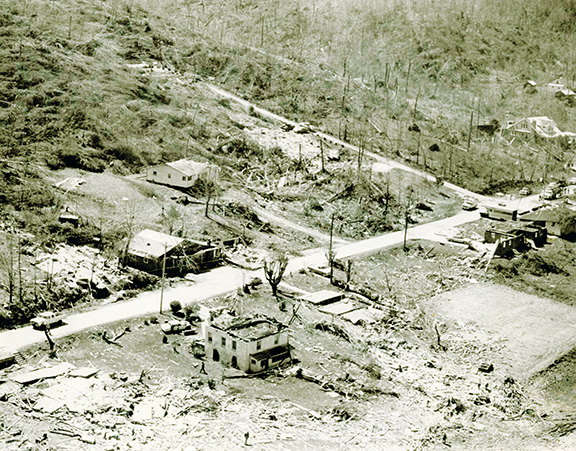
The killer tornado hit just before dark on Wednesday, April 3, accompanied by rain and hailstones the size of hen eggs. Millions of trees were uprooted and snapped off, thrown violently in all directions. Power and phone lines, including the brand-new cable-TV system then under construction were destroyed.
Downed trees made roads impassable and volunteers began cutting the trees out of the way well before midnight, a snarling chorus of muscle and machines, illuminated by headlights of the vehicles.
A federal official raised in western Virginia told me later he knew the mountain people would take care of themselves. “They are not like those people in Pennsylvania hit by floods, who sit on their butts and wait for someone to help them. Mountain folk help each other …”
Eye in the sky
The hardest-hit populated area was the Bealtown section of Murphy, and the very first day after the storm I helped friends dig out furniture and clothing from a house destroyed there.
“There’s a pistol and $500 we kept in a breadbox in the kitchen,” they said. “Let’s find that if we can.” We located it quickly and hauled their stuff in a light misty rain to a relative’s place at Martins Creek.
In fact, that was typical of many of the storm victims and the feds, who were trying to get a count, complained about it. They had difficulty tracking victims because relatives simply absorbed them, took them in. It was simply family, kin taking care of kin, like always.
By Friday, however, I was ready to be a reporter again. The late Harold Fisher, U.S. Forest Service ranger, estimated we had 10,000 acres of downed trees – 80 percent on private land, 20 percent federal. He had a helicopter standing by on the pad in Bealtown. I said save me a seat.
We flew for an hour or more, took a lot of photos. The twister had originally touched down in Fannin County, Ga., near Culberson and entered our county on the ground, tearing up everything in its path. Looked like a gigantic mower had chewed up houses and trees, scattering debris along its path.
It stayed on the ground for 20 miles, crossing and re-crossing U.S. 64. Demolished one end of Bealtown and then proceeded into the Slow Creek section of Peachtree, where it suddenly lifted up. We flew on to Wayah Bald and never saw any more damage.
Aftermath
The American Red Cross and then Federal Emergency Management Agency quickly showed up to help. FEMA brought in 35 singlewide trailers for homeless families, each a distinctive 1970s burnt orange and charcoal gray in color. We established a local disaster fund, which eventually raised $30,000, to help storm victims.
The governors of Georgia and Tennessee visited their tornado-hit towns (Tennessee suffered 45 deaths from the storms), but our new Republican governor was a no-show and got a lot of criticism from local Republicans and Democrats. Said he was tied up with a big golf event at Greensboro.
Heard some preachers said it was God’s punishment on Murphy for being so sinful. Did not sit well with me – did not think Murphy any more sinful than Blairsville or Blue Ridge, Ga.
“These high mountains will protect us from a tornado,” we had always told each other. “Tornadoes happen only to the flat-landers.”
After April 3, 1974, we never said that again. Never.
Wally Avett, a resident of Murphy, was the editor of the Cherokee Scout when the tornado of 1974 occurred. Call him at 828-837-5531 or email wallyavett@gmail.com.