
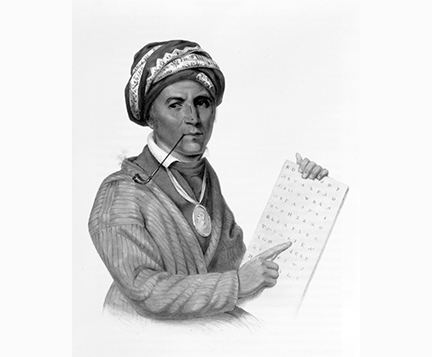
The Eastern Band of Cherokee Indians maintains a museum honoring Sequoyah near Vonore,Tenn. Artist’s drawing shows his turban and ever-present long pipe.
 |
Always interested in Cherokee history, I recently had our kind library ladies here at Murphy obtain a rare book for me – Old Frontiers by John P. Brown, published in 1938. Time to send it back to the university library that loaned it, so I need to write this while it’s fresh on my mind.
Thick book, didn’t read it all, but got some good insights to condense here.
First of all there was Fort Loudoun, now a large state park near Vonore, Tenn. It’s on Tellico Lake, near where the Tellico River that begins in our county runs into the Little Tennessee River.
I drove there with two friends from Murphy and wrote a column about it that appeared in this space several years ago. There is a map there that plainly shows Murphy being on the route builders of the fort took in 1756.
For the fort was constructed by South Carolina soldiers, a long ways from Charleston, which soon completely forgot about them. It was surrendered to the Cherokee in 1760 and soon burned.
Cherokee genius
Sequoyah was born about the same year in the little village of Tuskegee, near the ruins of the fort, a mixed-blood with a white father. His name was George Gist or Guess.
Like lots of other Cherokee men he went down into south Alabama for the big war against the hated Creeks, led by Andrew Jackson, who would eventually send both tribes to Oklahoma.
The Cherokee, according to most historians, had come south from the Great Lakes region, maybe Ohio, where they had been associated with the Iroquois. Their spoken languages reveal the link, but the Cherokee had no written language, no alphabet to build words with.
Sequoyah and his fellow Cherokee watched in wonder as Jackson’s soldiers wrote letters and read orders from distant places. The Indians called it “talking leaves” and laughed at Sequoyah, who said he could make it happen.
Said he had heard of a man named Moses who had letters cut into stones (our Ten Commandments story), and he could do the same. Other Cherokees, including Sequoyah’s own wife, scoffed at him.
He built a small cabin away from his family’s regular dwelling and worked there on his project. Never learned to speak English at all but acquired a schoolhouse spelling book and began to use the letters, turning some sideways or upside down to indicate the various sounds of spoken Cherokee.
Final triumph
His wife and friends destroyed his cabin, setting his work back but he labored on, working with a young daughter. Together they displayed his handiwork, he would write something on a paper and she could read it aloud to witnesses. Some called it witchcraft.
But it was a splendidly simple arrangement of 85 sounds they used daily, now fashioned into a Cherokee alphabet to spell out words. A miracle.
The whole tribe learned it quickly, soon had a Constitution and a Bible they could read. By January 1828, the Cherokee had their own newspaper, printed in their own language, fully 10 years before the Trail of Tears. Recognized for his work, Sequoyah got a medal from his tribe and a nice sum of money from the American government.
Now revered as a tribal statesman or philosopher, he was interviewed in Arkansas in 1840, keeping a room full of Indian admirers spellbound with his stories of the past. He died three years later in Mexico, in pursuit of a myth about a so-called “lost tribe” of wandering Cherokees.
Wally Avett first wrote for the Cherokee Scout as editor in 1969. His books are available as signed copies at the Scout office in Murphy. Call him at 837-5531 or email wallyavett@gmail.com.