
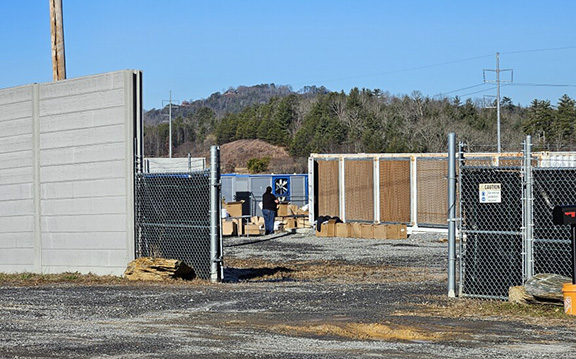
Murphy – The town council took steps on Aug. 12 to shield Murphy from the growing crypto mining industry, but when it comes to regulations, technology is a moving target.
While both Murphy and Cherokee County have taken steps to prevent new crypto mining operations, the county is not protected against existing mines and neither so far can prevent intrusion by the explosive rise of the artificial intelligence industry, which promises even bigger impacts than crypto mines.
Industry reports say AI has already overtaken bitcoin mining in power consumption. While the crypto industry has a narrow focus – mining crypto currency – the AI industry’s applications are limited only by human imagination and, at some point, AI’s ability to expand by itself.
“With AI offering up to 25 times more revenue than Bitcoin per kilowatt hour, some miners are adding AI processing to their data centers or even switching entirely from Bitcoin to AI,” according to cointelegraph.com, a news site that monitors the crypto currency industry.
Cherokee County has three crypto mines – in Marble, Ranger and on Harshaw Road, all established before the county’s moratorium and Murphy’s ban.
The plant in Marble, operated by Texas-based Core Scientific Inc., appears to be switching over to support AI, swapping out its crypto mining equipment with new technology.
Core Scientific – one of the more established large-scale Bitcoin miners – announced a 12-year partnership with CoreWeave to deliver about 270 megawatts to train artificial intelligence. The deal has an expected value of $6.7 billion.
Core Scientific’s Marble plant, which has a 104 megawatt capacity, would fulfill about 38 percent of the contract’s requirement.
The issues
Crypto mines are notoriously loud operations that consume huge amounts of electricity to run and cool equipment. While the Marble plant was first to arrive in 2018, it was the open-air plants on Harshaw Road and in Ranger that drew the heaviest criticism and triggered efforts to restrict them in the county.
The Harshaw Road facility was so loud, Commissioner Jan Griggs compared it to a commercial jet taking off. That plant has taken steps to improve conditions but is still loud, seriously affecting the quality of life for nearby residents.
The county imposed a temporary but open-ended moratorium against crypto mines and other high-impact industries in October 2023. A newly established planning board has until March 2025 to submit a report for dealing with these industries long term.
The moratorium applies only to unincorporated areas of the county. Murphy imposed a permanent ban on crypto mines following a public hearing on Aug. 12. However, neither measure restricts AI plants.
“I read nothing in the moratorium specific to AI,” County Manager Randy Wiggins said.
“The text amendment and prohibition were to the town’s zoning code,” Murphy Town Manager Chad Simons said. “Both amendments passed unanimously, but the law is silent on artificial intelligence facilities.”
As AI has shown, the data industry is a fast-moving target. What to do about AI has not even come up in local government, and the first news coverage of its industrial arrival in Cherokee County was just last week in the Cherokee Scout.
Bitcoin, the cryptocurrency that launched the crypto mining industry, was first released in 2009. The first mine in Cherokee County was established in 2018 – nine years later. It wasn’t until 2022 that local government took notice and started to take action.
On the other hand, ChatGPT, the AI interface that helped launch the AI industry, was first released in 2022, with the arrival of an AI facility in Cherokee County just two years later.
While crypto mining uses vast amounts of energy, AI leaves it in its dust.
Cointelegraph.com reported, “According to Goldman Sachs, a single ChatGPT query consumes nearly 10 times the energy of a typical Google search. MIT Technology Review reports that generating an AI image can use as much power as fully charging a smartphone.”
The reactions
Preventing crypto mine growth has been challenging in Cherokee County, which eschews zoning outside town limits.
The board of commissioners first tried to approach the issue with a noise ordinance but faced stiff opposition from a public concerned that such a law would have unintended consequences that would affect everyday mountain living. The county then approached the issue via creation of a “narrowly defined” land use ordinance, careful to point out that it was not zoning.
Commissioners first had to create a comprehensive plan and establish a planning board – comprised entirely of county commissioners, with Ben Adams as chair – before it could enact a moratorium on high-impact industries including things like privately operated prisons, nuclear waste dumps and crypto mines.
Since the moratorium took effect in October 2023, Adams and county staff have spent months working on a proposal to permanently ban high-impact industries.
The moratorium remains in effect for one year or until the board of commissioners enacts a high-impact land use ordinance. The planning board has until March 2025 to submit a report to the commissioners.
Because the county’s land use ordinance is a work in progress, AI could be added to the mix. A permit application would trigger an evaluation by Cherokee County Code Enforcement of the Marble plant’s shift in focus, Wiggins said, but county building codes administrator Jon Crest told the Scout no new permits have been issued.
Work in Marble is in progress, and it appears that AI as it is being developed there skirts the county’s moratorium and has no restrictions.
The moratorium does not apply inside town limits in Murphy or Andrews, leaving those two to come up with their own solutions. While Murphy has a ban on crypto mines, Andrews has not addressed the issue and remains vulnerable.
A ban on crypto was a fairly simple thing for the Town of Murphy, which has a zoning code that gives it control over what can be built and where inside its borders. Town leaders can follow the same process for AI.
However, regulation by either agency hinges on their ability to define what industrial-strength generative AI is.
Technology develops faster than government can respond, but AI takes it to a whole new level. Defining it to include in zoning and land use documents will be a challenge unlike anything local government has ever faced, including the crypto industry.
A definition that is too broadly written could have unintended consequences and affect industrial growth local governments would ordinarily invite. Defining it too narrowly could render it obsolete in a matter of days.