
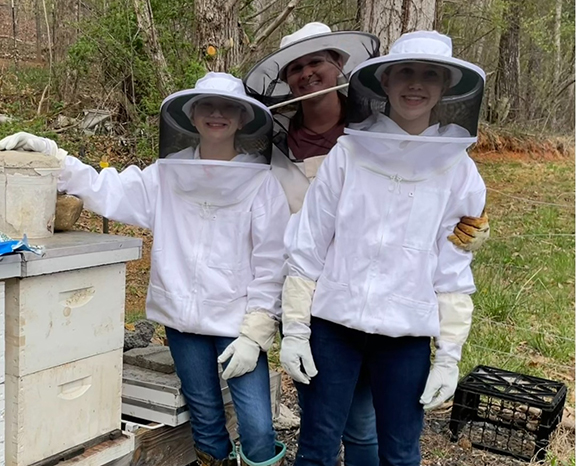
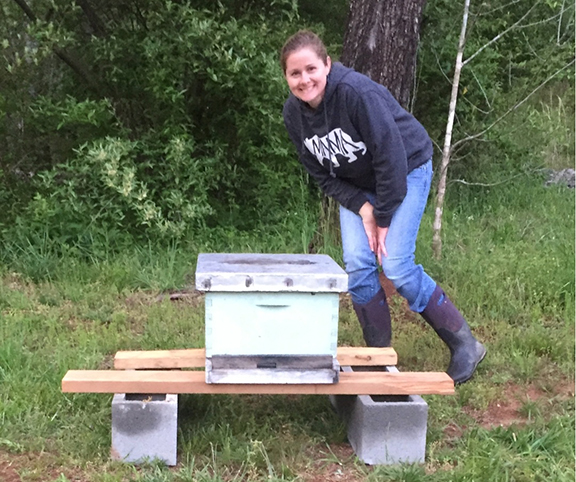
Hayesville Turkey-born Cameron Green is living the sweet life. Born in 1982, as a young adult she attended Rensselaer Polytechnic Institute for biomedical engineering.’
Green’s earlier jobs included working within the pharmaceutical industry in research studies, then as a coordinator for having the research done. Today, she is a homeschooling mom of children ages 11, 13 and 16.
Green’s hobbies include beekeeping, which recently earned her an award. On Jan. 8, she traveled to Louisville, Ky., to enter the North American Honey & Beeswax Competition at the North American Honey Bee Expo, the largest such show in North America.
One of the categories was the “Black Jar” competition, in which a participant places a sample of their honey into a black jar. Judges are unable to see the sample and vote solely on the taste.

Green took that category, saying with excitement, “I won it! It was the first time I entered anything and the first time I won.” Her award was for the best-tasting honey in North America.
While growing up, her best friend had bees, which was Green’s first experience with bees and beekeeping.
“I love honey and the bees are fascinating little creatures. They’re very important to our food supply, and their honey is delicious,” Green said.
In 2016, she became very interested in honeybees. However, she had small children at the time, and taking on bees then would have been more difficult to manage.
In 2020, Green got her first honeybees. While beekeeping is a process and can sometimes be challenging, she said the payoff is worth the effort.
“In the spring, the bees build up their brood to get ready for collecting nectar and making honey. It starts with a queen and worker bees. The queen lays eggs and if they’re fertile, they turn into female worker bees,” Green said. “If they’re not fertile, they become male drone bees with the purpose of flying off to mate with queens, making more bees.”
Sometimes, the bees build up quickly and swarm, which is not good because if they swarm they make a new queen. If that happens, the old queen takes off with half of the bees.
At that point, you’re left with only half of the resources needed to bring in nectar for making the honey. Worker bees are faithful and will follow the queen if she leaves, so it’s important to keep the hive a happy place so they stay put.
It’s an expensive hobby, starting at about $150 for some bees and a queen. The needed equipment adds additional costs to the hobby, so Green takes care of her bees, including keeping them mite-free.
“If bees get mites, they can eat the fat bodies of the bees and introduce diseases,” she said. “It’s also important to keep bees fed in the winter, and in the summer it’s hot and sweaty work.”
Harvesting the honey can be tricky.
“It’s kind of a funny little dance trying to get away from all the bees with the honey so they don’t follow me inside,” Green said. She keeps EpiPens around, as she’s been stung many times.
Honey has medicinal benefits, including antibacterial as well as anti-inflammatory properties.
“It’s best to consume raw unfiltered honey and local honey helps with allergies,” Green said.
She only uses a light filter to strain out bee parts in her honey, such as little legs and wings. She believes Sourwood honey is among the best tasting in the world.
When she’s not busy
with bees, she enjoys making her own vanilla extract, salt and sugar. Sometimes, she’ll even put vanilla in her honey.
Green also grinds her own grains for baking and makes her own marshmallows. She also likes taking road trips.
Her advice to others desiring to try their hand at beekeeping is to start with two hives in case one is weaker, have a mentor and get involved with a beekeeping association. Green is a member of the Appalachian Beekeepers Association in Murphy.
Details: Visit Rohs Ridge Farm on Facebook.