
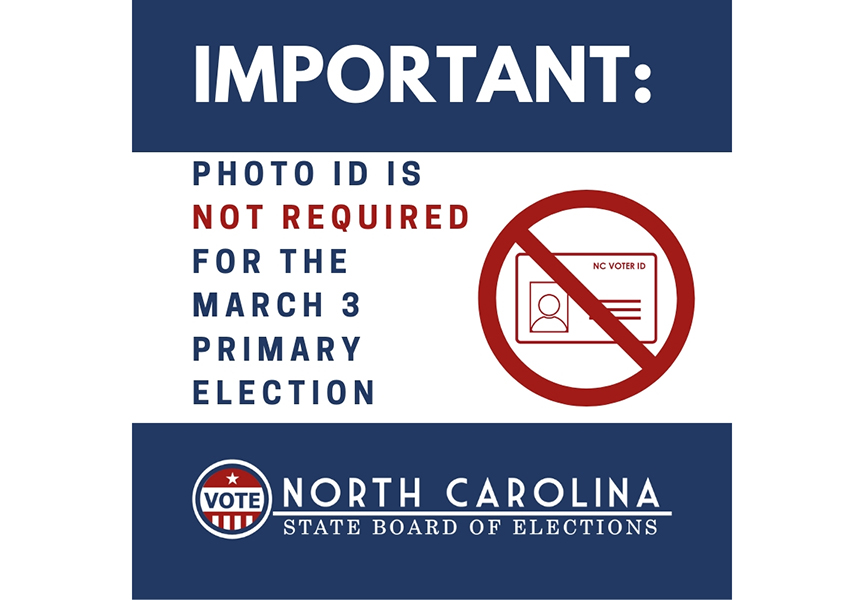
Voters will not have to show a photo identification when voting in North Carolina’s primary Tuesday, March 3.
Attorney General Josh Stein announced Thursday the N.C. Department of Justice will appeal the District Court’s decision to block the voter ID law, which was to take effect this year. However, to avoid confusion, the department would not seek one before the primary. State Republican leaders urged Stein to appeal the decision.
Absentee ballots for the primary will be available starting Monday, Jan. 13.
In November 2018, state voters approved a constitutional amendment requiring a photo ID to vote. Statewide, 55.49 percent of voters approved the referendum, while in Cherokee County it was approved by 77.71 percent.
“The people voted to change the constitution of the state of North Carolina,” said Bennie Jo McKinnon, who was recently elected chair of the Cherokee County Republican Party. “I wish they’d get it worked out in time.”
She said because the law provided for many forms of identification to be used, and even gave people the opportunity to obtain a free ID at local Board of Elections offices, the District Court’s “reason is not legit.”
“I don’t understand the judge’s reasoning,” McKinnon said, explaining so many services already require identification, including hospitals. “Honestly, I do not know a soul who doesn’t have an identification.”
U.S. District Court Judge Loretta Biggs ordered state officials not to enforce the voter ID law until a lawsuit filed by the N.C. NAACP and others is resolved. In the decision filed Dec. 31, the omission of public-assistance IDs as an acceptable form of photo ID was suspect that race was a motivating factor. It also noted that aside from military IDs, federal employee IDs were also omitted as acceptable forms of identification.
Legislators who enacted the voter ID law were mostly from illegally gerrymandered districts, Biggs said in the order. Blocking the law is the best interest of the public, she added.
After the General Assembly approved the law implementing the constitutional amendment in December 2018, over Gov. Roy Cooper’s veto, the state NAACP and others quickly filed lawsuits challenging it. Throughout the country, 34 states have voter ID requirements.
The North Carolina law required voters to show a photo ID when voting in person or to include a copy of a photo ID with their absentee ballot. Photo IDs accepted included a driver’s license from North Carolina or any other state, a state non-operator card, an approved college or university student or employee ID, an approved state or local government ID, a military or veterans ID card, a tribal enrollment card, a U.S. passport, or a state voter ID card. Schools and governments had to apply to seek approval from the state board of elections to determine if their IDs met the requirements.
All registered voters would be allowed to vote with or without a photo ID. Those without an ID would use a provisional ballot, which would count if the voter presented an accepted ID by the day before canvassing, or if they signed and affidavit declaring they have an exemption from the requirement. Exemptions include religious objections to being photographed and a natural disaster occurring within 100 days before the election.
The voter registration deadline for the primary is Friday, Feb. 7. Those who miss the deadline may register and vote during the one-stop early voting period from Feb. 13-29.