
By Gracey Sneed, Special to the Cherokee Scout
Murphy When rumors spread that the Olympic Park bomber was hiding in Murphy, few believed them. But for many locals, those whispers soon became personal memories.
For native Angie Owenby, the story began on a stormy night along Martins Creek. The rain was coming down in sheets, hammering against the metal roof of their double-wide and turning the yard into a slick mess of red clay.
“After he abandoned his truck, they said he walked the creek to keep his scent down,” Owenby said. “It was pouring rain that night. We lived in a double-wide right by the water. Mama was mad ‘cause the dog kept tearing at the under-pen like he was trying to crawl under the house.”
Her mother, irritated by the noise, told her to go get the dog. Angie grabbed a flashlight, but when she stepped out onto the porch, a strange stillness settled over the sound of the rain – the kind of silence that makes you listen harder.
“That back corner was just too dark,” she said. “I didn’t see the dog, and I just got this feeling not to go.”
She turned back inside, uneasy. Later that night, as the storm eased into a steady drizzle, they heard a slow, rhythmic crinkling beneath the trailer – like plastic shifting against the dirt.
“I told Mama, ‘A dog doesn’t work that slow,’ ” Owenby said, laughing. “She didn’t like me saying that one bit.”
The next morning, the world seemed washed clean by rain. Angie stepped outside for school, the porch light flicked on – and a man in dark, soaked clothing bolted down the creek, vanishing into the mist.
Truth sinks in
Weeks later, when the news broke that Eric Robert Rudolph – the fugitive behind the 1996 Atlanta Olympic Park bombing – had been hiding out in western North Carolina, the truth sank in.
“When I checked under the house, there was a little spot all hollowed out,” Owenby said. “There were cigarette butts, cracker wrappers and a soda can. He’d been right there under us.”
She still shakes her head at the thought. “I didn’t know I was sleeping on top of a fugitive,” she said.
Years later, Owenby would see him again – this time not beneath the floorboards, but beneath the flickering fluorescent lights of the local Save-a-Lot.
“It was raining again, of course,” she said. “He came in drenched, water dripping from his clothes and bought one can of Viennas, a pack of saltines and a two-pack of razors. Didn’t say a word.”
She remembered how quiet he was – eyes low, voice barely above a mumble – just another mountain man passing through.
“At first, I thought he was just another quiet mountain man,” she said. “Days later, when his mugshot appeared on TV after his arrest – right behind that same store – I nearly dropped my coffee.”
You’d never guess
Others in Murphy remember him differently – not with fear, but with the casual familiarity that small towns afford.
“His house on Vengeance Creek was right across from my granny’s,” said Josh Morgan, who was in sixth grade at the time. “He never really talked much, but he was polite and always waved.”
Josh recalled riding his bike past Rudolph’s old trailer, the smell of wood smoke and honeysuckle thick in the air.
“Sometimes you’d see him splitting firewood or working on something in the yard,” he said. “You’d never guess what he’d done.”
Alley McDonell still shakes her head when she tells the story.
“A few days before he got caught, my parents and I talked to him while walking the track at Murphy High School,” she said. “When we saw his picture later, we were floored. We’d just spoken to the man.”
The massive manhunt had brought hundreds of federal agents to the mountains – SUVs clogging two-lane roads, helicopters thundering overhead, checkpoints springing up in sleepy hollers where no one had ever seen a federal badge before. However, it was Murphy’s own people who kept the search moving.
“We used to feed the FBI every morning at Reid’s Place,” said Jessica Reid, whose family owned the diner. “They’d come in muddy, tired, hungry – we’d hand them biscuits and coffee, and send them back out.”
Polite as could be
Locals swapped sightings the way they traded fishing stories – one neighbor thought she saw a campfire on Hiwassee Dam Road, another swore he heard footsteps in the woods behind his barn.
Local businessman Tony Chiofolo didn’t realize how close he’d come until weeks later.
“He came into Log Cabin Auto Sales, polite as could be,” Chiofolo said. “Didn’t realize who he was ‘til I saw his picture on the news.”
Former officer Eddie Mathis still remembers the near miss that haunts him.
“He told me later I’d been just a few feet from him one night,” Mathis said. “It was dark. Never even saw him.”
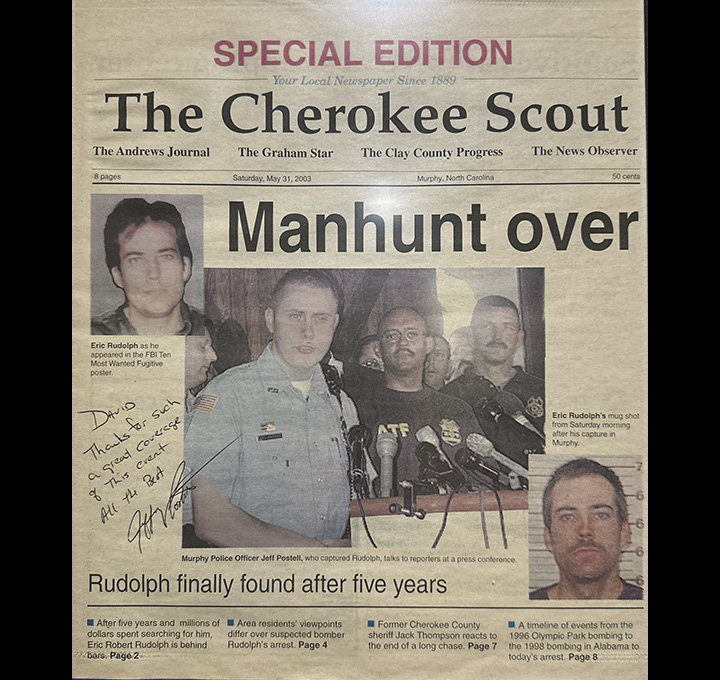
When the break finally came, it wasn’t the high-tech surveillance or the hundreds of agents that found him. It was a rookie cop – Officer Jeff Postell, barely out of his teens – who spotted a man rummaging through a Dumpster behind that same Save-a-Lot.
“After all those years and all that money, it was a local boy who brought him in,” said Jeana Conley, Postell’s former teacher at Andrews High School. “Jeff’s gone on to be a statesman and a role model. We’re all proud of him.”
Mountain resilience
Today, Murphy has returned to its familiar rhythm – quiet mornings, friendly waves and talk over coffee about weather and high school football. But every so often, someone brings up the years when a wanted man hid among them.
“It’s funny to think about now,” Owenby said, softly. “We were scared back then, sure. But it’s part of our story – just a wild piece of Murphy history.”
And, in the way only small towns can manage, the story of Eric Rudolph has become something
more than a dark chapter. It’s a tale retold with disbelief, humor and that mountain resilience that runs deep in these hills – a reminder that even when history passes through your backyard, life goes on; we still feed the dog, head to work and greet our neighbor with a wave.
Gracey Sneed is a native of Murphy and student at UNC Asheville.