
By Alan Wooten
The Center Square
Washington – Inside the U.S. Supreme Court on Jan. 13, two states argued their standing for protecting female sports from males in high school and college.
Outside was a veritable who’s who, from the president’s Cabinet to Congress to high-profile coaches to athletes and former athletes. And their opponents.
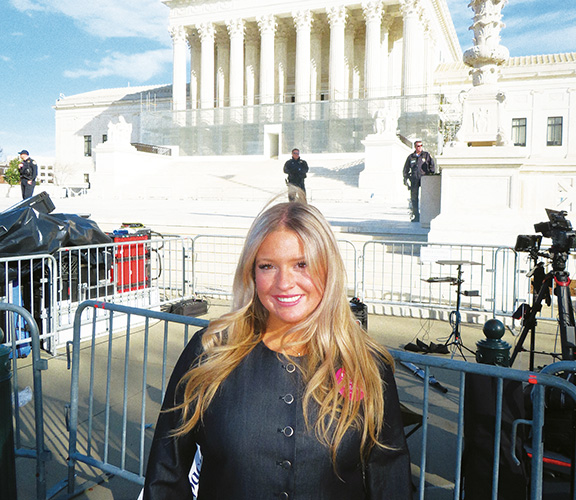
For former three-sport athlete Payton McNabb of Hiwassee Dam, N.C., the outside rally, rather than the jam-packed courtroom, was the place to be.
“From athletes to lawmakers, and everyone in between, it was beautiful,” McNabb told The Center Square moments after the rally in front of the Supreme Court ended.
She was especially inspired by Kaylie Ray, a former volleyball player at Utah State, saying her former court opponent, Brooke Slusser at San Jose State, was her friend and teammate.
“What binds us now is not rivalry, but a shared resolve to stand up for the women and girls whose futures depend on what happens
in the court,” Ray said. “Intimidation will not erase reality. We will not be silent forever.
McNabb, handling some 20 interviews over the last several days, shared her story and position. She went from being a top-three student in her class at Hiwassee Dam to needing extra time for testing due to medical issues resulting from another player’s spiked volleyball that hit her in the head.
Riley Gaines, her 3-month-old daughter alongside in a bulletproof vest, led the list of speakers McNabb praised – Slusser, XX-XY Athletics founder Jennifer Sey, television personality Sage Steele, Education Secretary Linda McMahon, U.S. Sen. Tommy Tuberville (R-Ala.) and Michigan Rep. Lisa McClain. McNabb said she didn’t even see Bruce Pearl, the retired basketball coach of Tennessee and Auburn with two Final Fours on the resume.
McNabb said for Ray, it was her first time at public speaking.
“This means a lot to her, and her sports means a lot to her,” she said of why it resonated so much. “For her to have the courage, in front of an intimidating crowd, I’m
very proud of her. She did it so gracefully and beautifully.”
That followed Slusser saying, “I will never be the same because an institution chose to protect one man on a women’s volleyball team instead of protecting the 18 other women on the team, the hundreds of other women in that conference.”
Inside, the high court heard oral arguments in two cases out of Idaho and West Virginia involving women and girls in sports. Decisions from the justices are predicted to come in June. The cases, respectively, are known as Little vs. Hecox and West Virginia vs. B.P.J.
Lindsay Hecox, now 24, didn’t make the women’s track and cross-country teams at Boise State. Idaho law, a first of its kind in 2020, says athletes from elementary school through college are to participate on respective male or female teams based on “original birth certificate issued at the time of birth.”
Becky Pepper-Jackson, a 15-year-old high school student, has identified as female since third grade, using medicine to resist male puberty. West Virginia law, enacted in 2021, is like Idaho in using birth certificate at time of birth.
The day’s proceedings included one justice, Ketanji Brown Jackson, responsible for the decision who in her confirmation could not give a definition of a woman to Sen. Marsha Blackburn (R-Tenn.). She was not recused.
Justice Samuel Alito, in one exchange, got agreement from a lawyer for the ACLU that deciding discrimination via Title IX included defining sex. Asked what it means to be a man or woman, boy or girl, the ACLU did not provide a definition.
Attorney General Pam Bondi of the U.S. Justice Department said the administration’s position is states have the authority to ban men from participation in women’s sports.
“This is common sense,” she said. “We are fighting to protect girls and women in the locker room and on the playing field – and we will be successful.”
President Richard Nixon signed Title IX into law in 1972. It says, “No person in the United States shall, on the basis of sex, be excluded from participation in, be denied the benefits of, or be subjected to discrimination under any education program or activity receiving federal financial assistance.”
The Department of Education in President Joe Biden’s administration attempted to change those 37 words with 1,561 pages of rewrite.
In a press conference after the arguments, John Bursch of the Alliance for Defending Freedom said, “It means a lot that the other side has to tell the court not to define sex in order to win this case.”
The Alliance for Defending Freedom – counsel alongside Idaho – bills itself as a “legal organization committed to protecting religious freedom, free speech, the sanctity of life, parental rights, and God’s design for marriage and family.”
McNabb said her focus was outside in the rally and she was anxious to see what happened inside.
Then it’s off to Florida for another event.
“I’m very hopeful about it,” she said. “You never know. You don’t want to get too excited, the fact you really don’t know. It is the most basic thing ever. I’m excited to hear what it ends up being.”
The Cherokee Scout contributed to this report.