
Brasstown gristmill operational again
Brasstown The rhythmic hum of grinding stone once again echoes through the heart of Brasstown, thanks to the full restoration of the Arrant Heritage Mill.
Tucked between Cherokee and Clay counties, Brasstown is a quiet corner of western North Carolina that has long celebrated a way of life centered on self-reliance, craftsmanship and community. In the 19th and early 20th centuries, Brasstown residents relied heavily on their local gristmill – not only as a practical necessity, but as a social cornerstone.
Before electricity and supermarkets, milling corn was essential to daily life. Families brought their dried corn to the mill to be ground into cornmeal, the base for everything from skillet cornbread to grits. The process was as communal as it was crucial: neighbors swapped stories, traded goods and caught up on local happenings while waiting their turn at the stone.
After decades of silence, the gristmill that once stood outside of Coble Dairy, then moved to the Bass Duval Merchandise store near the corner of Settawig Road, has been brought back to life, and with it, a piece of Appalachian history has been revived.
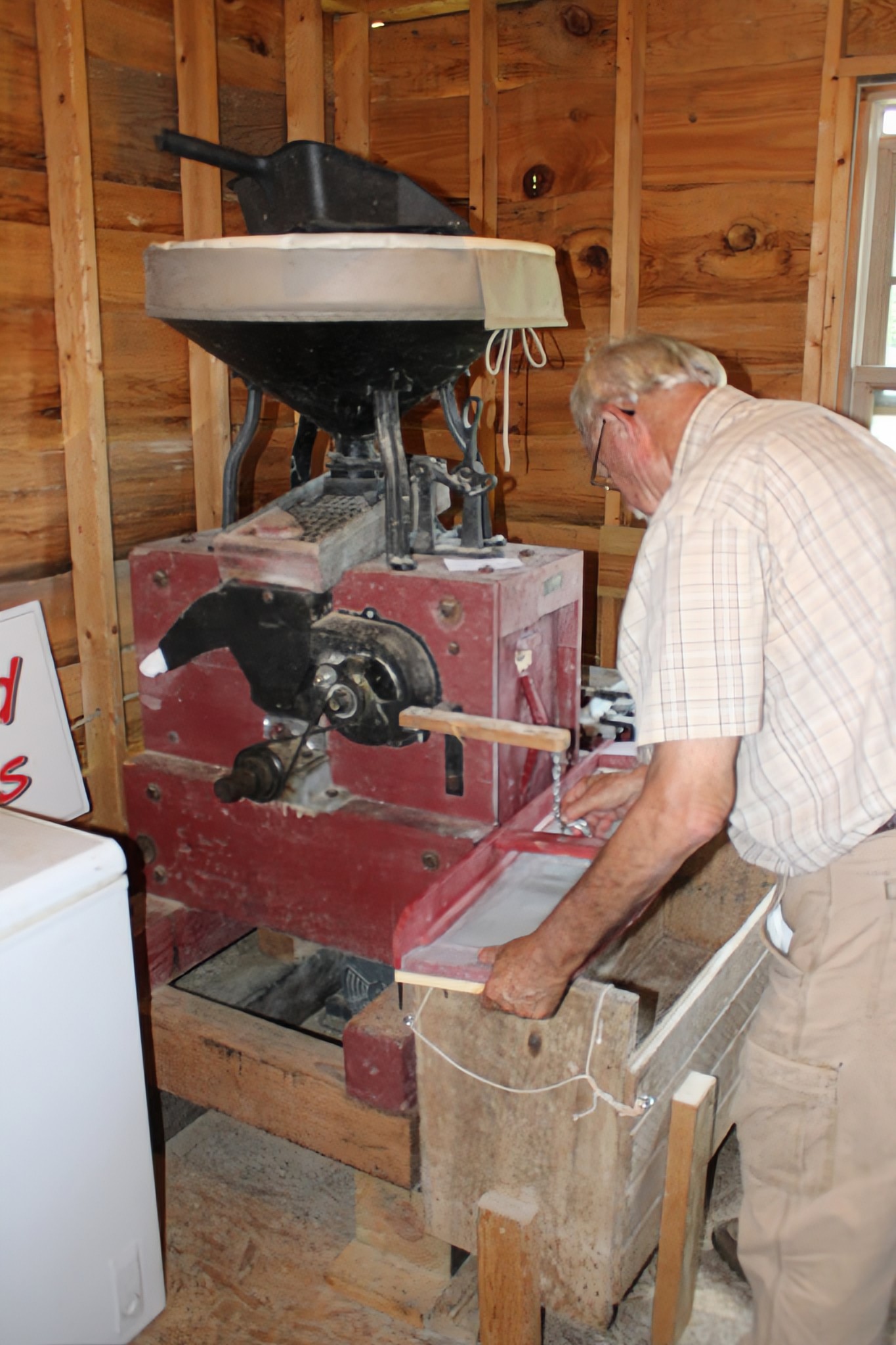
Clay Logan of Brasstown – along with local residents Larry Teems, Joe DesLauriers and Mike Logan – took on the challenge of reanimating the equipment.
“When I was a boy, once a month, we used to take a half-bushel of corn to the gristmill at Coble Dairy and we’d come out white,” Logan said, reminiscing about the way the cornmeal would blow out of the mill. “I got to wondering in 2014 what had happened to it, and I found it.”
The gristmill had been shut down in the 1970s after Arrant had a stroke and donated to John C. Campbell Folk School. Logan asked if he could restore the old mill.
“It was totally worn out,” Logan said. “So we had to restock and cut the wood to put back on it. It had a hit-or-miss motor, so we tore it apart and started over.”
Logan said the mill had been used so much that it had ground down into the wood. Teems cut a new piece of wood and had to be precise with the measurements.
The mill also needed new babbitt bearings, which had to be hand poured with a mixture of lead.
“You have to get it perfectly level,” Logan paused, remembering the extensive work the men had to do. “When we first poured it, we didn’t have it perfectly level and when we put it together, the stones hit at the top, but not on the bottom.”
In the end, Logan took the mill to Meadows Mills Inc. in North Wilkesboro, which specializes in milling equipment.
The mill’s motor is now fully electric.The grinding stones can be adjusted to coarseness.
Logan said once the repairs were finished, the old mill works again and is back to grinding cornmeal a few times per year. Once corn has been harvested and dried, it is usually the winter months which is a good time to grind it due to the low humidity.
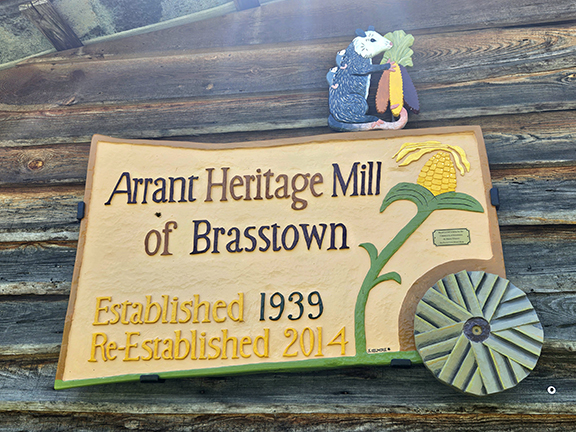
Stacie Gilmore of Brasstown took over hand-carving a wooden sign that showed the historical Arrant gristmill.
“I learned through classes with Paul Rolfe how to carve and use traditional hand gouges,” Gilmore said. “The sign is made of maple, and the possum and stone are poplar.”