

.
Murphy Carl Edwards started beekeeping in 1979, and got the honey he produced into Ingles Markets only one year later in 1980.
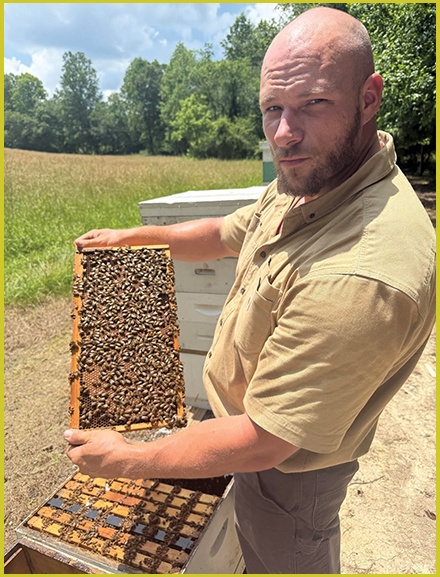
His grandson, Gage Killian, spent his whole life around bees, learning all he could by helping his grandfather. In 2019, Killian started up his own four hives as his way to step into the family business that his grandfather created.
Today, he has built 250 different hives across eight different locations in Murphy, Hayesville and Hiawassee, Ga.
“I’m about halfway to my goal of 500 hives,” Killian said. “I owe everything to my grandfather. He spent the time with me and taught me everything I know now.”
Gage Killian/Carl Edwards Honey can be found in 22 different Ingles Markets locations and two different apple orchards. There are two varieties of honey – wildflower and sourwood.
Wildflower honey is the product of bees that visit a wide variety of wildflowers, creating a “nature’s blend” of nectar that gives it a complex, regional flavor. Sourwood honey has a more specific flavor due to being a mono-floral variety. Sourwood honey is often considered a delicacy because Sourwood trees are only found in the Southern Appalachians and have a short summer bloom.
Local honey can help provide a wide variety of health benefits with its antioxidants, vitamins, minerals and antibacterial properties. Many use local honey to reduce allergies by desensitizing consumers to local pollen, soothe sore throats and coughs, support immune functions, aid digestion and improve energy levels.
Beekeeping is also extremely important for the local environment. By creating hives and encouraging the development of new hives, more bees are active. The bees support pollination, which is essential for plant reproduction, the production of food and supporting biodiversity.
Healthy bee populations ensure growth in the environment, which supports wildlife. Beekeeping has become increasingly important because bees have faced habitat loss, climate change and the threat of pesticides. Beekeeping creates protected and cared-for populations of bees to perform vital jobs in the environment.
“Our busy time of year is April through June. This is when the bees are most active, and it’s a seven-day-a-week job. We don’t get days off during this time, no matter what,” Killian said.
“It’s important for harvesting and essential to keep the bees from swarming, but
the hardest part of beekeeping is killing the mites that get into the bees. If these mites are killed, they can lead to colony death, so it’s crucial.”
After July, the bees begin going dormant for the upcoming cold weather.
Many people in cottage industries start or continue family businesses, making their job that much more important and personal for them. For Gage Killian, this is especially true.
“I’m grateful to have the opportunity to work with the bees. I’ve loved doing this since I was a kid,” he said.
“I’m thankful my grandfather started this business and taught me everything I needed to continue it. My goal is always to provide a good quality product for people.”