
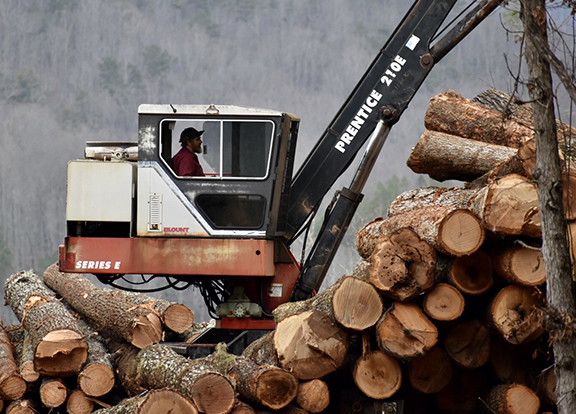
Murphy
For a county shrouded in trees and U.S. Forest Service lands, Cherokee County has lost its edge in the timber industry, but federal agencies are working to address that.
The Nantahala National Forest, Cheoah-Tusquitee Ranger District, has prepared a final Environmental Assessment, finding of no significant Impact and draft Decision Notice for the Crossover Project.
Findings can be seen at fs.usda.gov/r08/northcarolina/projects/56347.
These documents are also available for review by appointment at the Tusquitee Ranger District Office at 123 Woodland Drive.
The Crossover Project is a proposed Forest Service plan for the Nantahala National Forest, involving timber harvesting, prescribed burning and other stand improvement treatments, primarily in the Snowbird Mountains, to restore forest ecosystems and reduce wildfire risk. However, the project, which is under analysis, has faced controversy and opposition from environmental groups due to concerns about harvesting old-growth forest and its potential conflict with a new federal policy restricting such activities.
What is it?
The Crossover Project part of larger forest restoration efforts aiming to improve forest health, reduce the risk of catastrophic wildfires and restore certain ecosystems.
It proposes timber harvesting (including old-growth timber),
TIMBER, page 9A
prescribed burning and other forest stand treatments to improve forest structure and function.
It is located on the Nantahala National Forest, specifically targeting areas on the Snowbird Mountains between Cherokee and Graham counties.
Why is it controversial?
The conflict between the proposed timber harvest and new federal policy on old-growth forests is a key issue in ongoing discussions about the project.
u Old-growth timber harvest: The project includes plans to harvest old-growth forest, which has raised significant concerns from environmental organizations.
u Policy conflict: A new federal policy, established as part of the Collaborative Forest Landscape Restoration Program, prohibits harvesting old-growth forest unless absolutely necessary for project goals, creating a potential conflict with the Crossover Project.
u Opposition: Groups like MountainTrue and Environment America have opposed the project, advocating for stronger federal action to protect old-growth forests.
Addressing concerns
National forests, which are under the authority of the U.S. Department of Agriculture, are in crisis due to uncharacteristically severe wildfires, insect and disease outbreaks, invasive species and other stressors whose impacts have been compounded by too little active management, said Brooke Rollins, secretary of the Department of Agriculture.
For example:
- The 2023 Wildfire Hazard Potential for the Unites States report identifies 66,940,000 acres of NFS lands under a very high or high fire risk.
- Roughly 78,800,000 acres of NFS lands are already experiencing, or are at risk of experiencing, insect and disease infestations.
These threats – combined with overgrown forests, a growing number of homes in the wildland-urban interface, and more than a century of rigorous fire suppression – have all contributed to what is a full-blown wildfire and forest health crisis.
The Forest Service manages 144 million forested acres in 43 states.
Forest plans identify about 43 million acres suitable for timber production. Over the last five years, the Forest Service has sold an average 3 billion board feet annually.
“Immediate action is needed to mitigate risk, protect public health and safety and critical infrastructure, support local and rural economies, and mitigate threats to natural resources on NFS lands,” Rollins said. “We can do more to contribute to American prosperity and protect our national and economic security.
Emergency Situation Determination
“To address this crisis, I am making an Emergency Situation Determination under section 40807 of the Infrastructure Investment & Jobs Act,” Rollins said. “This ESD encompasses 66,940,000 acres of NFS lands rated as very high or high wildfire risk that are hereby determined to be an emergency situation as defined by IIJA.
“In addition, I have determined that the 78,800,000 acres of NFS lands designated under Section 602 of the Healthy Forest Restoration Act, that are experiencing declining forest health; at risk of experiencing substantially increased tree mortality over the next 15 years [from time of designation] from insect and disease infestation; or containing hazard trees posing an imminent risk to public health, infrastructure, and safety, are an emergency situation as defined in the IIJA.”
There are about 33,846,000 acres of NFS lands which overlap between wildfire and insect and disease risk. In total, this ESD designates 112,646,000 acres of NFS lands as an IIJA emergency situation, which is 59 percent of all NFS lands.
Actions taken pursuant to this ESD will support improving the durability, resilience, and resistance to fire, insects and disease within forests and grasslands across the National Forest System.
The Forest Service may also carry out authorized emergency actions after an ESD is declared to achieve relief from threats to public health and safety, critical infrastructure, and/or mitigation of threats to natural resources on NFS lands.
“These actions will improve the durability, resilience, and resistance to fire, insects, and disease within national forests and grasslands across the National Forest System,” Rollins said. “To be eligible to use this authority, at least 50 percent of the treatment areas supporting this authorized emergency action must be within the designated areas.”
Proposals using the special emergency action procedures include:
- Reduce wildland fire risk to communities, critical infrastructure or key ecological values; or
- Reduce/mitigate post fire risks needed to protect communities, critical infrastructure, or key ecological values; or
- Reduce hazardous fuels by removing or modifying vegetation to lower the risk of wildfires; or
- Reduce the density of fire-dependent forests; or
- Support the durability and resiliency of forests and grasslands; or
- Reduce hazardous fuels to help make wildfire response, as well as ingress or egress, safer and more effective; and
Authorized emergency actions to respond to emergency situations include the:
- Salvage of dead or dying trees;
- Harvest of trees damaged by wind or ice [note: or other natural disasters];
- Commercial and noncommercial sanitation harvest of trees to control insects or disease, including trees already infested with insects or disease;
- Reforestation or replanting of fire impacted areas through planting, control of competing vegetation, or other activities that enhance natural regeneration and restore forest species [Note: the restoration of forest species includes prevention, suppression, and eradication of insect, disease and invasive species outbreaks];
- Removal of hazardous trees in close proximity to roads and trails;
- Removal of hazardous fuels;
- Restoration of water sources or infrastructure [Note: the restoration of water sources includes watersheds];
- Reconstruction of existing utility lines; and
- Replacement of underground cables.
Timber production
In order to increase domestic jobs and prosperity, increase economic independence, and protect our national security, the Forest Service will issue new or updated guidance to increase timber production, decrease the time to offer timber supply and increase certainty in future timber supply. This guidance should include use of Good Neighbor Authority, stewardship contracting and agreements or contracts under the Tribal Forest Protection Act;
Rollins’ declaration also seeks to streamline, to the extent allowable by law, all processes related to timber production, including project planning, decision-making, implementation (including preparation, appraisals and measurements), and required certifications; as well as:
- Develop a strategy to improve the efficiency of delivering the timber program and increase quantity and consistency in volume offered; and
- Identify legislative proposals that would improve timber production and sound forest management.
Shared stewardship agreements
The Forest Service will work with state and local partners and federally recognized tribes to collaboratively align with their respective priorities. Many states and tribes have Forest Action Plans that prioritize critical treatment needs, and this memo directs the Forest Service to work with states and tribes to also prioritize these areas and projects.
“Given the urgency and cross-jurisdictional nature of the current crisis, the Forest Service shall work quickly to proactively update and expand Shared Stewardship Agreements to bring the full power of our partners to help address this emergency,” Rollins said. “Immediate implementation of actions under this ESD should proceed concurrently with the updating and creation of these agreements.”