
ARE THERE REALLY PANTHERS HERE?
Peachtree
Have you ever heard the Appalachian saying “screaming like a river painter?” (“Painter” being “panther” in the local dialect.) Throughout June, Cherokee Scout readers have been talking about the widely rumored panther when one was reportedly spotted on a trail camera and published in the June 18 edition.
Appalachia is full of stories of black panthers roaming the woods at night. The sounds of a woman screaming can cause the hairs on anyone’s neck to rise and is often what people hear and tell about.
Some folks have even spotted these big cats – some tan colored, others black as midnight.
Grandmother’s story
Local resident Jerry Sudderth remembers stories from his grandmother, Verdie Brittain Ledford, who lived where he resides in the early 1900s.
“My grandmother saw two panthers while she was living. One morning there was a board fence around the barn, and they had a cow and a new calf down there,” he said, slowly telling the story.
“She said her mother was washing the breakfast dishes up, and my great grandfather had already gone out to the store. She looked down there, and there was a panther laying on the top board of the fence, swishing its tail, watching that new calf. She said it was black, completely black, and her mother told her to run to the store – and when she ran out the door, the door slammed and the panther jumped down and went off toward the creek.”
Misidentifications
Sudderth told of another sighting, where his grandparents were riding home to Andrews from Peachtree one night and a black panther jumped across the hood of the car.
There are several people who talk about seeing these cats; however, there is a lot of speculation about what is really seen. According to the N.C. Wildlife Resources Commission, cougars were extirpated from the state in the late 1800s, and there has been no evidence of wild cougars living in the state since.
The NCWRC still receives reports and sightings of cougars, but biologists often find that nearly all of them are misidentifications.
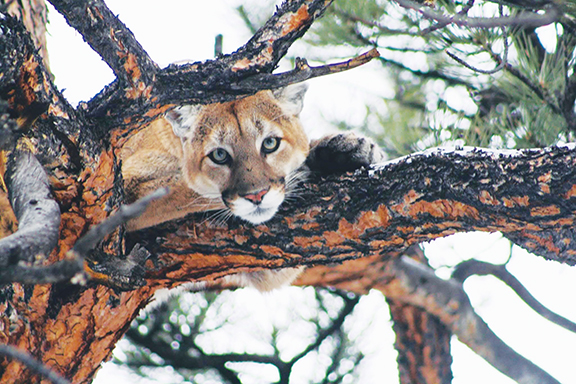
“We don’t have any scientific evidence of naturally occurring mountain lions in over 100 years,” NCWRC District 9 Biologist Justin McVey said.
A hunter’s perspective
Seth Stallard of Hiwassee Dam is an avid hunter who has been all over the county – and beyond – hunting big game.
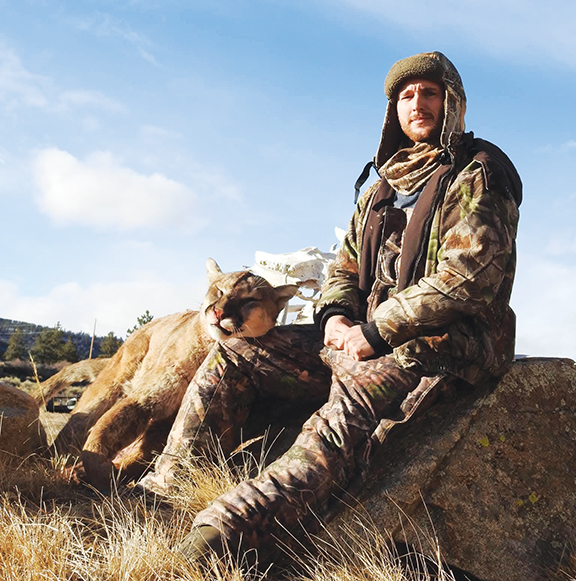
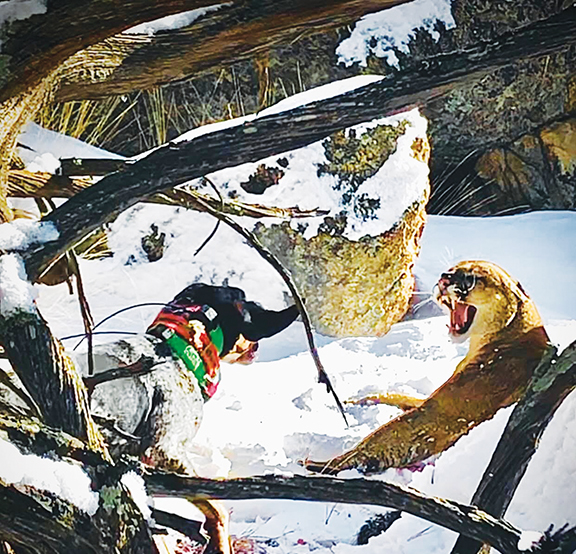
“I went to Colorado and treed three mountain lions in five days with my dogs,” he said. “Those same dogs, along with thousands of others, have run every mountain, hill, holler and creek in western North Carolina. Not one single mountain lion has ever been treed, no one has ever killed one, no one has run one over in their car.”
Stallard added that he put a trail camera photo of his cat online and had several people tell him it was a mountain lion, when he knew for a fact it was the cat that sleeps on his bed every night.
“People may fully ‘believe’ they see a black cat or a panther or Bigfoot,” he said. “But I don’t believe in, nor will ever ‘amen’ anybody for seeing them.”
So what happens if someone really does see a big cat? The NCWRC recommends:
- Report any large cat sightings immediately, especially if accompanied by clear photos, tracks or scat.
- Keep a safe distance – cougars are reclusive and nocturnal, but any large predator should always be respected.
Conventional safety tips apply: don’t run, back away slowly and make noise if you encounter a big cat.
No evidence
- The N.C. Wildlife Resources Commission emphasizes that Eastern cougars (Panthera concolor couguar) have been considered extinct in North Carolina since the late 1800s. They note that there’s no physical evidence – no bones, tissue, clear photos or scat – to confirm any are in the wild population today.
Most reported sightings are likely misidentified bobcats, domestic animals, coyotes, red foxes with mange or even viral images from out West. Occasionally, escaped or released captive cougars are found (e.g., 1980s cases near Tyrrell County), marked by ear tattoos.
Reports of “black panthers” are almost always misidentifications since melanistic cougars don’t exist. Instead, observers may be seeing black bears, bobcats or dogs – not true panthers.