
Nelson’s unfamiliar volleyball road leads to a familiar place
Murphy
Lady Bulldogs’ alum Grace Nelson’s volleyball career is coming full circle. As a kid, during the summer she would make annual trips to her parents alma mater, Emory & Henry University in Emory, Va., which included a stop to visit her grandparents about 30 minutes away.
After spending the first two years of her volleyball career at Catawba Valley Community College in Hickory, which included sitting out most of her freshman year due to an injury, she’ll continue the family tradition by playing for Emory & Henry this fall.
“I guess spending so much time there, the community is like no other,” Nelson said. “Emory & Henry’s such a special place to be and the small campus feel makes the environment so special and personal for each person. It’s really amazing and I can’t wait to be there.”
‘Go different places’
Nelson graduated from Murphy in 2021, which meant her last two years of high school were disrupted by the COVID-19 pandemic. Spring sports were canceled during her junior year, and the N.C. High School Athletic Association’s condensed 2020-21 calendar meant there was not a lot of down time between her senior volleyball, softball and outdoor track seasons.
She knew she wanted to play college volleyball, she just didn’t know where. With college volleyball athletes granted an additional year of eligibility, Nelson decided to look for a smaller school. She wanted to play and learn about herself rather than wait her turn on the bench for a few years.
While attending a camp at Lenoir-Rhyne University, Nelson had a few light conversations with Catawba Valley head coach Madison Pogue before Pogue asked if she wanted to play for her. Nelson visited the school with her dad and thought it was “everything I needed it to be.”
It was a different route than most athletes take. The traditional route is to attend a four-year institution. Athletes attend community college for one or two years, usually as a stepping stone to another institution.
It’s a delicate balance for players and coaches, who want to win but also know part of the job is helping players get to their next destination. About half the team is new each year. When Nelson got to Catawba, some of the returning players told her it’s still a team effort.
“If one person succeeds but the team doesn’t do really well, then no one gets to go anywhere,” Nelson said. “Individually, if the team buys into it, we get to go different places.”
Pogue initially recruited Nelson as an outside hitter, and she settled into that role early on in her freshman year. She had 44 kills, 92 digs and 12 aces through her first nine matches. The final match, though, is when things went awry.
‘I just couldn’t stand up’
Nelson said her legs were sore early in the season, but she kept working through it. Later in the season she jumped and landed awkwardly but played through it. Then in a game at Surry Community College, Nelson landed on her left knee. Her leg went one way while her body went the other.
She was always dramatic when she fell in high school, though always found a way to get back up. This time was different.
“I kept telling myself get up, get up, get up,” she said. “But I just couldn’t stand up.”
After being helped off the court, an MRI a few days later revealed that Nelson tore the anterior cruciate ligament and meniscus in her left knee. It was her first serious injury. Before then
Nelson said the most significant injury was a sprained ankle that put her in a walking boot for a few days.
Her older brother, Micah, who plays football at Western Carolina University, hadn’t suffered a serious injury at the time, so her family was a bit stumped on where to turn. Some of the uncertainty from when she was deciding where to go to college returned.
Once she had surgery and started rehab, Nelson said the competitive fire returned. She had surgery in Atlanta, and due to the distance between there and Hickory, enrolled in online classes for the spring semester. She also worked with Murphy athletic trainer Bob Grimes, as well as Penny Johnson to rehab her knee.
When she returned to Catawba Valley, Nelson had some catching up to do. First, she had to acclimate herself to the team again after being back in Murphy for the previous semester. Pogue said they had some one-on-one conversations to figure out the best ways to acclimate herself back into the team, and while Nelson did all the necessary work, her commitment to the sport takes care of the rest.
“When she came back there was no stopping her,” Pogue said. “Because people flock to that kind of work ethic, that kind of leader. As soon as they see her play, they’re going to be following her.”
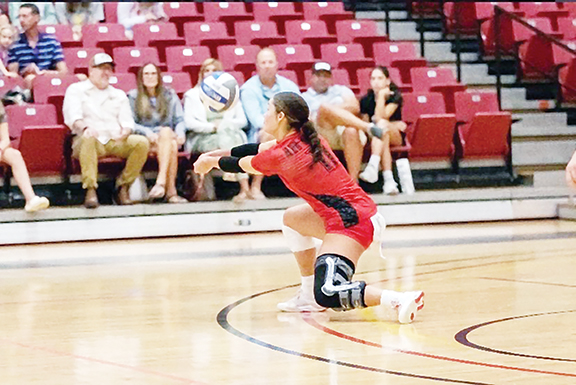
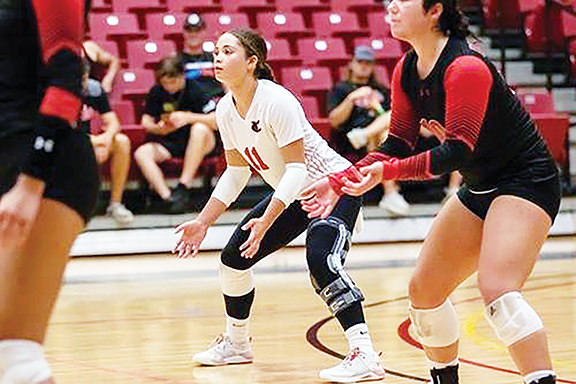
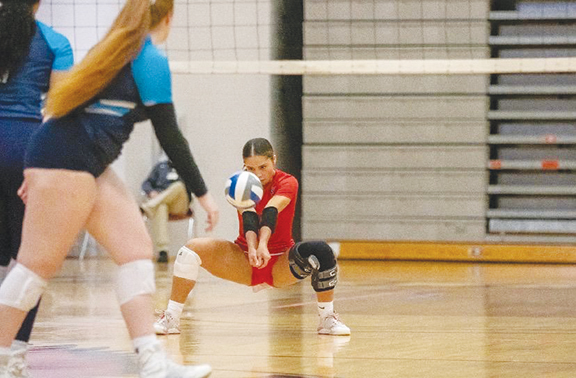
On the court, Nelson moved from outside hitter to libero. She’s always tried to have an all-around game, but this was the first time Nelson had played a mainly defensive role. It was something she thought could happen, as at 5-foot-8 Nelson is a little small to be a college hitter. Pogue knew Nelson was a tremendous athlete, and had faith she would adapt well to libero. Her time off allowed her to learn more about the game, and at times she would give tips to the coaching staff. That only helped her transition to libero, which can serve as a coach on the court to help set the defense.
‘Going to be amazing’
Once Nelson adjusted to playing with a brace and the mental hurdles associated with knee injuries, she quickly adapted to the position. She finished with a team-high 358 digs, and added 23 service aces. The relentless stayed too, as one time she almost put a tooth through her lip to get a ball.
“She developed into such an amazing leader,” Pogue said. “She’s explosive; even after injury, she worked to get explosive left to right, and she just saw the game so naturally that it fit perfectly at that position.”
Nelson is ready to transfer those skills to Division II volleyball at Emory & Henry. Her father, former Murphy coach and alum Thomas Nelson, served in various roles in the school’s athletic department from 1998-2006, including assistant football coach and softball coach.
He still has a lot of friends at the school, and Grace is hopeful for a big cheering section at home games. She’s also excited to make her own memories at the school, instead of always hearing what her parents used to do at certain campus locales.
Pogue said she’s ready for the step up in competition. She just has to get comfortable with a new coaching staff, and be confident in what she can do. Once that happens, the leadership and tenacity she displayed on the court will come through, making her a valuable part of another college program.
“She’s a special kid,” Pogue said. “Anyone who has come to see her play knows exactly what they’re getting. She’s going to be amazing.”