
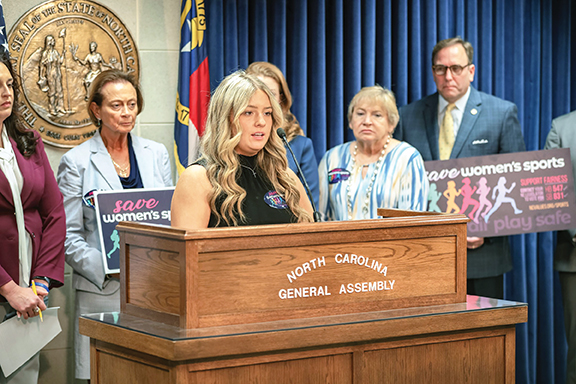
State bill bars transgender athletes in women’s sports
Raleigh – Hiwassee Dam High School senior Payton McNabb testified on April 19 in favor of House Bill 574, the Fairness in Women’s Sports Act, which would restrict athletes to compete for teams based on their sex at birth.
The bill states that teams will be designated as male, female or co-ed, with biological males only allowed to compete with biological females if there’s no female team for the sport, with an exception made for wrestling. State Rep. Karl Gillespie (R-Franklin) is one of the sponsors of the bill.
The bill passed 73-39, with three Democrats joining Republicans to vote in favor of the bill. The Senate version of the bill, SB 631, passed the next day on a 29-18 party-line vote. Sen. Kevin Corbin (R-Franklin) is one of the sponsors of that bill.
McNabb was injured in a volleyball match at Highlands on Sept. 1 by a player who had questions about whether she was born biologically female.
McNabb was hit in the head by a spike, suffering a concussion and neck injury that she said she’s still recovering from. She also suffered impaired vision, partial paralysis on her right side, “constant” headaches, anxiety and depression.
In school, accommodations were made due to her injury. She missed the rest of the volleyball season, but has played for the Lady Eagles’ basketball and softball teams since the injury.
“I’m not here for me because I know that my time playing is coming to an end,” McNabb said. I am here for every biological female athlete behind me – my little sister, my cousins, my teammates. Allowing biological males to compete against biological females is dangerous.
“I may be the first to come before you with an injury, but if this doesn’t pass, I won’t be the last.”
The Cherokee County Board of Education voted in a closed session meeting on Sept. 21 to cancel all remaining matches for county schools against Highlands, citing the team as a “safety issue” for student-athletes.
When discussing the vote with the Cherokee Scout, board member Jeff Tatham and former vice chair Jeff Martin said they were not able to find out the biological sex of the Highlanders’ player before voting, with Martin saying most board members felt the player was a “competitive advantage issue.”
More than 20 states have passed similar bills limiting transgender females from playing women’s sports. The Human Rights Campaign – the nation’s largest lesbian, gay, bisexual, transgender and queer organization – opposed North Carolina’s version.
“Women’s sports face many real issues, including chronic underfunding, unequal pay, lack of access and harassment and abuse of athletes,” state legislative director and senior counsel Cathryn Oakley wrote in a press release. “None of these challenges are addressed from preventing transgender children from playing sports alongside their friends. Yet again, the General Assembly is choosing to discriminate rather than legislate on the real issues facing North Carolina.”
Republicans in the U.S. House passed a bill Thursday that would change the definition of sex in Title IX to a person’s biology and genetics at birth, with recipients of federal funding who violate it possibly losing that money. However, the bill is likely dead on arrival in the Democrat-controlled Senate.
Earlier this month, the U.S. Department of Education announced an amendment to Title IX that would bar blanket bans of transgender athletes from playing sports, but instead would allow schools to decide whether a transgender athlete should be allowed to participate in sports based on a variety of factors such as age and the level of competitiveness.