
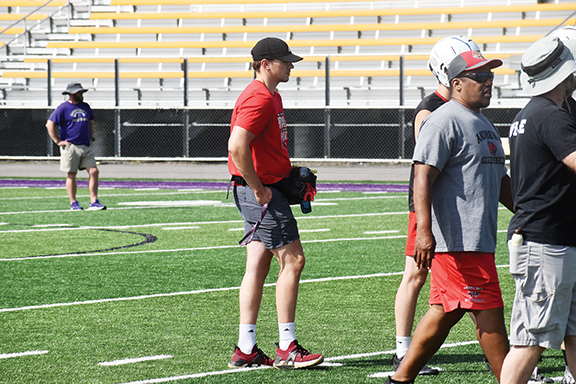
There was a momentary panic last month when Harris Regional Hospital decided not to provide athletic trainers for Cherokee County Schools. Without athletic trainers, school officials said there’s not likely to be a football season.
While that scenario has likely been avoided with local leaders approving a stop-gap solution to fund those positions out of funds raised from a school specific sales tax to fund the position for this year and the athletic trainers at Andrews and Murphy looking to return, it’s brought to light just how important athletic trainers are to the day-to-day operation of high school athletics.
The N.C. High School Athletic Association handbook states that an athletic trainer or first responder must attend all home or away games as well all practices or workouts where protective equipment like helmets or shoulder pads are worn. For football, that includes summer workouts as well as 7-on-7 scrimmages. The association also requires a licensed athletic trainer or first responder to be in attendance at all wrestling matches.
While both an athletic trainer or first responder can provide critical care in certain situations, having an athletic trainer is the preferred option as they tend to have more expertise in sports specific injuries and recovery.
“Let’s say a kid sprains his ankle,” Andrews athletic trainer Coulter Clement said. “An EMT might be able to tell you you sprained your ankle. An EMT might be able to tell you you sprained it, but that’s as far as they can get.
“They can’t determine if you’re still able to play, but with a brace but with ankle tape. They might know from their experience, but they’re not outright taught how to tape an ankle.”
It’s not that EMTs aren’t good at what they do, Clement said. It’s just that the skillset of an athletic trainer is better for what’s needed in high school sports. A first responder is helpful for immediate emergency care, while athletic trainers have more orthopedic knowledge.
Clement has a bachelor’s degree in athletic training, and those who don’t have a bachelor’s degree in athletic training can add a master’s degree in the subject. According to the National Athletic Trainer’s Association, athletic trainers have expertise in five different areas: prevention; clinical evaluation and diagnosis; immediate and emergency care; treatment and rehabilitation; and organization and professional health and well-being.
A typical day for an athletic trainer involves much more than just being there for practices or spring games. In the fall, Clement would typically get to Andrews by 1 p.m., though he’d prefer to come earlier but he’s only paid for 40 hours a week. At that time, female athletes are in advanced physical education classes, so he does rehab and treatment for athletes who can’t participate.
The rehab part is crucial for a rural, low-income county like Cherokee. Some athletes may not be able to afford physical therapy, and athletic trainers don’t charge for their care.
It’s something Heather Watson, who is the lead school nurse for Cherokee County, has seen in her proximity to Murphy High School’s football program.
Watson’s husband, Joseph is the head coach and spent 20 years as an assistant at Murphy before being promoted. After every game, one of the last things said before the team breaks down their postgame huddle is trainer Bob Grimes announcing what time treatment will be the next day.
“We have a lot of kids who I guarantee you would not receive the rehab if they were having to go elsewhere for that,” Watson said. “If they can get it before school or after school.”
Besides treatment, Clement said he’ll help set up the field for football practice, fill up water and drive up to the field on his gator with all the necessary equipment. If the team is in helmets or pads, that’s his priority, though he tries to check in on volleyball and soccer if he can.
For a game, he’ll set up sports drinks and water, as well as an ice bath for any heat-related illnesses. He also coordinates the emergency action plan in the event of a traumatic injury with Emergency Medical Services personnel and referees.
After this year, it will likely be more cost effective to find a new hospital to partner with to provide athletic trainers. Due to how rural western North Carolina is, Clement and Grimes would likely find a way to stay at Andrews and Murphy. Trainers can stay at a school even if it switches hospitals, as it could be challenging to another person qualified to do the job.