
Murphy – A workshop full of city employees – as well as the Outdoor Recreation, Centers of Commerce and Appalachian Culture committees – have been working like Santa’s elves for years, hustling to research, organize and design a plan to make Murphy an official Main Street Community.
This national designation status started in May 2019 with an official kickoff in February 2020. All the behind-the-scenes work will come to fruition Friday, July 1, when the town receives its official designation as a Main Street Community.
In order to apply, the town must meet two criteria – a population under 50,000, and an historic downtown. But that’s the easy part.
The Main Street Community incentive program birthed itself out of the decline of the downtown commerce bustle in the late 1970s. Malls replaced locally owned shops and became a destination point for socializing and shopping. This left many historical downtown buildings in ruins, some of which were eventually torn down.
The N.C. Department of Commerce wanted to revive the center of town energy in small towns across the state, which led to the creation of the Main Street Community program in 1980. North Carolina joined five other states as original mavericks within the national program. Murphy will join more than 200 communities across 46 states when it receives its official designation.
Just a few blinks before the COVID-19 pandemic, Laura LaChance, the downtown development director – along with a team of local, capable thinkers and innovators – applied to the Commerce Department hoping Murphy would be eligible for the designation.
“A number of our neighboring communities have already earned the status including Hendersonville, Sylva and Waynesville,” LaChance said. However, the process required tenacious focus.
“We had to create a vision for the town and then work to show progress toward implementation of that vision,” she added.
LaChance humbly points to the former town council as vital to the project.
“They are the reason this project happened,” she said.
Mayor Tim Radford shares LaChance’s gratitude.
“Former mayor Rick Ramsey, council member Gail Stansell Walker and the Murphy Power Board were instrumental in getting this program started back in early 2020, working closely with Sherry Adams and Chuck Halsall from the NC Department of Commerce,” Radford said.
To achieve the status, the town used the mission statement as their North Star. It’s a substantial one:
“Where rivers converge, history lives, outdoor adventure calls and North Carolina begins! Serving as the county seat of Cherokee County in the Appalachian Mountains, downtown Murphy serves as a beacon for endless fun featuring connections to outdoor recreational opportunities, the center of commerce with a host of locally owned restaurants, authentic shopping ventures and Appalachian art forms.”
The Murphy team then entered the rudimentary phase of the process much like a Cub Scout earning badges toward promotion to Boy Scout. The cub phase, called Downtown Associate Community, needed strategy and creativity. So the team got to work.
“We created three committees to focus on our three main identified goals,” LaChance said. The goals were named after steady research including public outreach, a vision forum, surveys of business as well as consumers and other kinds of outreach in the community.
Next came naming committees to oversee each of the three main goals: outdoor recreation, center of commerce and Appalachian culture. Each committee tasked itself with strategy and marketing plans meant to cumulate into the Main Street designation.
LaChance said, “The outdoor recreation committee worked to attract downtown business that connect to outdoor rec recreation goal. They considered what we can do to improve and point people to outdoor recreation.”
She suggested that downtown could use an outfitters store. After the committees formed viable plans, they then applied those plans to the four DAC criteria, including design of downtown public and private spaces like building facades and sidewalks.
LaChance was especially excited about this goal.
“We have a renewed focus on public spaces,” she said. “The alley between the Black & White Market and Urban Salon is closed now.”
LaChance said the team is waiting for the lights and beautiful steel benches and tables to open that space back up to the community. The funding for the restoration relied on donations.
Her favorite topic under DAC is Murphy’s pocket parks. “We have plans to make those spaces more inviting for the community to come enjoy space downtown,” LaChance said.
“I’m really excited about the visual downtown. It seems like every year we are adding new things to the design of downtown like flower baskets in pocket parks.”
LaChance said the town has four pocket parks, one on each corner of the main intersection.
“The old Entegra bank is for sale, and the pocket park is just a square of grass,” she said. “We’ve never done anything with that, and I’d like to change that.”
As a DAC, the city planners want to attracted tourism, yes, but they also have a solid focus on serving locals.
“There are no playgrounds near downtown or any structure for kids to play on,” LaChance said.
Her team is working to have an interactive art instillation that honors Murphy history but that the kids can play on as well.
“We want to honor the history through different types of art forms,” she said.
The Main Street Community designation will kick-start even more movement for downtown. LaChance plans to work with local business owners and groups to help implement the tenets of the mission statement.
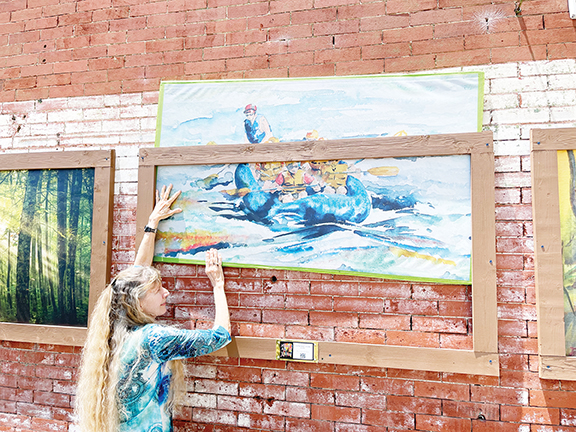
“As an example,” she said, “The Murphy Art Center has assisted the Appalachian art committee by hanging art murals downtown.”
Debra Vanderlaan, a Valley River Arts Guild member, spearheaded this project. One of the implementation goals to promote Murphy from a DAC to a Main Street Community requires community participation.
“We want to foster partnerships with the community. We want to bring organizations together who have a stake in downtown,” LaChance said.
In the end, all their work and ideas are meant to increase the economic vitality of downtown Murphy.
“The whole point is that the downtown businesses are prospering, which will benefit visitors as well as community members,:” she said. “We want to preserve that history of the those buildings and at the same time, we want the buildings refurbished, occupied and maintained.”
Radford recognizes the importance of Murphy’s status as a Main Street Community, saying, “This designation will open up many opportunities that we otherwise would not have access to. It’s a tremendous investment that will make the Town of Murphy an even better experience.”