

 |
Where do you live? Murphy, North Carolina, we say. If you’ve lived here any length of time you already have learned the phrase, “You’ve heard of Murphy’s law? Anything that can go wrong will – at the worst possible moment?” Remember where we live.
While the phrase did not become part of the language until the 1950s, there were elements of that law in effect from the first days of Murphy.
It starts with the man for whom the city is named – Archibald D. Murphey. Note the spelling. Murphy was named for Mr. Murphey – but due to a clerk misspelling the name on official documents, what was supposed to be “Murphey” is now and forevermore “Murphy.”
That inauspicious mistake can explain a lot of things that do not go according to plan here, but to his credit, it was not Archibald DeBow Murphey’s fault. He was dead and gone by the time our town was named for him – and he never set foot here.
Which segways into the question that causes most historians to go digging. “Why and who?” Who was this Archibald D. Murphey and why was our town named for him?
Archibald DeBow Murphey was the son of a Revolutionary War soldier who moved from Pennsylvania to Hyco Creek in North Carolina. Archibald was born in 1777, one of seven children.
Murphey attended a prep school in Greensboro, better known as David Caldwell’s “Log College.” In 1796, he entered the University of North Carolina, graduating with honors in 1799 and was hired as a professor at UNC, working there until 1801, when he married and left the University of North Carolina to study Law with William Duffy in Hillsborough.
While teaching at UNC, he was one of the first teachers of classics.
This was the start of a successful career as a lawyer and over the next 20 years he also ventured into land speculation and politics. He purchased a large estate known as The Hermitage from his father-in-law. Then he entered politics, becoming a North Carolina state senator serving from 1812 until 1819.
Murphey was a forward thinker and backed up his opinions with detailed legislative reports. In 1817, one of his reports bore a radical proposal. North Carolina should implement a publicly financed system of education. That system would include primary schools, academies and universities.
At the time there were no state supported schools. He wrote, “one of the strongest reasons which we can have for establishing a general plan of public instruction is the condition of the poor children of our country.” Murphy believed that the state could not expect to progress until it elevated the educational status of its people.
Two years later in another report he advocated advanced road and water transport improvements, with theory larger commercial cities would grow and markets develop at home for state produced products, enhancing the coffers of the state.
Despite the logic of his arguments by today’s standards, the N.C. legislature chose to ignore his proposals. Thus when offered a judgeship in Superior Court Murphey took the position until a decline in his financial affairs forced his resignation.
Murphey returned to his law practice and began writing a history of the state, a bold undertaking that was to be financed by a lottery authorized by the General Assembly. Murphey began assembling a massive collection of manuscripts and historical papers and began writing his history.
By 1820, Murphey’s business decline and poor health from rheumatism became a downward spiral. Some of his failed business ventures were ones trying to improve roads and canals as outlined in his earlier legislative proposal.
During his legislative term, Murphey had advocated abolishing the debtor’s prison, a move which also failed, and in 1829 Murphey was incarcerated in Greensboro for 20 days due to failure to pay off a debt. He also failed to complete his history of North Carolina.
Murphey died in 1832. He was 55, but his ideas did not die with him. The State Literary Fund was established in 1825, and in 1839, the public school act was passed. The first two chapters of his history of North Carolina survived, and his collection of manuscripts and letters have now become a primary source for many histories.
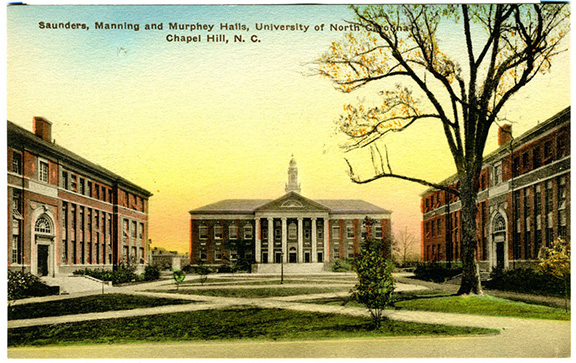
The University of North Carolina did not forget Murphey. Murphey Hall, built in 1924, was named for him. The building is almost 100 years old and still stands on the UNC campus, having undergone many renovations.
Public schools in Orange and Caswell counties have been named for Murphey, and the Murphey Traditional Academy in Greensboro bears his name.
As early as 1836, the General Assembly was already making plans for the soon to be vacated Cherokee lands. They voted the new lands would be under the jurisdiction of Macon County until a new county was formed, and the county seat of that county would be named Murphey.
The name for the new county was not yet set, with some proponents wanting to name the county for its most distinguished resident, Junaluska, who was still living at the time. But when the smoke cleared the county was named Cherokee County.
The town land was surveyed in 1837, laying off a town site with streets 100 feet wide, a one-acre public square, and 24½ acre lots facing four streets leading from the public square. The text for many of these documents as they made their way through the legislature were listed with the correct spelling, Murphey. However in the act providing for conveying the title for the 400-acre tract for the town it was listed as “Murphy.”
Despite the good intentions to honor Archibald D. Murphey, the first proponent of public education in our state, Murphy, North Carolina, we remain.
I would not venture that it was Murphy’s law that led to Murphy rather than Murphey – but then I cannot disprove it, either.
Bruce Voyles’ local history column runs every other week in the Cherokee Scout. Email him at RoadsLessTraveled@cherokeescout.com.